
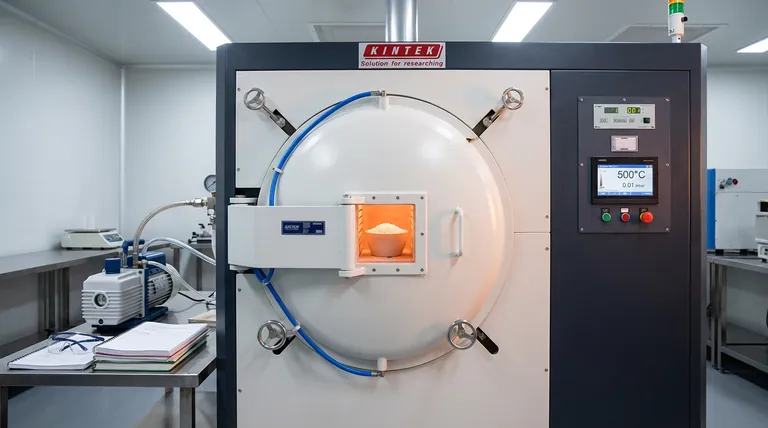
The primary role of a vacuum drying oven in this context is to execute the deep, long-term dehydration of anhydrous calcium chloride ($CaCl_2$) at temperatures reaching 500°C.
Because $CaCl_2$ is intensely hygroscopic, it traps moisture that standard heating cannot release; the vacuum oven creates a low-pressure environment that lowers the evaporation barrier, ensuring the salt is completely dry before it is used as a molten medium.
Core Insight: Anhydrous calcium chloride binds to water so aggressively that trace moisture often survives standard drying. By combining high heat (500°C) with a vacuum, you eliminate this "deep" moisture, preventing catastrophic hydrogen gas evolution and side reactions during the sensitive phosphorus extraction electrolysis.
Overcoming the Moisture Barrier
The Challenge of Hygroscopic Materials
Calcium chloride is not just moist; it is hygroscopic, meaning it actively attracts and binds water molecules from the surrounding environment.
Standard thermal drying often removes surface water but fails to extract moisture trapped deep within the crystal lattice or capillary structures.
The Mechanism of Vacuum Dehydration
The vacuum drying oven solves this by significantly reducing the ambient pressure surrounding the material.
This low-pressure environment reduces the evaporation barrier of water, allowing moisture to escape the material more freely than it would at atmospheric pressure.
High-Temperature Requirements
While vacuum aids evaporation, the primary reference dictates that high heat is still essential for $CaCl_2$.
The process requires maintaining the oven at 500°C for an extended period to ensure the thorough removal of stubborn, bound water prior to the salt being melted.
Protecting the Electrolysis Process
Preventing Hydrogen Evolution
The most critical reason for this rigorous drying involves the subsequent electrolysis step used for phosphorus extraction.
If water remains in the $CaCl_2$ when it is melted and electrified, it leads to the evolution of hydrogen gas. This creates a dangerous environment and destabilizes the electrolytic cell.
Eliminating Side Reactions
Beyond hydrogen generation, residual moisture acts as a contaminant that triggers adverse side reactions.
Thorough vacuum drying ensures the chemical purity of the molten salt medium, creating a stable baseline for the extraction of phosphorus without interference from hydrolysis or oxidation products.
Understanding the Trade-offs
Time Intensity vs. Purity
Achieving this level of dryness is not a quick process. It requires long-term heating, which demands significant time and energy resources compared to standard drying.
Equipment Limits
Unlike drying delicate nanomaterials (like graphene oxide or CdS nanosheets) which use vacuum ovens to dry at lower temperatures to preserve structure, drying $CaCl_2$ pushes the equipment to high thermal limits (500°C).
You must ensure your vacuum oven is rated for these high temperatures, as many standard laboratory vacuum ovens are designed for gentler, low-temperature solvent removal.
Making the Right Choice for Your Goal
When preparing your experimental apparatus for phosphorus extraction, consider these priorities:
- If your primary focus is Safety: Prioritize the 500°C vacuum cycle to strictly prevent hydrogen gas evolution during electrolysis.
- If your primary focus is Process Efficiency: Ensure your vacuum pump is capable of achieving deep vacuum quickly to lower the evaporation barrier and potentially shorten the heating duration.
The success of your phosphorus extraction relies not on the electrolysis itself, but on the absolute dryness of the molten salt prepared beforehand.
Summary Table:
| Feature | Requirement for CaCl2 Dehydration | Purpose in Phosphorus Extraction |
|---|---|---|
| Temperature | 500°C (High Heat) | Removes chemically bound water from crystal lattice |
| Pressure | Low Vacuum | Lowers evaporation barrier for deep moisture escape |
| Duration | Long-term Heating | Ensures absolute dryness of the hygroscopic salt |
| Goal | Purity & Safety | Prevents hydrogen gas evolution and side reactions |
Elevate Your Lab's Thermal Processing Precision
Don't let residual moisture compromise your sensitive electrolysis experiments. KINTEK provides industry-leading high-temperature vacuum systems designed to meet the rigorous demands of chemical purification and phosphorus extraction.
Why Choose KINTEK?
- Expert R&D: Solutions backed by specialized engineering for high-thermal applications.
- Versatile Systems: From Muffle and Tube furnaces to Vacuum and CVD systems, we offer fully customizable high-temp lab equipment.
- Proven Reliability: Our systems handle extreme conditions (up to 500°C and beyond) while maintaining consistent vacuum integrity.
Ready to optimize your dehydration protocols? Contact KINTEK today to discuss your unique needs and find the perfect high-temperature solution for your lab.
References
- Yuxiang Zhong, Xiao Yang. Extracting White Phosphorus from AlPO<sub>4</sub> through Molten Salt Processing. DOI: 10.5796/electrochemistry.24-69001
This article is also based on technical information from Kintek Furnace Knowledge Base .
Related Products
- Vacuum Heat Treat Sintering Furnace Molybdenum Wire Vacuum Sintering Furnace
- High Temperature Muffle Oven Furnace for Laboratory Debinding and Pre Sintering
- Vacuum Heat Treat Sintering and Brazing Furnace
- Molybdenum Vacuum Heat Treat Furnace
- Dental Porcelain Zirconia Sintering Ceramic Vacuum Press Furnace
People Also Ask
- What are the main structural components of a vacuum sintering furnace? Unlock Precision in High-Temperature Processing
- What are the key components of a vacuum sintering furnace? Essential Parts for Precision Material Processing
- What is the purpose of setting a mid-temperature dwell stage? Eliminate Defects in Vacuum Sintering
- How does vacuum sintering improve dimensional tolerances? Achieve Uniform Shrinkage and Precision
- How does vacuum sintering contribute to cost reduction in material processing? Lower Expenses with Superior Parts






