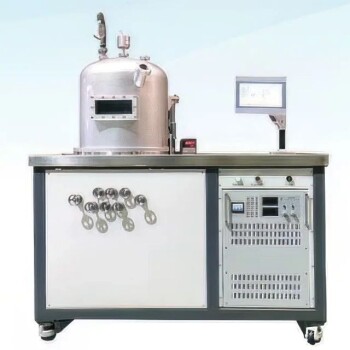
A Chemical Vapor Deposition (CVD) system serves as the primary reaction environment for the synthesis of nitrogen-enriched carbon nanotubes (NCNTs). It utilizes a high-temperature horizontal tube furnace to create a strictly controlled thermal zone, facilitating the decomposition of gaseous precursors and their directional growth onto catalyst surfaces.
By precisely regulating reaction temperatures (typically 700°C or 800°C) and managing the flow of specific gases like ammonia, the CVD system allows researchers to dictate the nitrogen doping content and the specific atomic configuration of the resulting nanotubes.

The Mechanics of Synthesis
Controlled Thermal Decomposition
The core function of the CVD system is to maintain a stable, high-temperature environment. By heating the reaction chamber to specific set points—often between 700°C and 800°C—the system ensures the thermal energy is sufficient to decompose feedstock gases.
Catalyst-Driven Nucleation
Inside the furnace, the decomposed gas molecules interact with catalyst particles on a substrate. The thermal field within the CVD system drives the nucleation process, allowing carbon atoms to assemble into nanotubes.
Directional Growth
Beyond simple formation, the CVD setup promotes directional growth. The system facilitates a uniform, continuous, and dense filamentous network, often resulting in vertically aligned structures that improve properties like thermal conductivity.
Tuning Nitrogen Characteristics
Regulating Doping Content
The CVD system acts as a flow controller for dopant precursors. By strictly managing the flow rate of nitrogen sources, such as ammonia, the system controls exactly how much nitrogen is incorporated into the carbon lattice.
Defining Atomic Structure
The system's control over temperature and gas atmosphere directly influences the chemical structure of the NCNTs. It allows for the fine-tuning of the distribution ratio between pyridinic and pyrrolic nitrogen sites.
Modifying Electronic Properties
By altering these nitrogen configurations, the CVD process effectively tailors the electronic and catalytic properties of the nanotubes. This transforms a standard carbon nanotube into a specialized material suitable for advanced electrochemical applications.
Understanding the Trade-offs
Temperature Sensitivity
While high temperatures are necessary for growth, slight deviations can alter the product. Operating at the lower end (around 700°C) may favor certain nitrogen configurations, while higher temperatures (800°C) might improve crystallinity but alter the doping ratio.
Uniformity vs. Complexity
Achieving a uniform network of NCNTs requires precise gas distribution. If the precursor flow is not perfectly balanced across the catalyst surface, you may encounter issues with particle aggregation or inconsistent doping levels, reducing the material's specific surface area.
Making the Right Choice for Your Goal
The CVD system is a tunable tool, not a static machine. Your settings should reflect your specific end-goal for the material.
- If your primary focus is catalytic activity: Prioritize temperature and ammonia flow settings that maximize pyridinic nitrogen sites, as these are often more active for electrochemical reactions.
- If your primary focus is structural alignment: Focus on the stability of the thermal field and gas flow kinetics to ensure directional, vertical growth for high-purity arrays.
Success in synthesizing NCNTs depends on using the CVD system not just to grow carbon, but to precisely engineer the chemical environment at the atomic level.
Summary Table:
| CVD Function | Impact on NCNTs |
|---|---|
| Thermal Decomposition | Operates at 700°C-800°C to break down precursors for growth. |
| Catalyst Interaction | Facilitates nucleation and assembly of carbon atoms on substrates. |
| Flow Regulation | Manages ammonia flow to precisely dictate nitrogen doping content. |
| Atmosphere Control | Influences the ratio of pyridinic to pyrrolic nitrogen sites. |
| Kinetics Management | Ensures directional, vertically aligned growth for high-purity arrays. |
Elevate Your Nanomaterial Synthesis with KINTEK
Precision is the foundation of high-performance nitrogen-enriched carbon nanotubes. Backed by expert R&D and world-class manufacturing, KINTEK provides advanced CVD systems, Tube, Muffle, Rotary, and Vacuum furnaces designed to master the complexities of thermal decomposition and gas flow kinetics.
Whether you need to fine-tune nitrogen configurations or ensure uniform vertical growth, our laboratory high-temperature systems are fully customizable to meet your unique research requirements.
Ready to engineer your materials at the atomic level? Contact KINTEK today for a customized solution.
References
- Neeraj Gupta, Alberto Villa. Metal-Free Catalytic Conversion of Veratryl and Benzyl Alcohols through Nitrogen-Enriched Carbon Nanotubes. DOI: 10.3390/c10010013
This article is also based on technical information from Kintek Furnace Knowledge Base .
Related Products
- 915MHz MPCVD Diamond Machine Microwave Plasma Chemical Vapor Deposition System Reactor
- Custom Made Versatile CVD Tube Furnace Chemical Vapor Deposition CVD Equipment Machine
- RF PECVD System Radio Frequency Plasma Enhanced Chemical Vapor Deposition
- MPCVD Machine System Reactor Bell-jar Resonator for Lab and Diamond Growth
- HFCVD Machine System Equipment for Drawing Die Nano Diamond Coating
People Also Ask
- What is the MPCVD method and why is it considered effective for diamond deposition? Superior Purity & High Growth Rates
- What factors influence the quality of diamond deposition in the MPCVD method? Master the Critical Parameters for High-Quality Diamond Growth
- What is the purpose of a microwave plasma chemical vapor deposition system? Grow High-Purity Diamonds and Advanced Materials
- What are some key features and benefits of the microwave plasma chemical vapor deposition system? Achieve Unmatched Material Synthesis
- What is the basic principle of operation for the microwave plasma chemical vapor deposition system? Unlock High-Purity Material Growth