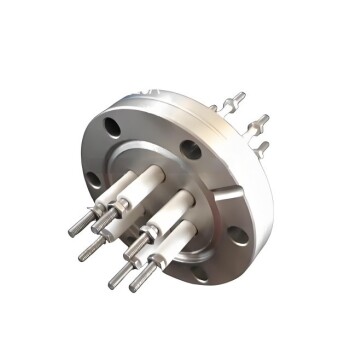
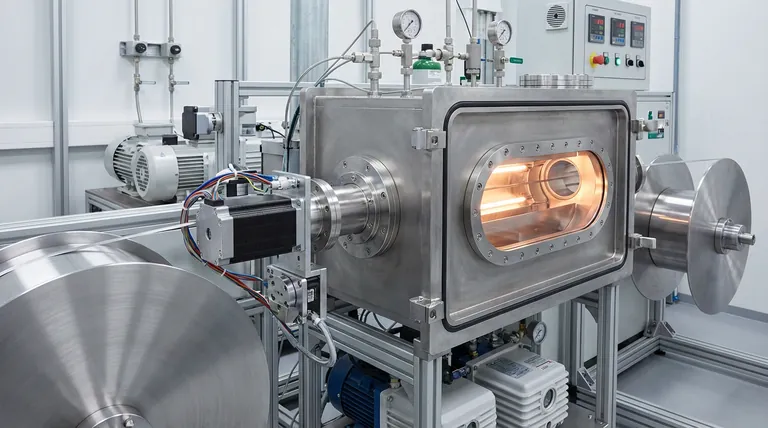
In a Roll-to-Roll (R2R) carbon nanotube (CNT) production line, the stepper motor and rotary motion vacuum feedthrough operate in tandem to form a specialized precision wire control system. The stepper motor generates precise rotational force outside the chamber, while the feedthrough transmits this torque into the high-temperature reaction zone. This combination drives the stainless steel wire substrate at a constant velocity without breaking the critical vacuum or pressure seal.
By decoupling the mechanical drive from the reaction environment, this system allows for rigorous speed control externally while maintaining the strict atmospheric purity required internally for consistent nanotube growth.
The Role of the Stepper Motor
Precision Speed Control
The primary function of the stepper motor in this assembly is to provide high-precision rotational speed control. Unlike standard motors, a stepper motor moves in discrete steps, allowing for exact management of the rotation rate.
Driving the Substrate
This rotational force is used to drive the stainless steel wire through the system. By maintaining a constant velocity, the motor ensures that every section of the wire spends the exact same amount of time in the reaction zone.
The Function of the Vacuum Feedthrough
Transmitting Mechanical Power
The rotary motion vacuum feedthrough acts as the bridge between the external environment and the internal furnace. It physically transmits the mechanical power generated by the stepper motor into the reaction chamber.
Maintaining Environmental Integrity
Crucially, the feedthrough accomplishes this transmission while maintaining the system’s seal and airtightness. It prevents ambient air from entering and process gases from escaping, regardless of whether the furnace is under vacuum or pressurized.
Achieving Continuous Production
Ensuring Consistent Growth
The collaboration between these two components is vital for the continuous and consistent growth of carbon nanotubes. The stepper motor guarantees the wire moves smoothly, preventing jerky motions that could disrupt growth patterns.
Protecting the Reaction Zone
Simultaneously, the feedthrough ensures the high-temperature reaction zone remains uncontaminated. This stability is essential, as fluctuations in pressure or atmosphere can ruin the quality of the CNTs being produced.
Operational Considerations and Trade-offs
Mechanical Dependency
While this system offers high precision, it creates a point of mechanical dependency. Any fluctuation in the stepper motor's power supply or accuracy will immediately translate to the wire speed, directly altering the thickness or density of the nanotube growth.
Seal Maintenance vs. Torque Transmission
The feedthrough must balance the tightness of the seal with the friction applied to the rotating shaft. An overly tight seal ensures airtightness but may require higher torque from the motor, potentially leading to mechanical wear or heat generation at the interface.
Making the Right Choice for Your Goal
To optimize your R2R CNT production line, consider how these components align with your specific manufacturing targets:
- If your primary focus is growth uniformity: Prioritize a high-resolution stepper motor to ensure the wire velocity remains mathematically constant throughout the process.
- If your primary focus is chamber purity: Prioritize a high-quality vacuum feedthrough that offers minimal leak rates, ensuring the reaction environment remains strictly isolated.
By synchronizing precise external control with robust internal isolation, you establish the baseline stability required for high-yield nanotube production.
Summary Table:
| Component | Primary Function | Impact on CNT Production |
|---|---|---|
| Stepper Motor | High-precision rotational speed control | Ensures constant substrate velocity for uniform growth |
| Vacuum Feedthrough | Mechanical torque transmission | Maintains vacuum/pressure seal while moving power into the chamber |
| Wire Substrate | Material carrier (Stainless Steel) | Provides the surface for continuous nanotube deposition |
| Reaction Zone | High-temp chemical environment | The controlled space where gas-to-solid CNT growth occurs |
Elevate Your R2R Production with KINTEK Precision
Consistency is the backbone of high-yield carbon nanotube manufacturing. At KINTEK, we specialize in the engineering and supply of advanced thermal systems, including CVD, Vacuum, and high-temp furnaces that integrate seamlessly with precision control components like stepper motors and feedthroughs.
Whether you are scaling a Roll-to-Roll production line or developing a custom R&D setup, our expert manufacturing team offers fully customizable solutions tailored to your unique atmospheric and torque requirements.
Ready to optimize your reaction environment? Contact us today to discover how KINTEK’s industry-leading expertise can ensure the stability and purity your materials demand.
Visual Guide

References
- Jean‐Luc Meunier, Jason R. Tavares. Continuous Reactive-Roll-to-Roll Growth of Carbon Nanotubes for Fog Water Harvesting Applications. DOI: 10.3390/c10010009
This article is also based on technical information from Kintek Furnace Knowledge Base .
Related Products
- CF KF Flange Vacuum Electrode Feedthrough Lead Sealing Assembly for Vacuum Systems
- Ultra Vacuum Electrode Feedthrough Connector Flange Power Lead for High Precision Applications
- Laboratory Vacuum Tilt Rotary Tube Furnace Rotating Tube Furnace
- Vacuum Sealed Continuous Working Rotary Tube Furnace Rotating Tube Furnace
People Also Ask
- Why is a vacuum sealing process necessary for the synthesis of TaAs2 single crystals? Ensuring Purity in CVT Method
- Why is a PTFE-lined stainless steel autoclave used for Ni12P5 synthesis? Key Benefits for Nanomaterial Production
- What is the function of PTFE sealing rings in plastic pyrolysis? Ensure Safe, Anaerobic Material Decomposition
- What is the function of a Teflon-lined stainless steel autoclave in the hydrothermal synthesis of Bi2O3 precursors?
- Why is a stainless steel autoclave with a Teflon liner necessary for BiVO4? Ensure Purity & High Performance