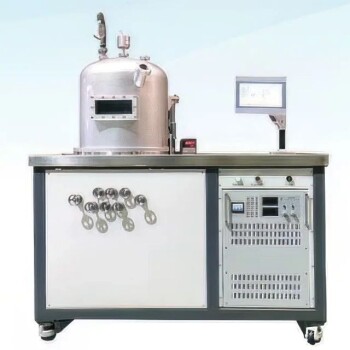
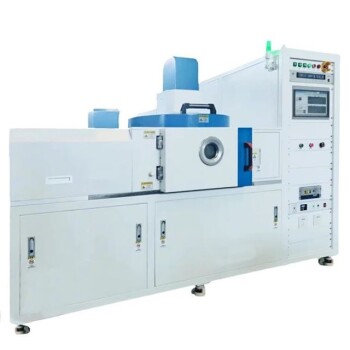
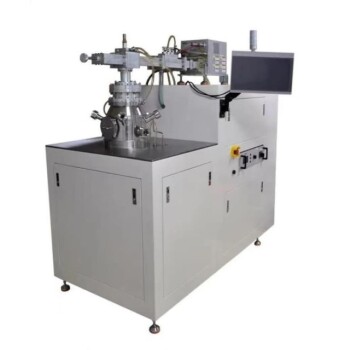
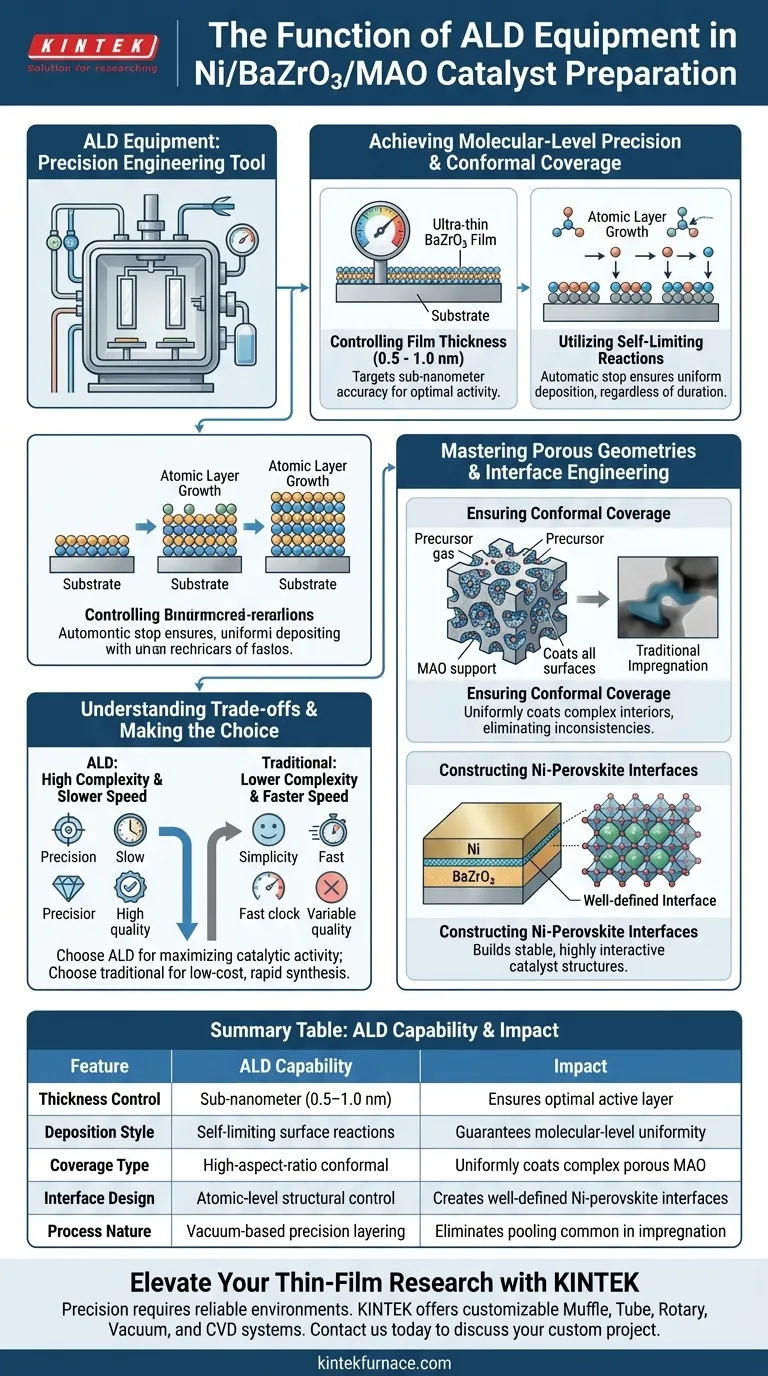
Atomic Layer Deposition (ALD) equipment functions as a precision engineering tool in the preparation of Ni/BaZrO3/MAO catalysts. Its primary role is to deposit ultra-thin, highly continuous films of BaZrO3 onto MgAl2O4 (MAO) supports via self-limiting surface chemical reactions. By strictly controlling the film thickness between 0.5 and 1.0 nm, the equipment ensures a level of molecular uniformity that traditional synthesis methods cannot achieve.
The core value of ALD equipment lies in its ability to create a perfectly conformal interface on complex porous structures. By replacing random impregnation with controlled atomic layering, it enables the construction of well-defined Ni-perovskite interfaces essential for optimal catalytic performance.
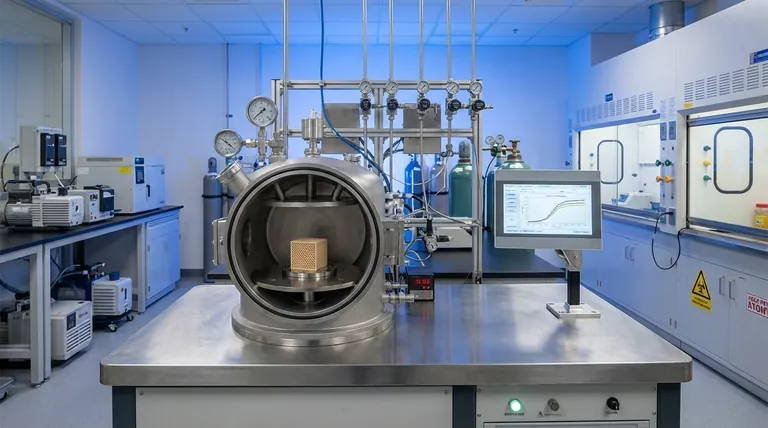
Achieving Molecular-Level Precision
Controlling Film Thickness
The defining capability of ALD equipment is its ability to regulate coating thickness with sub-nanometer accuracy.
For this specific catalyst, the equipment targets a precise window between 0.5 and 1.0 nm. This ensures the BaZrO3 layer is thin enough to remain active but continuous enough to function effectively.
Utilizing Self-Limiting Reactions
The equipment operates using self-limiting surface chemical reactions.
This mechanism ensures that once a surface is fully coated with a single atomic layer, the reaction stops automatically. This prevents uneven accumulation and guarantees that the deposition is uniform, regardless of the reaction duration.
Mastering Porous Geometries
Ensuring Conformal Coverage
One of the most significant challenges in catalyst preparation is coating complex, porous supports like MAO.
ALD equipment overcomes this by allowing precursor gases to penetrate deep into the porous architecture. It coats the interior surfaces just as evenly as the exterior, ensuring conformal coverage across the entire support structure.
Superiority Over Impregnation
Traditional impregnation methods often result in uneven pooling or incomplete coverage within pores.
In contrast, ALD equipment ensures a molecular-level uniform distribution of the active components. This eliminates structural inconsistencies that could lead to weak points or reduced efficiency in the final catalyst.
Engineering the Catalyst Interface
Constructing Ni-Perovskite Interfaces
The ultimate goal of using ALD in this context is to create a specific relationship between the nickel (Ni) and the perovskite structure.
The equipment facilitates the construction of well-defined Ni-perovskite interfaces. By ensuring the BaZrO3 film is continuous and uniform, the equipment lays the groundwork for a stable and highly interactive catalyst structure.
Understanding the Trade-offs
Complexity vs. Simplicity
While ALD offers superior quality, it introduces significantly higher complexity compared to traditional methods.
Traditional impregnation is generally faster and requires less sophisticated hardware. ALD requires specialized equipment capable of managing vacuum conditions and precise precursor pulses.
Process Speed
The self-limiting nature of ALD, while beneficial for precision, inherently restricts the speed of production.
Building a film layer-by-layer is a time-intensive process. This makes ALD less suitable for rapid, high-volume bulk production where molecular precision is not a critical requirement.
Making the Right Choice for Your Goal
- If your primary focus is maximizing catalytic activity: Rely on ALD to ensure conformal coverage and optimal interaction at the Ni-perovskite interface.
- If your primary focus is low-cost, rapid synthesis: Recognize that traditional impregnation offers speed but sacrifices the molecular uniformity provided by ALD.
ALD equipment transforms catalyst preparation from a bulk mixing process into an exercise in precise atomic architecture.
Summary Table:
| Feature | ALD Equipment Capability | Impact on Catalyst Performance |
|---|---|---|
| Thickness Control | Sub-nanometer (0.5–1.0 nm) | Ensures optimal active layer thickness |
| Deposition Style | Self-limiting surface reactions | Guarantees molecular-level uniformity |
| Coverage Type | High-aspect-ratio conformal coating | Uniformly coats complex porous MAO supports |
| Interface Design | Atomic-level structural control | Creates well-defined Ni-perovskite interfaces |
| Process Nature | Vacuum-based precision layering | Eliminates pooling common in impregnation |
Elevate Your Thin-Film Research with KINTEK
Precision at the atomic scale requires reliable high-temperature and vacuum environments. At KINTEK, we empower researchers and manufacturers with cutting-edge laboratory solutions. Backed by expert R&D and manufacturing, KINTEK offers Muffle, Tube, Rotary, Vacuum, and CVD systems, along with other specialized high-temp furnaces—all fully customizable to meet the unique demands of your catalyst synthesis and ALD-related workflows.
Ready to transform your material engineering with molecular-level precision? Contact us today to discuss your custom project and see how our expertise can drive your next breakthrough.
Visual Guide
References
- Kai Shen, John M. Vohs. Enhanced Methane Steam Reforming Over Ni/BaZrO3. DOI: 10.1007/s10562-025-05087-5
This article is also based on technical information from Kintek Furnace Knowledge Base .
Related Products
- HFCVD Machine System Equipment for Drawing Die Nano Diamond Coating
- Custom Made Versatile CVD Tube Furnace Chemical Vapor Deposition CVD Equipment Machine
- Multi Heating Zones CVD Tube Furnace Machine for Chemical Vapor Deposition Equipment
- 915MHz MPCVD Diamond Machine Microwave Plasma Chemical Vapor Deposition System Reactor
- Inclined Rotary Plasma Enhanced Chemical Deposition PECVD Tube Furnace Machine
People Also Ask
- What is Hot-filament Chemical Vapor Deposition (HFCVD)? Achieve High-Quality Thin Films with Precision Control
- What are the equipment for chemical vapor deposition? A Guide to the 5 Essential Components
- What is the significance of the vacuum pressure control system in the CVD coating process for powders?
- What is the function of high-purity Argon (Ar) gas during CVD? Optimize Your Thin Film Uniformity and Purity
- What are the advantages of using Chemical Vapor Deposition (CVD) for coating turbine blades? Enhance Life & Performance