
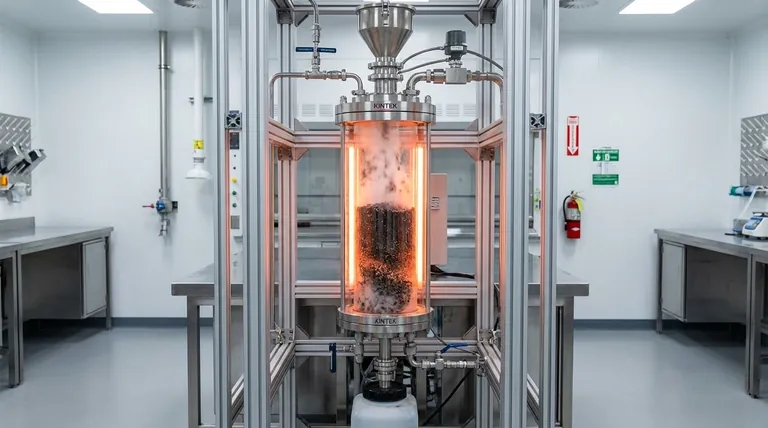
The primary advantages of using a semi-continuous vertical quartz reactor lie in its ability to maintain chemical purity while ensuring uniform gas distribution during the activation process. This specific configuration combines high-temperature resistance with a geometry that forces activation media to pass evenly through the biochar, directly leading to a higher quality end product.
The reactor's ability to remain inert at temperatures up to 850°C, combined with a vertical structure that promotes uniform steam and nitrogen flow, is critical for producing activated carbon with a high specific surface area.
Material Stability and Inertness
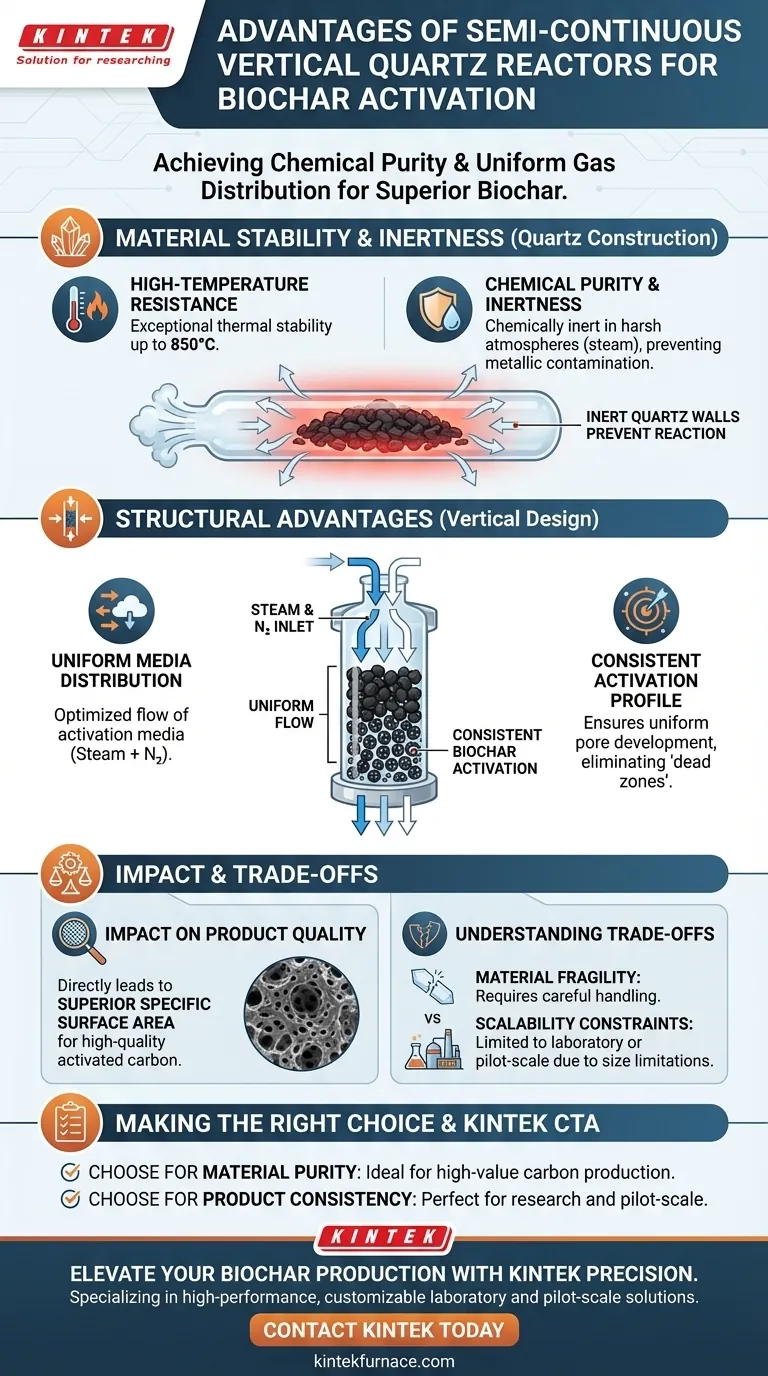
High-Temperature Resistance
The quartz construction of the reactor is fundamental to its performance. It offers exceptional thermal stability, allowing the system to operate effectively at temperatures as high as 850°C.
Chemical Purity in Harsh Atmospheres
Unlike metal reactors that might react with aggressive activation agents, quartz remains chemically inert. This stability is maintained even in the presence of steam atmospheres, preventing contamination of the biochar sample.
Structural Advantages for Activation
Uniform Media Distribution
The vertical structure of the reactor is designed to optimize the flow of gases. It ensures that the activation media—typically a mixture of steam and nitrogen—passes uniformly through the sample layer rather than bypassing it.
Consistent Activation Profile
Because the gas flow is uniform, every particle of biochar is exposed to the same activation conditions. This eliminates "dead zones" or uneven activation, ensuring the entire batch achieves consistent properties.
Impact on Final Product Quality
superior Surface Area
The combination of stable high temperatures and uniform gas contact directly influences the microstructure of the biochar. This process facilitates the development of high specific surface areas, a key metric for high-quality activated carbon.
Understanding the Trade-offs
Material Fragility
While quartz offers superior chemical resistance, it is physically brittle. Unlike stainless steel, it requires careful handling to prevent breakage during loading, unloading, or thermal cycling.
Scalability Constraints
Vertical quartz tubes generally have limitations regarding diameter and length due to manufacturing costs and structural integrity. This often limits this specific reactor type to laboratory or pilot-scale operations rather than massive industrial throughput.
Making the Right Choice for Your Goal
To determine if this reactor suits your specific activation requirements, consider the following:
- If your primary focus is material purity: This reactor is ideal because the inert quartz prevents metallic contamination during high-temperature steam activation.
- If your primary focus is product consistency: The vertical flow design ensures uniform pore development, making it the right choice for research or high-value carbon production.
By leveraging the thermal and structural benefits of a vertical quartz reactor, you ensure the production of consistently high-performing activated carbon.
Summary Table:
| Feature | Advantage for Biochar Activation | Key Benefit |
|---|---|---|
| Quartz Material | Chemically inert up to 850°C | Prevents sample contamination |
| Vertical Design | Optimizes steam and nitrogen flow | Ensures uniform activation and pore development |
| Thermal Stability | High-temperature resistance | Supports consistent high-quality production |
| Flow Dynamics | Eliminates "dead zones" | Achieves high specific surface area |
Elevate Your Biochar Production with KINTEK Precision
Ready to achieve superior material purity and consistent activation results? At KINTEK, we specialize in high-performance laboratory solutions backed by expert R&D and precision manufacturing.
Whether you need advanced Quartz Reactors, Muffle, Tube, or CVD systems, our high-temperature equipment is fully customizable to meet your unique research and pilot-scale requirements.
Contact KINTEK today to discover how our specialized furnace systems can optimize your lab's efficiency and product quality.
Visual Guide
References
- Jakub Čespiva, Wei‐Hsin Chen. Sustainable off-grid gasification: co-production of electricity, heat, and activated carbon. DOI: 10.20517/energymater.2024.104
This article is also based on technical information from Kintek Furnace Knowledge Base .
Related Products
- Vertical Laboratory Quartz Tube Furnace Tubular Furnace
- Custom Made Versatile CVD Tube Furnace Chemical Vapor Deposition CVD Equipment Machine
- Laboratory Quartz Tube Furnace RTP Heating Tubular Furnace
- Slide PECVD Tube Furnace with Liquid Gasifier PECVD Machine
- MPCVD Machine System Reactor Bell-jar Resonator for Lab and Diamond Growth
People Also Ask
- What are the key differences between single-zone and multi-zone vertical tube furnaces? Choose the Right Furnace for Your Lab
- What is the purpose of using an industrial-grade vertical tube furnace in phosphorus recovery? High-Fidelity Simulation
- How do heat treatment processes influence the configuration of a vertical tube furnace? Optimize for Quenching, Annealing, and More
- What is a vertical tube furnace and how does it function? Optimize Material Processing with Precision
- How are wafers loaded and unloaded in a vertical tube furnace? Achieve Precision and Purity in Wafer Processing




