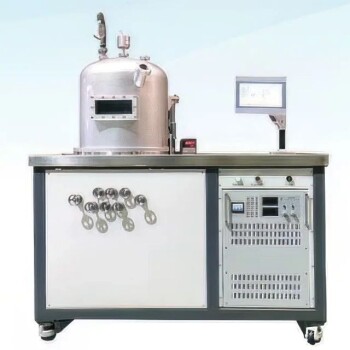
The horizontal hot-wall quartz tube CVD system acts as the foundational reactor for synthesizing 2D monolayer MoS2-MoSe2 lateral superlattices. By rigorously controlling temperature gradients, vacuum pressure, and distinct precursor sources, this system facilitates the lateral epitaxial growth required to produce high-resolution surface templates.
This system functions as a precision engineering tool that transforms raw precursors into predefined templates. Its ability to create specific lateral superlattices is the critical prerequisite for enabling subsequent Area-Selective Atomic Layer Deposition (SAS-ALD).
Mechanisms of Synthesis and Control
Orchestrating the Reaction Environment
The primary function of this CVD system is to establish a stable, controllable environment for material growth. It utilizes a horizontal hot-wall quartz tube design to maintain uniform thermal conditions.
Within this chamber, the system precisely regulates vacuum pressures and temperature gradients. These variables are the control knobs that dictate the quality and structure of the emerging superlattice.
Managing Complex Precursor Interaction
The system allows for the integration of multiple material phases simultaneously. It accommodates solid precursors, specifically MoO3 powder and KCl flux, alongside vapor-phase sources.
For the sulfur and selenium components, the system utilizes diethyl sulfide (DES) and dimethyl selenide (DMSe). The equipment manages the flow and interaction of these vapor-phase sources to drive the reaction.
Facilitating Lateral Epitaxial Growth
The interaction of these elements results in lateral epitaxial growth. This specific growth mode is what allows the MoS2 and MoSe2 materials to form a coherent 2D monolayer superlattice.
Unlike vertical stacking, this lateral arrangement creates the distinct surface patterns necessary for advanced template applications.
Critical Dependencies and Requirements
The Necessity of High Resolution
The output of this system is not merely a coating, but a high-resolution predefined template. The system must operate within tight parameters to ensure the template's features are sharp enough for future processing.
If the CVD process lacks precision, the resulting surface will fail to serve as an effective guide for subsequent deposition steps.
Preparation for SAS-ALD
The ultimate purpose of this equipment is to prepare the surface for Area-Selective Atomic Layer Deposition (SAS-ALD). The superlattice serves as a roadmap for where materials will be deposited in future steps.
Therefore, the system's function is inextricably linked to the success of the SAS-ALD process; without the correct template, selective deposition is impossible.
Leveraging CVD for Advanced Template Fabrication
To maximize the utility of a horizontal hot-wall quartz tube CVD system, consider your specific end goals:
- If your primary focus is material quality: strict management of the MoO3 powder and KCl flux interaction is required to ensure the purity of the 2D monolayer.
- If your primary focus is downstream processing: ensure the system is calibrated to produce high-resolution templates that align perfectly with the requirements of SAS-ALD.
Ultimately, this system serves as the critical bridge between raw chemical precursors and the sophisticated surface architectures needed for advanced nanoscale manufacturing.
Summary Table:
| Feature | Function in Superlattice Synthesis |
|---|---|
| Reactor Type | Horizontal hot-wall quartz tube for uniform thermal zones |
| Growth Mode | Facilitates lateral epitaxial growth for 2D monolayers |
| Precursor Control | Manages solid (MoO3/KCl) and vapor (DES/DMSe) phases |
| Primary Output | High-resolution predefined templates for SAS-ALD |
| Key Parameters | Precise vacuum pressure and temperature gradient regulation |
Elevate Your Nanoscale Manufacturing with KINTEK
Precision in superlattice fabrication starts with a reactor you can trust. KINTEK provides industry-leading CVD systems, Muffle, Tube, Rotary, and Vacuum furnaces, all backed by expert R&D and manufacturing. Whether you are synthesizing 2D monolayers or preparing complex surface templates, our systems are fully customizable to meet your unique laboratory needs.
Ready to achieve superior material growth? Contact our experts today to discover how KINTEK's high-temperature solutions can optimize your SAS-ALD and CVD processes.
References
- Jeongwon Park, Kibum Kang. Area-selective atomic layer deposition on 2D monolayer lateral superlattices. DOI: 10.1038/s41467-024-46293-w
This article is also based on technical information from Kintek Furnace Knowledge Base .
Related Products
- HFCVD Machine System Equipment for Drawing Die Nano Diamond Coating
- Custom Made Versatile CVD Tube Furnace Chemical Vapor Deposition CVD Equipment Machine
- Vertical Laboratory Quartz Tube Furnace Tubular Furnace
- Multi Heating Zones CVD Tube Furnace Machine for Chemical Vapor Deposition Equipment
- Slide PECVD Tube Furnace with Liquid Gasifier PECVD Machine
People Also Ask
- What is Hot-filament Chemical Vapor Deposition (HFCVD)? Achieve High-Quality Thin Films with Precision Control
- What are the equipment for chemical vapor deposition? A Guide to the 5 Essential Components
- What is the significance of the vacuum pressure control system in the CVD coating process for powders?
- What is the function of high-purity Argon (Ar) gas during CVD? Optimize Your Thin Film Uniformity and Purity
- What are the advantages of using Chemical Vapor Deposition (CVD) for coating turbine blades? Enhance Life & Performance