
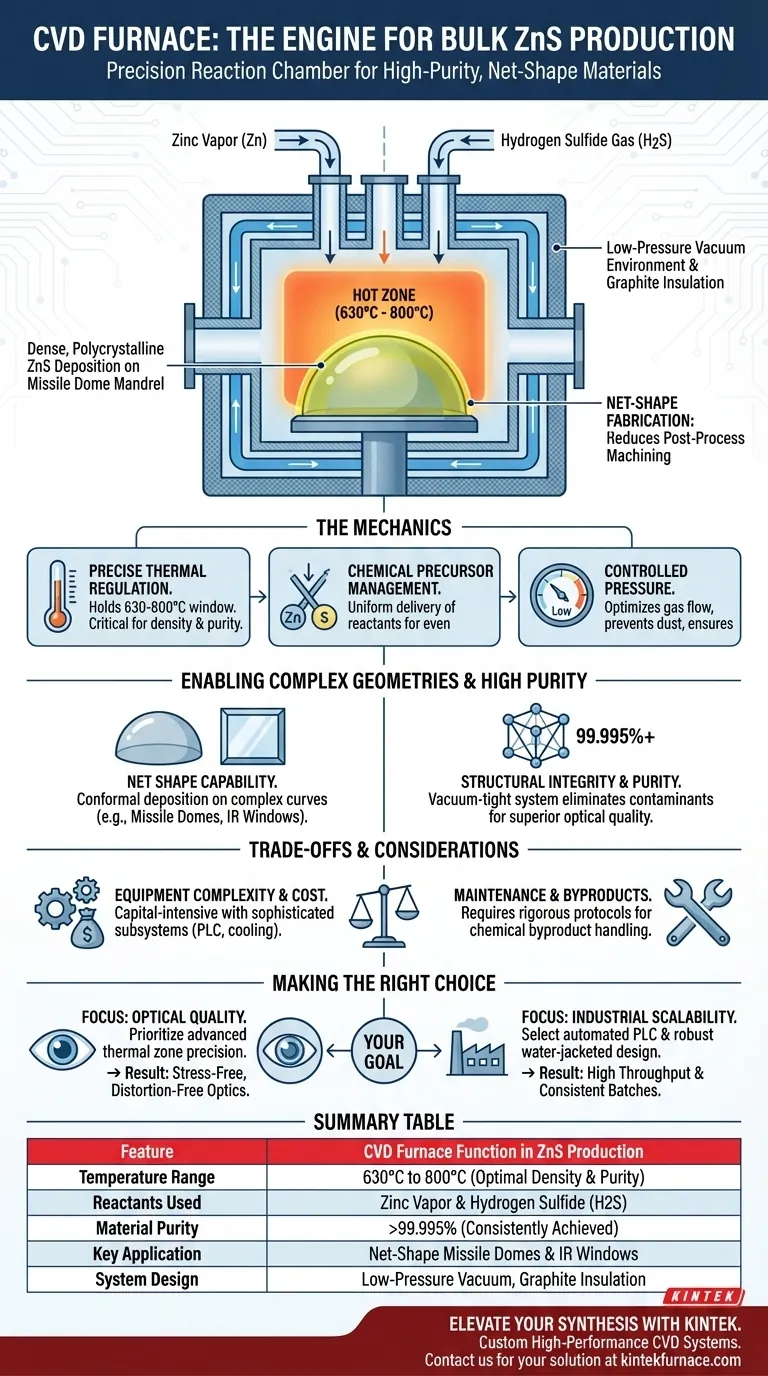
The primary function of a CVD furnace in bulk ZnS production is to act as a precision reaction chamber. Specifically, it maintains a low-pressure environment at high temperatures, typically between 630°C and 800°C, to facilitate a chemical reaction between zinc vapor and hydrogen sulfide gas. This process results in the deposition of dense, polycrystalline Zinc Sulfide (ZnS), enabling the creation of solid, bulk materials rather than just thin surface coatings.
Core Insight: Unlike standard CVD applications that focus on thin films, the furnace configuration for ZnS is designed for bulk material synthesis. It allows for the "net shape" fabrication of complex, high-purity components—such as missile domes and infrared optical windows—that require structural integrity and exceptional optical clarity.
The Mechanics of the Deposition Process
Precise Thermal Regulation
The furnace creates a "hot zone," often utilizing graphite insulation and heating elements.
For ZnS production, the system must hold a strictly controlled temperature range of 630-800°C. This specific thermal window is critical to ensure the chemical reaction occurs at a rate that promotes density and purity.
Chemical Precursor Management
The furnace is responsible for the safe and uniform delivery of reactants.
It introduces zinc vapor and hydrogen sulfide (H2S) into the chamber. The furnace design ensures these gases mix thoroughly to deposit ZnS uniformly across the substrate or mandrel.
Controlled Pressure Environment
The process operates under low pressure to optimize the mean free path of the gas molecules.
While general CVD furnaces can range from vacuum to 2 psig, ZnS production relies on low pressure to prevent gas-phase nucleation (dust formation) and ensure the material deposits solidly on the target surface.
Enabling Complex Geometries
Net Shape Capability
One of the most valuable functions of this furnace type is the ability to produce "net shape" components.
Because the gas reactants are highly conformal, the furnace can deposit material onto irregularly shaped mandrels. This allows for the direct fabrication of complex curves, such as missile domes, reducing the need for extensive post-process machining.
Structural Integrity and Purity
The furnace environment is designed to eliminate contaminants.
By maintaining a sealed, vacuum-tight environment (often utilizing water-cooled stainless steel walls), the system produces materials with purity levels often exceeding 99.995%. This results in fine-grained, mechanically hard materials suitable for demanding optical applications.
Understanding the Trade-offs
Equipment Complexity and Cost
CVD furnaces capable of bulk production are capital-intensive.
They require sophisticated subsystems, including liquid-cooled power supplies, PLC automation, and pneumatic valve headers. High durability is required to offset the initial investment, making them best suited for high-value industrial applications.
Maintenance and Byproducts
While often self-cleaning regarding the chamber walls, the handling of chemical byproducts presents a challenge.
The reaction between Zinc and H2S produces byproducts that must be managed carefully. The system requires rigorous maintenance protocols to handle the exhaust and scrubbers, ensuring safety and environmental compliance.
Making the Right Choice for Your Goal
To maximize the value of a CVD furnace for ZnS production, align your equipment selection with your specific output requirements.
- If your primary focus is Optical Quality: Prioritize a furnace with advanced thermal zone precision to prevent gradients that could cause stress or optical distortion in the window or dome.
- If your primary focus is Industrial Scalability: Select a system featuring automated PLC process controls and a robust, water-jacketed design to ensure high throughput and consistent batch-to-batch repeatability.
Success in bulk ZnS production relies not just on the chemistry, but on the furnace's ability to maintain an unwavering, contaminant-free environment over long deposition cycles.
Summary Table:
| Feature | CVD Furnace Function in ZnS Production |
|---|---|
| Temperature Range | 630°C to 800°C for optimal density and purity |
| Reactants Used | Zinc vapor and Hydrogen Sulfide (H2S) gas |
| Material Purity | Consistently achieves levels exceeding 99.995% |
| Key Application | Net-shape fabrication of missile domes and IR windows |
| System Design | Low-pressure vacuum environment with graphite insulation |
Elevate Your Advanced Material Synthesis with KINTEK
Unlock the full potential of your lab with high-performance CVD systems designed for the most demanding applications. Backed by expert R&D and manufacturing, KINTEK offers state-of-the-art Muffle, Tube, Rotary, Vacuum, and CVD systems, all fully customizable to meet your unique thermal and chemical processing needs. Whether you are producing high-purity ZnS optics or pioneering new thin-film technologies, our equipment provides the unwavering precision and durability your research demands.
Ready to optimize your production? Contact KINTEK today to discuss your custom furnace solution with our specialists!
Visual Guide
Related Products
- Controlled Inert Nitrogen Hydrogen Atmosphere Furnace
- Multi Heating Zones CVD Tube Furnace Machine for Chemical Vapor Deposition Equipment
- 1200℃ Controlled Inert Nitrogen Atmosphere Furnace
- Dental Porcelain Zirconia Sintering Ceramic Vacuum Press Furnace
- Custom Made Versatile CVD Tube Furnace Chemical Vapor Deposition CVD Equipment Machine
People Also Ask
- How does hydrogen furnace annealing assist in preparing mechanically alloyed powders for compaction?
- How does atmospheric annealing in a controlled hydrogen furnace affect the cold compaction behavior of metal powders?
- What are the characteristics and uses of hydrogen atmospheres in furnaces? Unlock Clean Metal Processing
- What are the characteristics and uses of hydrogen atmosphere in furnaces? Achieve Superior Surface Purity and Bonding
- What controlled-atmosphere furnace conditions are required for sintering powder metallurgy copper alloy compacts? Ideal Setup



















