Achieving coating uniformity in large-scale tantalum-carbon composites requires precise physical manipulation of the sample during production. Adjusting the position and height within the chamber is necessary to optimize gas flow organization and strictly manage the mass transfer process. Without these adjustments, the natural consumption of reactants creates uneven concentration gradients, leading to inconsistent metallic coatings across the material.
In a high-temperature deposition furnace, reactants are actively consumed as they travel, creating zones of varying gas concentration. Systematically adjusting sample position and flipping orientation compensates for these gradients, ensuring consistent coating quality in both axial and radial dimensions.
The Mechanics of Deposition Inhomogeneity
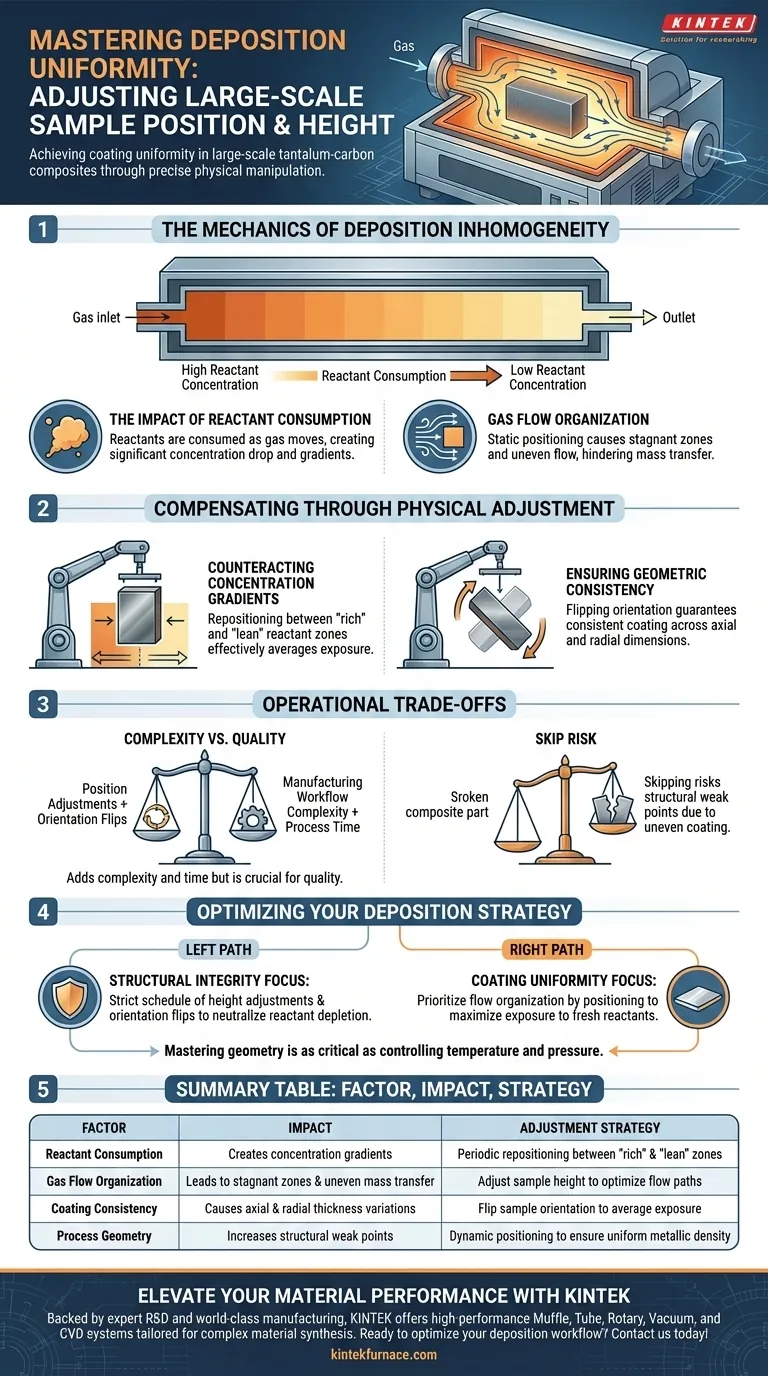
The Impact of Reactant Consumption
The fundamental challenge in preparing large-scale composites is that reactants are consumed as the process unfolds.
As the gas mixture moves through the high-temperature furnace, the chemical components required for the coating are depleted.
This results in a significant drop in reactant concentration from the inlet to the outlet, creating a "gradient" rather than a uniform atmosphere.
Gas Flow Organization
Static positioning within the chamber often leads to stagnant zones or uneven flow paths.
Adjusting the height of the sample directly influences how the gas flows around and through the composite structure.
Optimizing this gas flow organization is critical for efficient mass transfer, ensuring the reactants actually reach the surface of the material.
Compensating Through Physical Adjustment
Counteracting Concentration Gradients
Because the gas concentration is not uniform, a stationary sample will inevitably develop a coating that is thicker in some areas and thinner in others.
Changing the sample's position moves it between "rich" and "lean" reactant zones.
This movement effectively averages out the exposure, preventing structural inconsistencies caused by localized depletion.
Ensuring Geometric Consistency
Large-scale materials are particularly susceptible to variations across their length (axial) and width (radial).
Flipping the sample's orientation is a critical step to ensure the metallic coating is applied evenly across the entire geometry.
This mechanical intervention guarantees better axial and radial consistency, which is essential for the final performance of the tantalum-carbon composite.
Operational Trade-offs
Complexity vs. Quality
Introducing position adjustments and orientation flips adds complexity to the manufacturing workflow.
It requires precise intervention, which may increase process time compared to a static deposition approach.
However, skipping this step risks producing a composite with significant structural weak points due to uneven coating thickness.
Optimizing Your Deposition Strategy
To maximize the quality of your tantalum-carbon composites, you must treat sample positioning as a dynamic variable.
- If your primary focus is structural integrity: Implement a strict schedule of height adjustments and orientation flips to neutralize the effects of reactant depletion.
- If your primary focus is coating uniformity: Prioritize flow organization by positioning samples to maximize exposure to fresh reactant streams before consumption occurs.
Mastering the geometry of sample placement is just as critical as controlling temperature and pressure for producing high-performance composites.
Summary Table:
| Factor | Impact on Deposition | Adjustment Strategy |
|---|---|---|
| Reactant Consumption | Creates concentration gradients from inlet to outlet | Periodic repositioning between 'rich' and 'lean' zones |
| Gas Flow Organization | Leads to stagnant zones and uneven mass transfer | Adjust sample height to optimize flow paths around geometry |
| Coating Consistency | Causes axial and radial thickness variations | Flip sample orientation to average exposure across all surfaces |
| Process Geometry | Increases structural weak points in large-scale parts | Dynamic positioning to ensure uniform metallic density |
Elevate Your Material Performance with KINTEK
Precision in sample positioning is only half the battle; the right thermal environment is the other. Backed by expert R&D and world-class manufacturing, KINTEK offers high-performance Muffle, Tube, Rotary, Vacuum, and CVD systems tailored for complex material synthesis. Whether you are developing advanced tantalum-carbon composites or specialized thin films, our customizable lab high-temperature furnaces provide the stability and flow control your research demands.
Ready to optimize your deposition workflow? Contact us today to discover how our custom furnace solutions can solve your most challenging uniformity issues!
Visual Guide
References
- Junyu Zhu, Haohong Jiang. Fabrication and mechanical properties of porous tantalum carbon composites by chemical vapor deposition. DOI: 10.1038/s41598-025-86680-x
This article is also based on technical information from Kintek Furnace Knowledge Base .
Related Products
- Custom Made Versatile CVD Tube Furnace Chemical Vapor Deposition CVD Equipment Machine
- Slide PECVD Tube Furnace with Liquid Gasifier PECVD Machine
- Multi Heating Zones CVD Tube Furnace Machine for Chemical Vapor Deposition Equipment
- 915MHz MPCVD Diamond Machine Microwave Plasma Chemical Vapor Deposition System Reactor
- MPCVD Machine System Reactor Bell-jar Resonator for Lab and Diamond Growth
People Also Ask
- Why are CVD tube furnace sintering systems indispensable for 2D material research and production? Unlock Atomic-Scale Precision
- What is a CVD tube furnace and what is its primary function? Discover Precision Thin-Film Deposition
- Which industries and research fields benefit from CVD tube furnace sintering systems for 2D materials? Unlock Next-Gen Tech Innovations
- How does CVD tube furnace sintering enhance graphene growth? Achieve Superior Crystallinity and High Electron Mobility
- What improvements can be made to the bonding force of gate dielectric films using a CVD tube furnace? Enhance Adhesion for Reliable Devices