
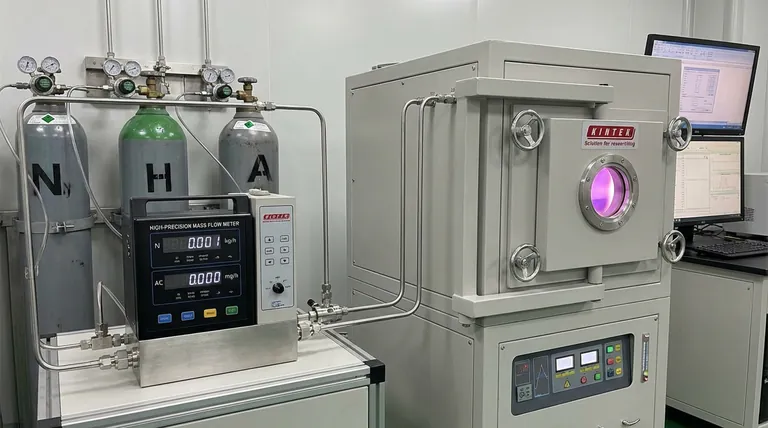
High-precision mass flow meters serve as the command center for atmospheric composition within a plasma nitriding furnace. They are responsible for the precise injection of process gases—typically nitrogen, hydrogen, argon, or methane—at exact, preset ratios. This granular control over gas volume and mixture is the deciding factor in the success of the surface treatment.
By strictly regulating gas ratios and partial pressures, mass flow meters allow operators to move beyond simple coating and achieve microstructural engineering. They provide the control necessary to determine the specific phase of the nitrided layer, directly dictating the material's final fatigue and wear resistance.
The Science of Gas Ratio Control
Managing the Component Gases
A plasma nitriding atmosphere is rarely a single gas. It is a complex recipe involving nitrogen, hydrogen, argon, and sometimes methane.
The mass flow meter must deliver these distinct components simultaneously. It ensures that the specific "recipe" required for the alloy being treated is maintained without deviation.
Determining Nitrogen Partial Pressure
The core variable in this process is the nitrogen partial pressure.
By adjusting the flow of nitrogen relative to other gases, the meter allows the operator to fine-tune how much nitrogen is available to diffuse into the steel. This pressure is the primary variable that influences the depth and composition of the hardened layer.
Engineering the Material Microstructure
Controlling the "White Layer"
The most critical role of the mass flow meter is controlling the formation of the compound layer, often called the "white layer."
Depending on the application, a thick white layer may be desirable for wear resistance, or it may need to be minimized to prevent brittleness.
Through precise flow adjustments, operators can generate controlled thicknesses of this layer or completely suppress it to meet specific fatigue resistance requirements.
Selecting the Crystal Phase
Not all white layers are created equal. The gas ratio determines the specific metallurgical phase that forms on the surface.
High-precision control allows for the specific generation of γ' (gamma prime, Fe4N) or ε (epsilon, Fe2-3N) phases.
This distinction is vital: one phase may offer better toughness, while the other offers superior hardness. The mass flow meter effectively acts as a phase-selection switch.
Operational Consistency and Trade-offs
The Risk of Flow Fluctuations
In any furnace operation, maintaining a constant reducing atmosphere is critical.
While the primary goal in nitriding is diffusion, the principle of stability applies universally. Just as gas fluctuations in other furnace types can cause localized inconsistencies in reduction processes, unstable flow in nitriding leads to uneven case depths.
The Trade-off of Complexity
Implementing high-precision mass flow control introduces complexity to the furnace system.
It requires rigorous calibration and monitoring. If a meter drifts even slightly, the nitrogen potential shifts.
This can result in the unintentional formation of a brittle phase where a tough phase was required, potentially compromising the component's structural integrity under load.
Making the Right Choice for Your Goal
To maximize the effectiveness of your plasma nitriding process, align your gas control strategy with your end-product requirements.
- If your primary focus is Fatigue Resistance: Prioritize a flow strategy that lowers nitrogen partial pressure to suppress the formation of the white layer entirely.
- If your primary focus is Wear Resistance: Utilize precise ratios to specifically promote the formation of the ε (epsilon) phase within the compound layer.
- If your primary focus is Toughness: Adjust the gas mixture to target the γ' (gamma prime) phase, which generally offers better ductility than the epsilon phase.
Ultimately, the mass flow meter is not just a valve; it is the tool that translates your metallurgical specifications into physical reality.
Summary Table:
| Feature | Role in Plasma Nitriding | Impact on Material |
|---|---|---|
| Gas Ratio Control | Precision mixing of $N_2$, $H_2$, $Ar$, and $CH_4$ | Ensures atmosphere consistency for specific alloys |
| Partial Pressure | Regulates nitrogen availability for diffusion | Determines the depth of the hardened case layer |
| White Layer Control | Suppresses or promotes compound layer formation | Balances surface hardness versus brittleness |
| Phase Selection | Targets $\gamma'$ (gamma prime) or $\epsilon$ (epsilon) phases | Optimizes for toughness or extreme wear resistance |
| Flow Stability | Prevents atmosphere fluctuations | Ensures uniform case depth across all components |
Elevate Your Heat Treatment Precision with KINTEK
Don't let gas fluctuations compromise your metallurgical results. Backed by expert R&D and manufacturing, KINTEK offers high-performance Muffle, Tube, Rotary, Vacuum, and CVD systems—all fully customizable to meet your unique plasma nitriding and high-temperature laboratory needs.
Whether you are targeting specific crystal phases or suppressing white layers for fatigue resistance, our engineering team provides the tools you need for absolute control. Contact us today to optimize your furnace performance and see how our advanced gas management solutions can transform your production quality.
References
- André Paulo Tschiptschin. PROCESSOS SOB VÁCUO USADOS PARA TRATAMENTOS TÉRMICOS E DE SUPERFÍCIE DE AÇOS E LIGAS ESPECIAIS. DOI: 10.17563/rbav.v43i1.1262
This article is also based on technical information from Kintek Furnace Knowledge Base .
Related Products
- Spark Plasma Sintering SPS Furnace
- Slide PECVD Tube Furnace with Liquid Gasifier PECVD Machine
- Inclined Rotary Plasma Enhanced Chemical Deposition PECVD Tube Furnace Machine
- Inclined Rotary Plasma Enhanced Chemical Deposition PECVD Tube Furnace Machine
- 1700℃ Controlled Inert Nitrogen Atmosphere Furnace
People Also Ask
- How does the heating mechanism of Spark Plasma Sintering (SPS) function? Enhance TiC/SiC Composite Fabrication
- Why is it necessary to maintain a high vacuum environment during the SPS of SiC? Key to High-Density Ceramics
- What are the technical advantages of using an SPS sintering furnace? Elevate Al2O3-TiC Material Performance
- What are the steps in the discharge plasma sintering process? Master Fast, High-Density Material Consolidation
- What are the advantages of spark plasma sintering (SPS) over traditional forging? Precision Microstructural Control



















