
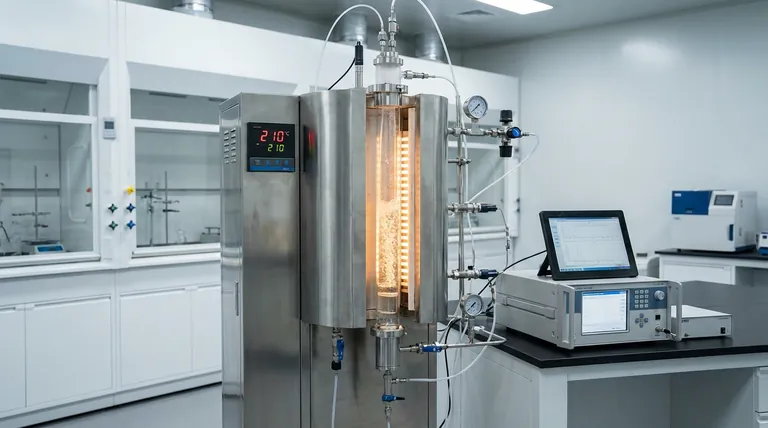
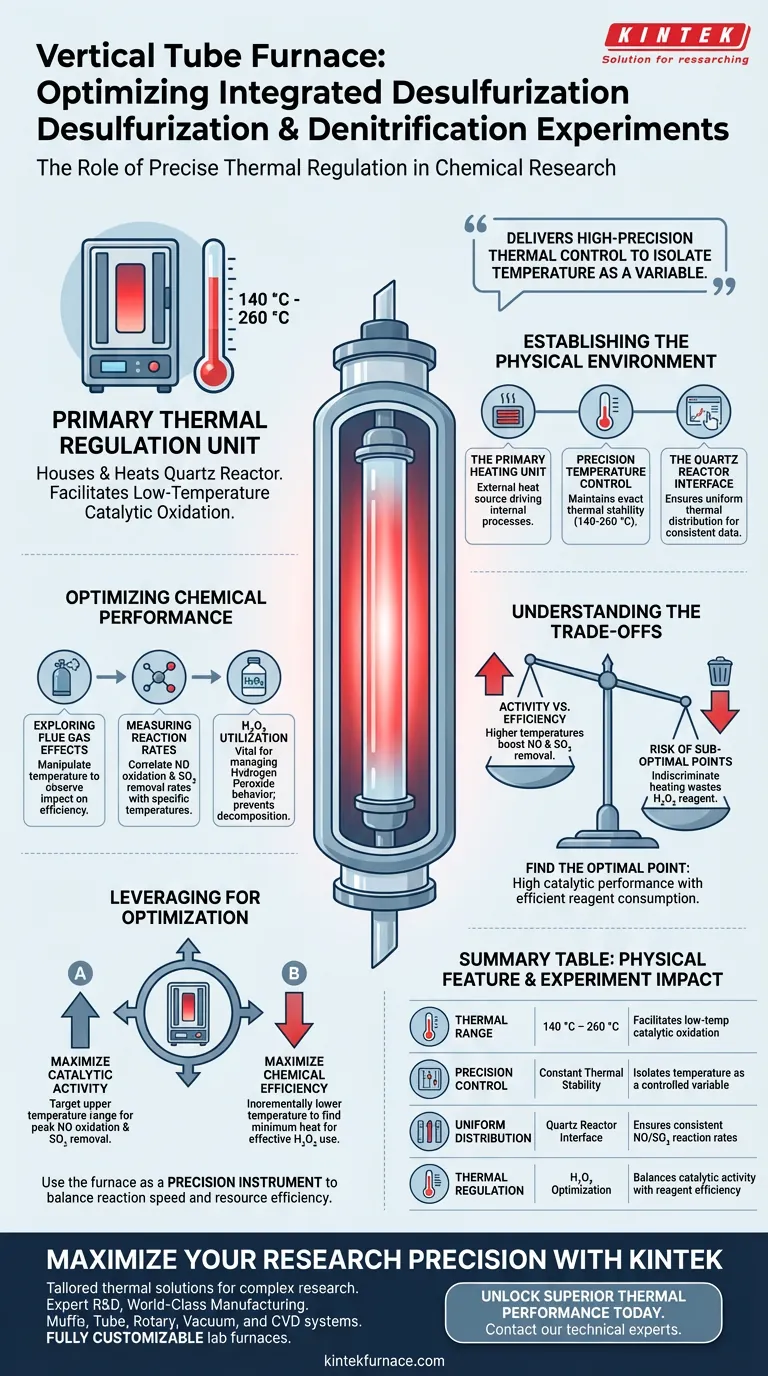
A vertical tube furnace acts as the primary thermal regulation unit for integrated desulfurization and denitrification experiments, specifically designed to house and heat a quartz reactor. Its central physical contribution is the provision of a precisely controlled temperature environment, typically maintained between 140 °C and 260 °C, to facilitate catalytic oxidation.
By delivering high-precision thermal control, the furnace allows researchers to isolate temperature as a variable, identifying the specific conditions that maximize removal rates while minimizing chemical waste.
Establishing the Physical Environment
The Primary Heating Unit
The vertical tube furnace serves as the foundational hardware for the experiment. It surrounds the quartz reactor, acting as the external heat source that drives the internal chemical processes.
Precision Temperature Control
The core function of this equipment is maintaining exact thermal stability. It does not merely heat the apparatus but ensures the temperature remains constant within the specified low-temperature window (140-260 °C).
The Quartz Reactor Interface
The physical conditions created by the furnace are transferred directly to the quartz reactor inside. This setup ensures that the flue gas passing through the reactor experiences uniform thermal distribution, which is critical for consistent experimental data.
Optimizing Chemical Performance
Exploring Flue Gas Effects
The precise control allows researchers to manipulate the temperature of the flue gas systematically. By adjusting the furnace settings, you can observe how thermal changes directly impact the efficiency of the system.
Measuring Reaction Rates
Specific attention is paid to two key metrics: NO oxidation rates and SO2 removal rates. The furnace environment enables the correlation of these rates with specific temperature points to determine kinetic behavior.
H2O2 Utilization
In these specific experiments, the furnace conditions are vital for managing Hydrogen Peroxide (H2O2) behavior. The temperature must be sufficient to drive reactions without causing inefficient decomposition or waste of the H2O2 reagent.
Understanding the Trade-offs
The Balance of Activity vs. Efficiency
A critical trade-off exists within the 140-260 °C range provided by the furnace. Higher temperatures generally increase catalytic activity, potentially boosting NO and SO2 removal.
The Risk of Sub-optimal Points
However, increasing temperature indiscriminately can lead to poor H2O2 utilization. The challenge lies in using the furnace to find the "optimal point"—a specific temperature where catalytic performance is high, but reagent consumption remains efficient.
Leveraging the Furnace for Optimization
To derive the most value from your vertical tube furnace setup, align your thermal settings with your specific experimental metrics.
- If your primary focus is maximizing catalytic activity: Target the upper end of the provided temperature range to test the limits of NO oxidation and SO2 removal rates.
- If your primary focus is chemical efficiency: Utilize the furnace's precision to incrementally lower temperatures, identifying the minimum heat required for effective H2O2 utilization.
Success in these experiments relies on using the furnace not just as a heater, but as a precision instrument to balance reaction speed with resource efficiency.
Summary Table:
| Physical Feature | Functional Contribution | Impact on Experiment |
|---|---|---|
| Thermal Range | 140 °C – 260 °C | Facilitates low-temperature catalytic oxidation |
| Precision Control | Constant Thermal Stability | Isolates temperature as a controlled variable |
| Uniform Distribution | Quartz Reactor Interface | Ensures consistent NO/SO2 reaction rates |
| Thermal Regulation | H2O2 Optimization | Balances catalytic activity with reagent efficiency |
Maximize Your Research Precision with KINTEK
Are you looking to optimize your catalytic oxidation rates? KINTEK provides industry-leading thermal solutions tailored for complex chemical research. Backed by expert R&D and world-class manufacturing, we offer a comprehensive range of Muffle, Tube, Rotary, Vacuum, and CVD systems.
Whether you need precise low-temperature control for desulfurization or high-temp durability for material synthesis, our lab furnaces are fully customizable to meet your unique experimental needs.
Unlock superior thermal performance today. Contact our technical experts to find the perfect furnace for your laboratory.
Visual Guide
References
- Yanyuan Bai, Qi Xiao. Experimental study on integrated desulfurization and denitrification of low-temperature flue gas by oxidation method. DOI: 10.1038/s41598-024-53765-y
This article is also based on technical information from Kintek Furnace Knowledge Base .
Related Products
- Vertical Laboratory Quartz Tube Furnace Tubular Furnace
- Custom Made Versatile CVD Tube Furnace Chemical Vapor Deposition CVD Equipment Machine
- Vacuum Sealed Continuous Working Rotary Tube Furnace Rotating Tube Furnace
- Slide PECVD Tube Furnace with Liquid Gasifier PECVD Machine
- Split Chamber CVD Tube Furnace with Vacuum Station CVD Machine
People Also Ask
- What are the key differences between single-zone and multi-zone vertical tube furnaces? Choose the Right Furnace for Your Lab
- How are wafers loaded and unloaded in a vertical tube furnace? Achieve Precision and Purity in Wafer Processing
- Why is a vertical tube furnace preferred for quenching tests? Achieve Rapid, Repeatable Cooling for Accurate Results
- How are metal support wires selected for sample suspension? Expert Guide to High-Temp Furnace Materials
- What is the purpose of using an industrial-grade vertical tube furnace in phosphorus recovery? High-Fidelity Simulation



















