
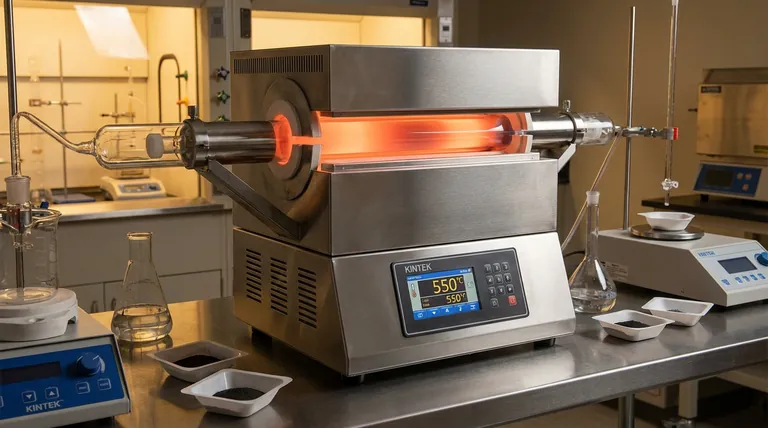
Muffle and Tube furnaces serve as the primary reaction vessels for converting nitrogen-rich precursors into bulk graphitic carbon nitride ($g-C_3N_4$). These devices provide the stable, high-energy environment necessary to drive the thermal polymerization of monomers like dicyandiamide (DCDA). By strictly controlling parameters such as a heating rate of 5 °C/min and a sustained temperature of roughly 550 °C, these furnaces facilitate the condensation of precursors into a characteristic 2D layered structure.
Core Takeaway The furnace is not merely a heat source; it is a kinetic regulator. By maintaining precise heating ramps and dwell times, Muffle and Tube furnaces control the polymerization rate, ensuring the material forms a crystalline, layered framework rather than an amorphous or incompletely reacted solid.
The Mechanics of Thermal Polymerization
Precise Temperature Regulation
The synthesis of bulk carbon nitride requires overcoming significant energy barriers to link monomer units.
Furnaces must maintain a specific high-temperature setpoint, typically around 550 °C for DCDA precursors.
This sustained thermal energy is the catalyst that transforms small organic molecules into a polymeric network.
Controlled Heating Rates
The rate at which temperature increases is as critical as the final temperature itself.
A controlled ramp, such as 5 °C/min, prevents the rapid volatilization of the precursor before it can polymerize.
This gradual increase allows for the orderly arrangement of atoms, facilitating the formation of the material's signature graphitic layers.
Duration and Dwell Time
Achieving a stable structure requires time for the reaction to reach completion.
A constant temperature duration, often lasting 4 hours, ensures that the polymerization propagates throughout the entire bulk of the material.
This "dwell time" eliminates unreacted monomers and stabilizes the final layered morphology.
The Role of Atmosphere and Containment
Sealed Environments and Crystallinity
While Muffle furnaces are often used for air-calcination, Tube furnaces offer a sealed environment critical for specific synthesis goals.
This containment ensures a uniform thermal history for the sample, which is vital for determining the final crystallinity of the material.
It allows for the precise transformation of precursors, such as trithiocyanuric acid, into well-defined structures.
Inert Atmosphere Capabilities
When avoiding oxidation is paramount, the Tube furnace becomes indispensable.
It enables the introduction of inert gases like high-purity argon during the heating process.
This prevents the carbon elements from "burning off" (oxidizing) at high temperatures (e.g., 600 °C), ensuring the carbon framework remains intact while allowing for specific modifications like doping or encapsulation.
Understanding the Trade-offs
Muffle vs. Tube Limitations
Muffle furnaces generally offer larger chamber volumes, making them suitable for synthesizing larger batches of bulk material in air.
However, they lack the precise atmospheric control of Tube furnaces, making them less ideal for reactions requiring inert gases or specific dopants (like sulfur) that might oxidize or escape.
The Risk of Thermal Gradients
Inaccurate heating rates or uneven heat distribution can lead to heterogeneous products.
If the heating rate is too fast, the precursor may sublime rather than polymerize, resulting in low yields.
If the temperature fluctuates during the dwell time, the material may suffer from poor crystallinity or inconsistent electronic properties.
Making the Right Choice for Your Synthesis
Selecting the correct furnace configuration depends on the specific chemical requirements of your precursor and your target material properties.
- If your primary focus is standard bulk production: Utilize a Muffle furnace with a slow ramp (5 °C/min) to 550 °C in air to maximize yield and cost-efficiency.
- If your primary focus is doping or morphology control: Choose a Tube furnace to introduce an inert atmosphere (Argon) or a sealed environment, preventing oxidation and preserving dopant concentrations.
- If your primary focus is high crystallinity: Prioritize strict adherence to the dwell time (e.g., 4 hours) and ramp rates to ensure the precursors have sufficient time to organize into a 2D lattice.
Ultimately, the furnace acts as the architect of the material, where the precision of thermal control directly dictates the quality of the final carbon nitride structure.
Summary Table:
| Feature | Muffle Furnace | Tube Furnace |
|---|---|---|
| Primary Use | Large-scale bulk synthesis in air | Doping, morphology control, & inert gas reactions |
| Atmosphere | Ambient air (typically) | Controlled inert gas (Argon/Nitrogen) or vacuum |
| Heating Ramp | Standard (e.g., 5 °C/min) | High precision for sensitive kinetics |
| Key Benefit | High volume & cost-efficiency | Prevents oxidation & ensures high crystallinity |
| Target Temp | ~550 °C for DCDA precursors | Precise setpoints up to 600 °C+ |
Elevate Your Material Synthesis with KINTEK Precision
Don’t let thermal gradients or oxidation compromise your research. KINTEK provides industry-leading Muffle, Tube, Rotary, Vacuum, and CVD systems designed for the rigorous demands of carbon nitride and advanced material preparation.
Backed by expert R&D and precision manufacturing, our lab high-temp furnaces are fully customizable to meet your specific heating ramps, dwell times, and atmospheric requirements.
Ready to achieve superior crystallinity and yield?
Contact KINTEK today to find your custom furnace solution!
References
- New Insights In‐Plane Porous Defects Formation Mechanism of Single‐Layer Graphitic Carbon Nitride by Tetrahydrofuran Etching Reaction. DOI: 10.1002/sstr.202500259
This article is also based on technical information from Kintek Furnace Knowledge Base .
Related Products
- High Temperature Muffle Oven Furnace for Laboratory Debinding and Pre Sintering
- 1400℃ Muffle Oven Furnace for Laboratory
- Laboratory Muffle Oven Furnace with Bottom Lifting
- 1200℃ Muffle Oven Furnace for Laboratory
- Multi Heating Zones CVD Tube Furnace Machine for Chemical Vapor Deposition Equipment
People Also Ask
- What thermal phenomena occur during polymer binder burnout in ceramic green bodies? Lab Furnace Guide
- Why is controlled heat treatment in a muffle furnace necessary for calcined clay? Achieve Optimal Pozzolanic Activity
- What role does a high-temperature muffle furnace play in STFO synthesis? Achieve Pure Perovskite Results
- How does a high-temperature muffle furnace facilitate the formation of LaNbxAl1−xO3+δ perovskite structures? Key Roles
- What role does a high-temperature muffle furnace play in the multi-stage synthesis of Li0.5MnFe1.5O4? Key to Pure Spinel



















