
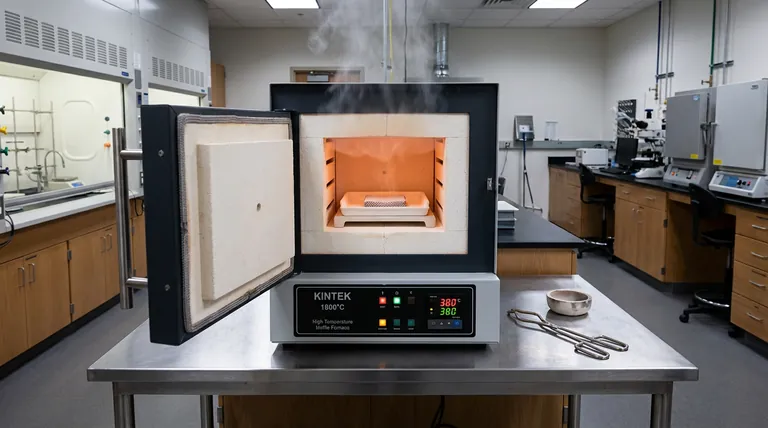
The high-temperature Muffle Furnace functions as a precision thermal reactor designed to bond hydrophobic coatings to metal substrates through a two-stage heating profile.
Specifically, it subjects PTFE-coated nickel foam to a controlled temperature of 240°C to eliminate chemical surfactants, followed by a ramp to 380°C to sinter the PTFE. This process transforms a loose surface coating into a structurally integrated, acid-resistant layer essential for fuel cell operations.
Core Takeaway The muffle furnace is not just a heater; it is a stabilization tool that isolates the material to manage distinct chemical transitions. Its primary value lies in decoupling the removal of impurities (surfactants) from the physical bonding (sintering) of the coating, ensuring the final product does not peel under stress.
The Two-Step Thermal Mechanism
To understand the furnace's role, you must look at the specific chemical requirements of the PTFE suspension being applied to the nickel foam.
Step 1: Decomposing Surfactants (240°C)
The first function of the furnace is purification. The coating suspension contains surfactants that help spread the PTFE but weaken the final bond if left behind.
By holding the temperature at 240°C, the furnace thermally decomposes these organic agents. This removes the "chemical noise," effectively cleaning the interface between the coating and the metal skeleton before the final bond is formed.
Step 2: Melting and Sintering (380°C)
Once the impurities are evacuated, the furnace temperature is raised to 380°C. This is the sintering phase.
At this temperature, the PTFE particles melt and fuse together. They flow into the porous structure of the nickel foam, creating a cohesive, continuous hydrophobic layer.
The Result: Structural Stability
This thermal cycling creates a robust physical anchor. Without this specific high-temperature treatment, the coating would likely peel off when exposed to the acidic environment of an operating fuel cell.
Why a Muffle Furnace is Required
You might ask why a standard oven or direct heating method isn't sufficient. The answer lies in environmental control.
Precise Thermal Isolation
A muffle furnace operates by heating an enclosed air chamber with resistive elements, isolating the material from direct combustion or external contaminants.
This creates a stable oxidative environment where temperature fluctuations are minimized. The furnace ensures that the entire nickel foam substrate receives uniform thermal energy, which is critical for consistent sintering across the complex geometry of the foam.
Controlled Reaction Kinetics
The transition from 240°C to 380°C must be managed carefully. The muffle furnace allows for controlled heating rates.
This control ensures that surfactants are fully removed before sintering begins. If these steps overlapped or occurred too quickly due to uneven heating, gases from the decomposing surfactants could become trapped inside the hardening PTFE, creating voids and weak points.
Understanding the Trade-offs
While the muffle furnace is the standard tool for this process, there are operational constraints that must be respected to ensure success.
Sensitivity to Temperature Deviations
The window for success is relatively narrow. If the temperature in the second stage drops significantly below 380°C, the PTFE will not sinter completely, resulting in a porous, weak coating.
Conversely, excessive temperatures beyond the target range can degrade the polymer chains of the PTFE or oxidize the nickel substrate aggressively, ruining the material's conductivity.
Throughput Limitations
Muffle furnaces are typically batch-processing tools. Because they rely on heating a static air chamber, they may have slower ramp-up and cool-down times compared to continuous conveyor furnaces.
This makes them excellent for precision and quality control in batch production but potentially a bottleneck in high-volume, continuous manufacturing environments.
Making the Right Choice for Your Goal
The use of a muffle furnace is dictated by your specific adherence requirements and the harshness of the end-use environment.
- If your primary focus is Adhesion Strength: Prioritize the accuracy of the 240°C dwell time; ensuring all surfactants are gone is the single biggest factor in preventing coating delamination.
- If your primary focus is Chemical Resistance: Ensure the furnace reaches and holds a uniform 380°C to guarantee a fully sintered, non-porous PTFE surface that creates a perfect barrier against acids.
Ultimately, the muffle furnace acts as the guarantor of coating integrity, converting a temporary mixture into a permanent engineering surface.
Summary Table:
| Process Phase | Temperature | Primary Function | Structural Result |
|---|---|---|---|
| Stage 1: Decomposition | 240°C | Removes surfactants/impurities | Purifies the metal-coating interface |
| Stage 2: Sintering | 380°C | Melts and fuses PTFE particles | Creates a cohesive, acid-resistant layer |
| Environment | Controlled | Thermal isolation & uniformity | Prevents voids and ensures consistent adhesion |
Elevate Your Material Stability with KINTEK
Precise temperature control is the difference between a failing coating and a high-performance fuel cell component. KINTEK provides industry-leading thermal solutions, including Muffle, Tube, Rotary, and Vacuum systems, tailored for complex processes like PTFE sintering and surfactant removal.
Backed by expert R&D and manufacturing, our furnaces are fully customizable to meet your unique lab or production needs. Ensure structural integrity and uniform sintering for your substrates today.
Consult with a KINTEK Thermal Expert
References
- Siyuan Wu, Kui Jiao. Multi‐Factor Optimization of Nickel Foam Flow Fields: Insights into Structural and Surface Modifications for High‐Performance PEMFCs. DOI: 10.1002/advs.202416770
This article is also based on technical information from Kintek Furnace Knowledge Base .
Related Products
- 1700℃ High Temperature Muffle Oven Furnace for Laboratory
- 1800℃ High Temperature Muffle Oven Furnace for Laboratory
- 1200℃ Muffle Oven Furnace for Laboratory
- High Temperature Muffle Oven Furnace for Laboratory Debinding and Pre Sintering
- 1400℃ Muffle Oven Furnace for Laboratory
People Also Ask
- What is the primary function of a high-temperature laboratory muffle furnace in chemical synthesis? Achieve Precision.
- How does a high-temperature laboratory muffle furnace affect material properties? Transform Anodic Oxide Films Fast
- What role does a muffle furnace play in BCZY712 electrolyte powder production? Achieve Perfect Phase Purity
- How does the two-stage sintering process contribute to the synthesis of MeCuFeO3 perovskite? Optimize crystal purity.
- How does a muffle furnace impact Ni/MgAl2O4 catalysts? Optimize Stability and Catalytic Performance



















