
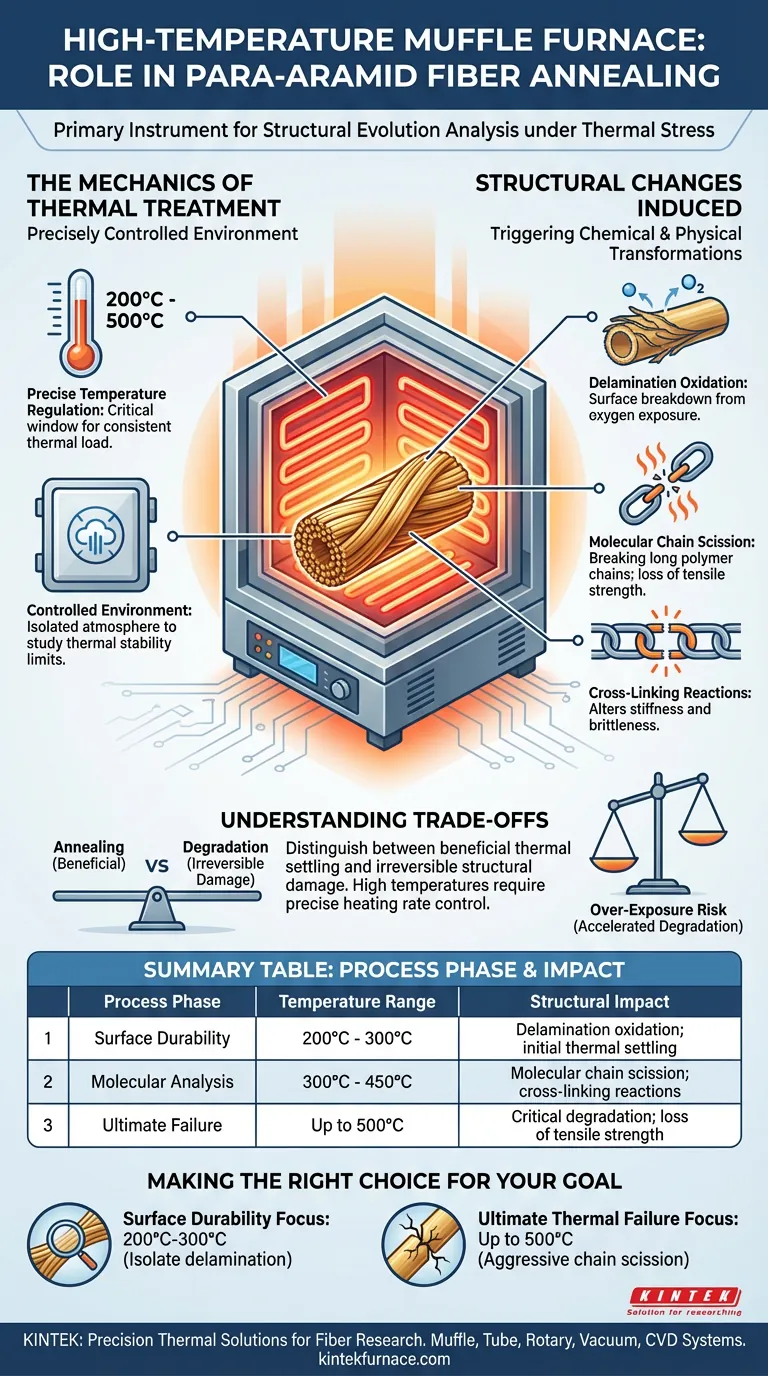
A high-temperature muffle furnace serves as the primary instrument for inducing and analyzing structural evolution in para-aramid fibers under thermal stress. It creates a precisely controlled environment, typically between 200°C and 500°C, to trigger specific chemical and physical transformations necessary for material research.
The core function of the furnace is to simulate high-temperature degradation, allowing researchers to isolate how heat impacts the fiber's molecular integrity through oxidation, chain scission, and cross-linking.
The Mechanics of Thermal Treatment
Precise Temperature Regulation
The fundamental role of the muffle furnace is to maintain exact temperature gradients.
For para-aramid fibers, this generally involves operating within a critical window of 200°C to 500°C.
This precision ensures that the thermal load applied to the material is consistent and reproducible across experiments.
Creating a Controlled Environment
Beyond simple heating, the furnace provides a stable atmosphere for the fibers.
This isolation is necessary to study how the physical and chemical properties of the material evolve solely in response to temperature.
It acts as the core equipment for determining the thermal stability limits of the fiber.
Structural Changes Induced by the Furnace
Delamination Oxidation
One of the primary structural changes induced by the furnace is delamination oxidation.
This process involves the breakdown of the fiber's surface layers due to high-temperature oxygen exposure.
Monitoring this helps researchers understand how the fiber's exterior durability degrades over time.
Molecular Chain Scission
The thermal energy supplied by the furnace triggers molecular chain scission.
This is the breaking of the long polymer chains that give para-aramid fibers their characteristic high strength.
Studying this mechanism is vital for predicting the loss of tensile strength in high-heat applications.
Cross-Linking Reactions
Simultaneously, the heat treatment can induce cross-linking reactions between polymer chains.
While chain scission weakens the material, cross-linking can alter its stiffness and brittleness.
The furnace allows for the precise observation of the competition between these degrading and restructuring forces.
Understanding the Trade-offs in Thermal Analysis
Annealing vs. Degradation
While the term "annealing" implies a treatment to improve properties, in the context of para-aramid research at these temperatures, the focus is often on degradation.
The furnace is used to push the material to its limits to identify failure points.
Researchers must distinguish between beneficial thermal settling and irreversible structural damage.
The Risk of Over-Exposure
Operating at the higher end of the 500°C spectrum accelerates degradation significantly.
Excessive heat can lead to rapid total loss of mechanical properties, making the data difficult to capture accurately.
Precise control of the heating rate is essential to capture the nuances of the structural evolution before total failure occurs.
Making the Right Choice for Your Goal
When utilizing a high-temperature muffle furnace for para-aramid fiber analysis, align your parameters with your specific research objectives.
- If your primary focus is analyzing surface durability: Concentrate on the lower temperature range (200°C–300°C) to isolate the effects of delamination oxidation without triggering massive chain scission.
- If your primary focus is determining ultimate thermal failure: Utilize the upper temperature range (up to 500°C) to aggressively induce molecular chain scission and cross-linking reactions.
By mastering the thermal environment within the muffle furnace, you convert raw heat into critical data regarding the lifecycle and limitations of high-performance fibers.
Summary Table:
| Process Phase | Temperature Range | Structural Impact on Fibers |
|---|---|---|
| Surface Durability | 200°C - 300°C | Delamination oxidation and initial thermal settling |
| Molecular Analysis | 300°C - 450°C | Molecular chain scission and cross-linking reactions |
| Ultimate Failure | Up to 500°C | Critical degradation and loss of tensile strength |
Precision Thermal Solutions for Fiber Research
Maximize your material research accuracy with KINTEK’s high-performance laboratory solutions. Backed by expert R&D and manufacturing, KINTEK offers Muffle, Tube, Rotary, Vacuum, and CVD systems designed to provide the precise temperature gradients required for analyzing para-aramid fibers and other high-performance materials.
Whether you need standard equipment or a customizable system tailored to your unique research needs, our furnaces ensure consistent, reproducible results. Contact us today to discuss how our lab high-temperature furnaces can optimize your annealing and degradation studies!
Visual Guide
References
- Chunyan Zhu, Chen Yang. Testing and characterization of high-temperature degradation performanceof para-aramid fibres. DOI: 10.35530/it.075.01.2023115
This article is also based on technical information from Kintek Furnace Knowledge Base .
Related Products
- 1700℃ High Temperature Muffle Oven Furnace for Laboratory
- High Temperature Muffle Oven Furnace for Laboratory Debinding and Pre Sintering
- 1800℃ High Temperature Muffle Oven Furnace for Laboratory
- 1200℃ Muffle Oven Furnace for Laboratory
- 1400℃ Muffle Oven Furnace for Laboratory
People Also Ask
- What is the primary function of a high-temperature laboratory muffle furnace in chemical synthesis? Achieve Precision.
- How does a high-temperature laboratory muffle furnace affect material properties? Transform Anodic Oxide Films Fast
- What role does a muffle furnace play in BCZY712 electrolyte powder production? Achieve Perfect Phase Purity
- What is the role of a high-temperature muffle furnace in guava leaf carbonization? Master Precise Pyrolysis Control
- What role does a muffle furnace play in sintering photocathodes? Enhance Electrode Conductivity & Catalytic Activity



















