
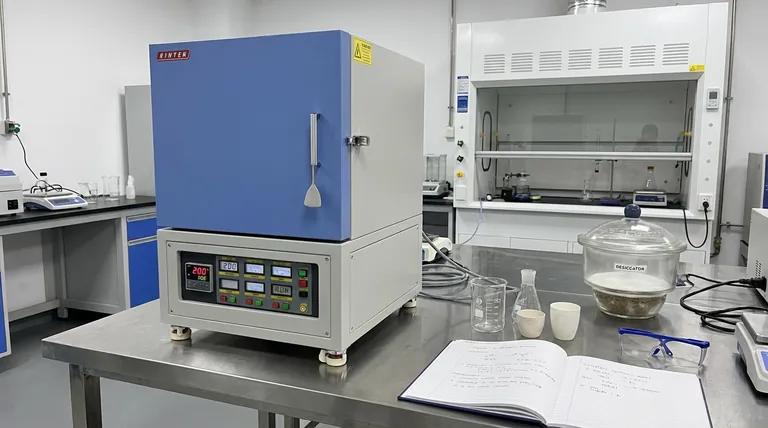
In the synthesis of Si@Al adsorbents, a muffle furnace acts as the primary reactor for controlled thermal transformation. It provides the high-temperature environment required to facilitate a thermochemical reaction between sodium silicate and electrocoagulation precipitation waste. By maintaining a steady state (typically 200°C for two hours), the furnace converts these raw precursors into a functional, highly active porous material.
The muffle furnace is the critical tool that transforms industrial waste into a high-performance adsorbent by precisely controlling the thermal conditions necessary for structural development and chemical bonding.
The Mechanism of Thermal Synthesis
Facilitating Thermochemical Reactions
The furnace provides the thermal energy needed to initiate a reaction between sodium silicate and aluminum-rich waste.
This heat allows the chemical precursors to interact at a molecular level, overcoming the energy barriers required for synthesis.
Without this consistent heat source, the raw materials would remain a simple mixture rather than a chemically bonded composite.
Developing Pore Architecture
The controlled heating process is responsible for inducing the specific pore structures within the Si@Al matrix.
As the temperature is maintained, the internal structure of the material rearranges to create the high surface area required for adsorption.
The precision of the muffle furnace ensures that these pores are uniform and optimized for capturing target pollutants.
Engineering Material Properties
Achieving Physicochemical Stability
The thermal treatment stabilizes the material, ensuring that the resulting adsorbent does not degrade during liquid-phase applications.
By reaching specific temperature thresholds, the furnace helps "lock" the silicon and aluminum components into a durable framework.
This process essentially transforms "soft" waste into a robust, solid-state material capable of enduring harsh environmental conditions.
Ensuring Uniform Heating
The "muffle" design isolates the sample from direct contact with heating elements and combustion gases.
This isolation creates a uniform temperature field, which is vital for ensuring that the entire batch of Si@Al adsorbent has consistent properties.
Uniformity prevents "hot spots" that could cause localized melting or "cold spots" that result in incomplete reactions.
Understanding the Trade-offs
Balancing Temperature and Time
While higher temperatures can accelerate reactions, exceeding the target 200°C may lead to the collapse of the delicate pore structures.
The synthesis requires a delicate balance: enough heat to drive the reaction, but not so much that the material sinters into a non-porous solid.
Additionally, while longer durations can ensure complete conversion, they also increase energy consumption and may lead to unwanted crystal growth.
Limitations of Thermal Processing
Muffle furnaces are highly effective but are typically limited by batch size and the time required for heating and cooling cycles.
Rapidly cooling the material after the 2-hour treatment can sometimes lead to thermal stress, potentially compromising the structural integrity of the adsorbent.
How to Apply This to Your Project
Optimizing Your Synthesis Process
To achieve the best results when synthesizing Si@Al or similar adsorbents, consider your specific performance requirements:
- If your primary focus is Maximum Surface Area: Ensure strict adherence to the 200°C threshold to prevent pore collapse caused by overheating.
- If your primary focus is Structural Durability: Focus on the "soak time" (duration) to ensure the thermochemical bond between the silicon and aluminum is fully matured.
- If your primary focus is Batch Consistency: Utilize a furnace with digital PID controllers to eliminate temperature fluctuations during the two-hour window.
The muffle furnace is the bridge between raw waste and high-value functional materials, providing the precise thermal environment necessary to engineer the adsorbent's core properties.
Summary Table:
| Process Element | Role in Si@Al Synthesis | Outcome for Adsorbent |
|---|---|---|
| Thermal Energy | Initiates reaction between precursors | Chemical bonding of Si and Al waste |
| Temperature (200°C) | Maintains stable reaction environment | Prevents pore collapse / Overheating |
| Muffle Isolation | Protects from direct heating elements | Uniform material properties & batch consistency |
| Soak Time (2hr) | Allows for molecular rearrangement | High-performance porous architecture |
Elevate Your Materials Synthesis with KINTEK
Precision is the difference between industrial waste and high-performance adsorbents. KINTEK provides the advanced heating technology required to achieve consistent, highly active porous structures.
Backed by expert R&D and manufacturing, we offer a comprehensive range of Muffle, Tube, Rotary, Vacuum, and CVD systems, all fully customizable to meet your unique laboratory or industrial requirements. Whether you are optimizing surface area or ensuring structural durability, our high-temperature furnaces deliver the thermal uniformity your research demands.
Ready to refine your synthesis process? Contact KINTEK today to find the perfect thermal solution for your lab.
References
- Xiaoyu Xu, Suli Zhi. Preparation and Application of Si@Al Adsorbents for Different Pollutants Removal from Aqueous Solution. DOI: 10.3390/separations11010029
This article is also based on technical information from Kintek Furnace Knowledge Base .
Related Products
- 1400℃ Muffle Oven Furnace for Laboratory
- 1700℃ High Temperature Muffle Oven Furnace for Laboratory
- 1800℃ High Temperature Muffle Oven Furnace for Laboratory
- 1200℃ Muffle Oven Furnace for Laboratory
- High Temperature Muffle Oven Furnace for Laboratory Debinding and Pre Sintering
People Also Ask
- What is the primary function of a high-temperature laboratory muffle furnace in chemical synthesis? Achieve Precision.
- How does a high-temperature laboratory muffle furnace affect material properties? Transform Anodic Oxide Films Fast
- How does a muffle furnace facilitate Ag/ATP catalyst preparation? Optimize Calcination for Superior Performance
- What is the function of a muffle furnace in MOF-derived zirconia conversion? Optimize Phase & Pore Engineering
- What is the role of a laboratory high-temperature muffle furnace in H13 steel treatment? Optimize Tool Performance



















