
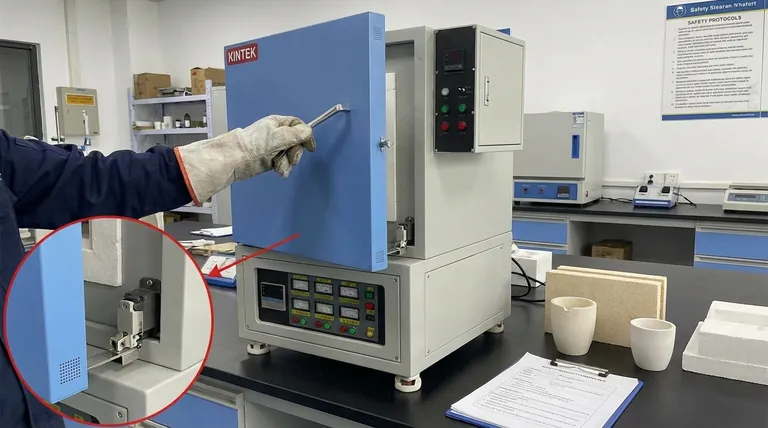
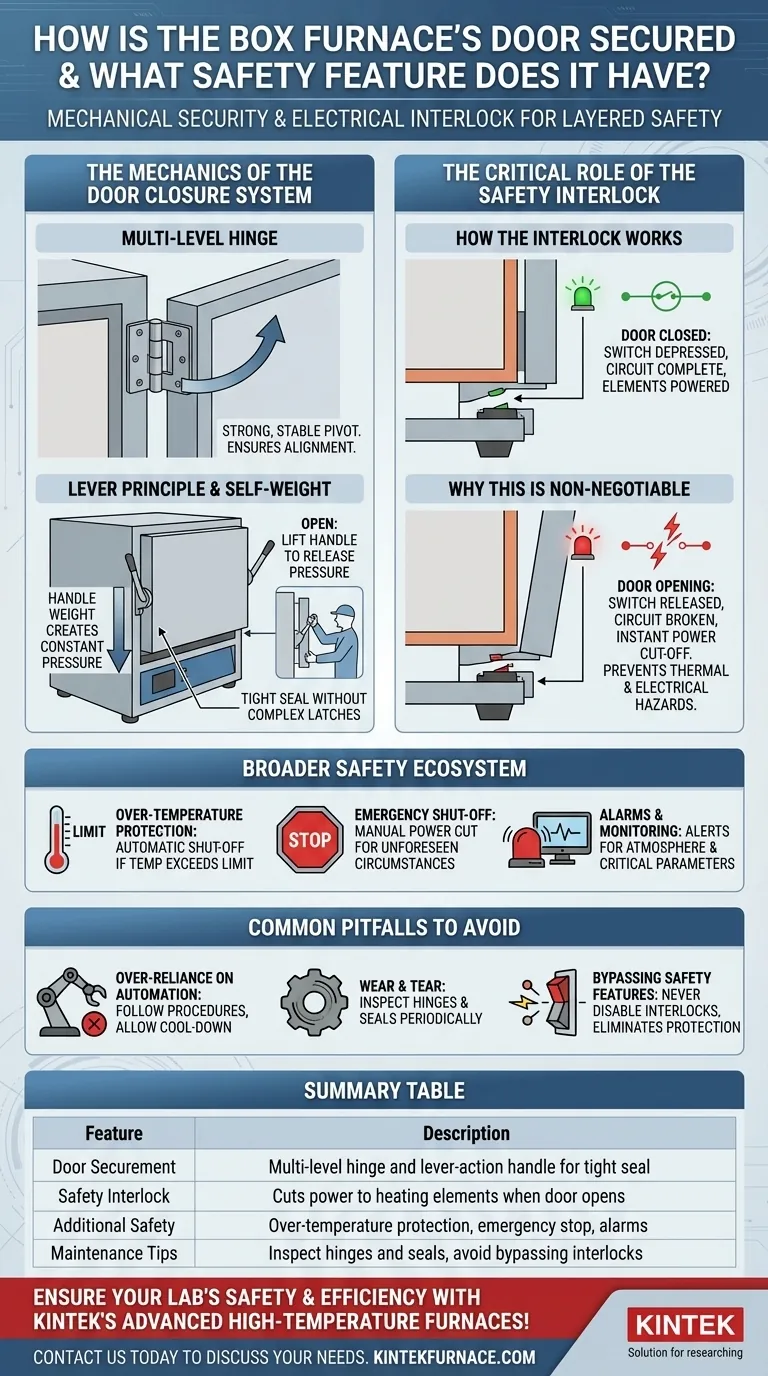
A box furnace door is secured through a simple and robust mechanical system that combines a multi-level hinge with a lever-action handle. The door closes tightly using the handle's own weight, creating a secure seal. Critically, it includes a safety interlock switch that immediately cuts power to the heating elements the moment the door is opened, preventing operator exposure to thermal and electrical hazards.
The furnace's design philosophy is one of layered safety. It pairs a reliable physical door closure with an automatic electrical cutoff, ensuring that the primary hazard—energized heating elements—is neutralized before an operator can access the chamber.
The Mechanics of the Door Closure System
Understanding the door's mechanical design reveals its inherent reliability. The system is designed for simplicity and consistent performance without complex, failure-prone latches.
The Multi-Level Hinge
The door is mounted to the furnace body using a multi-level hinge. This provides a strong, stable pivot point that ensures the door swings away smoothly and aligns correctly when being closed.
The Lever Principle and Self-Weight
Closure is not achieved by a traditional latch but by the clever use of physics. The handle is designed so that its own weight, acting through a lever, pulls the door firmly against the furnace face. This creates a constant, secure pressure for a tight seal.
Opening the Door
To open the door, an operator simply lifts the handle lock upward. This action overcomes the handle's self-weight, releasing the pressure. On some models, a secondary rubber hook may also need to be unlatched before the door can be swung open to the side.
The Critical Role of the Safety Interlock
While the mechanical closure contains heat, the electrical interlock is the most critical active safety feature of the door system.
How the Interlock Works
Located at the lower end of the furnace opening, the safety interlock is a small switch. When the door is closed, it physically depresses this switch, completing the electrical circuit and allowing the heating elements to receive power.
The instant the door begins to open, the switch is released. This immediately breaks the circuit, cutting off all power to the heating elements.
Why This is a Non-Negotiable Feature
This design acts as a fundamental failsafe. It makes it physically impossible for an operator to open the door and be exposed to electrically live heating coils. It protects against severe burns and electrical shock, forming the cornerstone of the furnace's operational safety.
Understanding the Broader Safety Ecosystem
The door interlock does not work in isolation. It is part of a larger system of controls and failsafes designed to protect the operator, the equipment, and the materials inside.
Over-Temperature Protection
This is a secondary temperature controller that monitors the furnace independently. If the primary controller fails and the temperature rises beyond a safe limit, this system will shut off the furnace, preventing a catastrophic meltdown.
Emergency Shut-Off Controls
Virtually all modern furnaces are equipped with a large, conspicuous emergency stop button. This allows an operator to manually cut all power to the unit in any unforeseen circumstance that the automated systems do not detect.
Alarms and Monitoring
Modern program-controlled furnaces often include systems that monitor critical parameters like internal atmosphere (e.g., oxygen content) in addition to temperature. If any parameter deviates from the setpoint, an audible or visual alarm will alert the operator to the problem.
Common Pitfalls to Avoid
Trusting the equipment requires understanding its limitations and the operator's role in maintaining safety.
Over-Reliance on Automation
While the interlock is effective, it should not replace proper procedure. Operators should always ensure a heating program is complete and allow for a cool-down period before opening the door to avoid thermal shock to the sample and unnecessary heat exposure.
Wear and Tear on Mechanical Parts
The hinge, handle, and door seal are all mechanical components subject to wear. They should be inspected periodically to ensure the door continues to align and seal properly. A compromised seal leads to heat loss and energy inefficiency.
Bypassing Safety Features
Under no circumstances should the door interlock or any other safety feature be disabled or bypassed. Doing so eliminates the core protection built into the furnace and creates an extremely hazardous operating condition.
Making the Right Choice for Your Goal
By understanding these integrated systems, you can ensure safe, reliable, and effective use of the box furnace.
- If your primary focus is operator safety: Always verify the function of the door interlock and know the location of the emergency shut-off before beginning any operation.
- If your primary focus is equipment longevity: Routinely inspect the door's hinge and seal for wear and ensure the over-temperature protection is set correctly to prevent accidental damage.
- If your primary focus is process integrity: Rely on the full suite of monitoring systems and alarms, not just the door, to confirm the internal environment remains stable throughout your process.
A deep understanding of these integrated mechanical and electrical safety systems empowers you to operate the equipment with both confidence and security.
Summary Table:
| Feature | Description |
|---|---|
| Door Securement | Multi-level hinge and lever-action handle for tight seal |
| Safety Interlock | Cuts power to heating elements when door opens |
| Additional Safety | Over-temperature protection, emergency stop, alarms |
| Maintenance Tips | Inspect hinges and seals, avoid bypassing interlocks |
Ensure your lab's safety and efficiency with KINTEK's advanced high-temperature furnaces! Leveraging exceptional R&D and in-house manufacturing, we provide diverse laboratories with reliable solutions like Box, Muffle, Tube, Rotary, Vacuum & Atmosphere Furnaces, and CVD/PECVD Systems. Our strong deep customization capability precisely meets your unique experimental needs. Contact us today to discuss how our furnaces can enhance your operations and protect your team!
Visual Guide
Related Products
- Vacuum Hot Press Furnace Machine Heated Vacuum Press Tube Furnace
- Mesh Belt Controlled Atmosphere Furnace Inert Nitrogen Atmosphere Furnace
- Vacuum Heat Treat Sintering Furnace with Pressure for Vacuum Sintering
- 600T Vacuum Induction Hot Press Vacuum Heat Treat and Sintering Furnace
- Vacuum Hot Press Furnace Machine Heated Vacuum Press
People Also Ask
- Why use Vacuum Hot Press (VHP) for ZnS Ceramics? Achieve Superior IR Transparency and Mechanical Strength
- What are the benefits of the vacuum environment system in a vacuum hot press furnace? Unlock High-Density Sintering
- What safety features are incorporated in vacuum hot press furnaces? Ensure Operator and Equipment Protection
- How have vacuum hot press furnaces transformed material processing? Achieve Superior Density and Purity
- Why is a high vacuum environment crucial when preparing copper-carbon nanotube composites in a vacuum hot press furnace? Achieve Superior Composite Integrity



















