
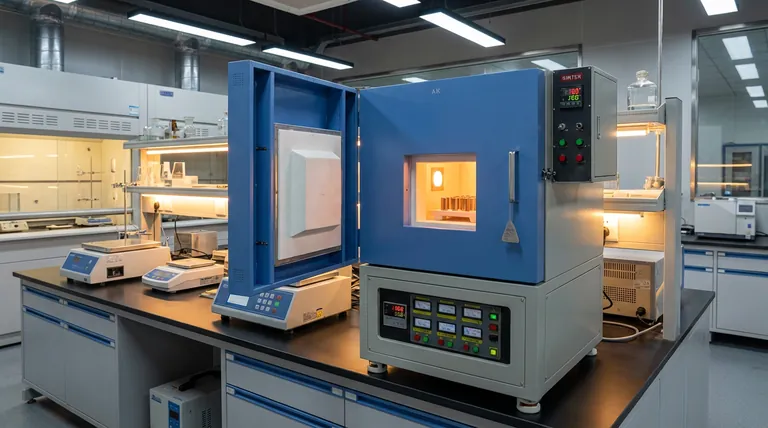
A high-temperature laboratory muffle furnace ensures the quality of the oxide film on Ti-6Al-4V ELI alloy by establishing a uniform thermal environment and a stable oxidation atmosphere. This equipment precisely controls heating power and dwell times to facilitate steady oxygen adsorption, while employing a slow cooling method to mitigate thermal stress and prevent the protective layer from peeling.
Core Insight: The integrity of the oxide film is determined as much by how the material cools as how it heats. While high temperatures drive the chemical reaction, the muffle furnace’s ability to execute a controlled, slow cooling process is the deciding factor in preventing structural failure and ensuring adhesion.
The Mechanics of Film Formation
Creating a high-quality TiO2 (titanium dioxide) layer requires more than just heat; it requires an environment that strictly governs the kinetics of oxidation.
Uniform Thermal Environment
The muffle furnace provides a consistent thermal profile across the entire sample. This uniformity is critical for ensuring that oxygen atoms are stably adsorbed onto the surface of the Ti-6Al-4V ELI alloy.
Without this thermal consistency, the chemical reaction rates would vary across the substrate, leading to uneven film thickness and potential weak points in the protective layer.
Controlled Diffusion and Dwell Time
The furnace maintains precise heating power over extended periods, often requiring dwell times as long as 50 hours.
This sustained exposure allows oxygen to diffuse deeply into the substrate. The result is a robust oxide film grown in situ, rather than a superficial coating that sits on top of the material.
Influence of Temperature on Kinetics
Systematic studies using temperatures such as 848 K, 898 K, and 948 K demonstrate that temperature directly influences film morphology.
Higher oxidation temperatures within the furnace accelerate oxygen diffusion and chemical reaction rates. This leads to thicker, more uniform oxide layers with improved coverage, offering superior protection against wear.
Critical Phase: Stress Management
The most sophisticated function of the muffle furnace in this process is its management of the post-oxidation phase.
Gradual Stress Release
The primary reference highlights that the furnace must employ a slow furnace cooling method after the dwell time concludes.
Rapid cooling would cause a thermal shock due to the differing expansion coefficients of the metal substrate and the oxide ceramic layer.
Preventing Structural Failure
By cooling the material slowly, the furnace allows thermal stress between the oxide film and the substrate to release gradually.
This prevents the catastrophic failures common in thermal processing, such as the protective layer cracking or peeling off.
Understanding the Trade-offs
While the muffle furnace enables high-quality oxidation, operators must balance process parameters to avoid common pitfalls.
Temperature vs. Grain Size
Increasing the furnace temperature generally improves uniformity and thickness, which enhances wear resistance.
However, higher temperatures also result in larger grain sizes within the oxide layer. Operators must balance the need for rapid kinetics with the microstructural requirements of the final application.
Process Duration vs. Throughput
The requirement for long dwell times (e.g., 50 hours) combined with slow cooling makes this a time-intensive batch process.
Attempting to rush the cooling phase to increase throughput will almost invariably compromise the adhesion of the film, rendering the treatment ineffective.
Making the Right Choice for Your Goal
To optimize the Thermal Oxidation of Ti-6Al-4V ELI, align your furnace settings with your specific performance metrics:
- If your primary focus is Film Adhesion: Prioritize the slow cooling ramp rate above all other parameters to ensure thermal stresses are fully dissipated before the sample reaches room temperature.
- If your primary focus is Wear Resistance: Utilize the higher end of the temperature range (approx. 948 K) to maximize film thickness and uniformity, ensuring a harder, more durable surface.
The muffle furnace is not just a heating element; it is a precision instrument for stress management that transforms a chemical reaction into a structural enhancement.
Summary Table:
| Key Process Factor | Influence on Oxide Film | Muffle Furnace Role |
|---|---|---|
| Thermal Uniformity | Ensures consistent film thickness & oxygen adsorption | Provides a stable, uniform heating environment |
| Dwell Time (up to 50h) | Facilitates deep oxygen diffusion for in situ growth | Maintains precise heating power for long durations |
| Temperature (848K-948K) | Controls oxidation kinetics and film morphology | Allows adjustable settings to balance thickness vs. grain size |
| Cooling Method | Prevents film peeling and thermal stress cracking | Executes slow, controlled furnace cooling |
Elevate Your Material Integrity with KINTEK Precision
Don't let thermal stress compromise your oxide film quality. Backed by expert R&D and world-class manufacturing, KINTEK provides high-performance Muffle, Tube, Rotary, Vacuum, and CVD systems designed to meet the rigorous demands of Ti-6Al-4V ELI processing.
Whether you need precise dwell time control or specialized slow-cooling programs, our lab high-temp furnaces are fully customizable to your unique research or production needs.
Ready to optimize your thermal oxidation process? Contact us today to speak with a specialist and discover how KINTEK's advanced heating solutions can deliver the durability and precision your laboratory requires.
References
- Krzysztof Aniołek, Jan Rak. Effect of Temperature on Thermal Oxidation Behavior of Ti-6Al-4V ELI Alloy. DOI: 10.3390/ma17164129
This article is also based on technical information from Kintek Furnace Knowledge Base .
Related Products
- 1800℃ High Temperature Muffle Oven Furnace for Laboratory
- 1700℃ High Temperature Muffle Oven Furnace for Laboratory
- 1200℃ Muffle Oven Furnace for Laboratory
- Laboratory Muffle Oven Furnace with Bottom Lifting
- 1400℃ Muffle Oven Furnace for Laboratory
People Also Ask
- How does a high-temperature laboratory muffle furnace affect material properties? Transform Anodic Oxide Films Fast
- What is the primary function of a high-temperature laboratory muffle furnace in chemical synthesis? Achieve Precision.
- What functions does a laboratory muffle furnace perform for AISI 1025 steel post-processing? Precision Thermal Control
- Why is a laboratory high-temperature muffle furnace used for BaTiO3? Achieve Optimal Tetragonal Crystalline Phases
- What role does a muffle furnace play in plant bark mineral analysis? Essential for Precise Dry Ashing & Trace Extraction



















