
At its core, a muffle furnace provides three primary advantages: it isolates the material being heated from contaminants produced by the fuel or heating element, it delivers exceptionally uniform temperature, and it can achieve very high temperatures safely. This combination makes it an indispensable tool for processes requiring a clean, controlled, and consistent thermal environment.
The true value of a muffle furnace isn't just its ability to get hot, but its function as a self-contained, contaminant-free chamber. This ensures that the results of your process—whether for analysis, materials testing, or heat treatment—are due to temperature alone, not chemical interference.
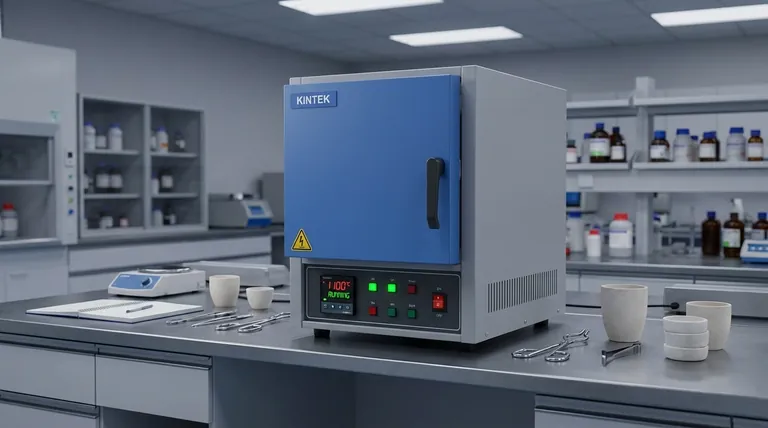
The Core Principles: Why a Muffle Furnace Excels
A muffle furnace's advantages stem directly from its fundamental design, which centers on control and isolation.
Contaminant-Free Heating
The defining feature is the "muffle"—a sealed inner chamber, often made of ceramic, that separates the workload from the heating elements and any combustion byproducts.
This isolation is critical for applications like ashing, where even trace contaminants could alter the chemical composition and skew analytical results.
Superior Temperature Uniformity
Heating elements are typically placed around the exterior of the muffle chamber. Heat is transferred to the sample via radiation and convection, not direct contact.
This indirect heating method ensures the entire chamber, and therefore the entire sample, reaches a highly uniform temperature. This prevents hot spots and guarantees consistent material processing.
High-Temperature Capability
Muffle furnaces are constructed with durable, heat-resistant materials and heavy insulation, allowing them to safely reach and maintain extreme temperatures, often up to 1800°C (3272°F).
Modern units feature programmable controllers for precise temperature ramps and soaks, enabling complex and repeatable thermal cycles.
Practical Advantages in Application
These design principles translate into tangible benefits across laboratory and industrial settings.
Versatility Across Materials and Processes
The controlled environment allows for the processing of a wide range of materials, including low-carbon steel, stainless steel, copper, ceramics, and composites.
They are used for diverse applications such as heat-treating, determining ash or moisture content, melting point analysis, and elemental analysis in the food, pharmaceutical, and environmental industries.
Operational Efficiency
Many modern muffle furnaces can reach their maximum temperature in approximately one hour, saving valuable time in laboratory and production workflows.
Their compact, insulated design also contributes to energy efficiency compared to less-contained heating methods.
Durability and Low Maintenance
Built with robust, corrosion-resistant materials, muffle furnaces are designed for long-term use in demanding environments.
The separation of the heating elements from the processing chamber protects them from corrosive fumes or sample spatter, reducing maintenance costs and extending their operational life.
Built-In Safety Features
Safety is a primary design consideration. Features often include circuit breakers for over-current protection, insulated outer walls that remain cool to the touch, and optional flap doors or adjustable air inlets to manage fumes safely.
Understanding the Trade-offs and Considerations
While powerful, a muffle furnace is not the universal solution for all heating applications. Understanding its limitations is key to proper selection.
Muffle Furnace vs. Tube Furnace
Compared to a tube furnace, a muffle furnace typically offers a larger internal capacity and a higher maximum temperature for a similar cost.
However, a tube furnace is superior for processes that require a continuous flow of a specific gas directly over a sample, as its cylindrical geometry is optimized for this task.
Atmosphere Control
While a muffle furnace can operate with different static atmospheres (e.g., air, nitrogen), achieving a perfect vacuum or managing complex, dynamic gas mixtures requires more specialized and expensive equipment.
The Need for Customization
A standard, off-the-shelf furnace may not meet the needs of highly specialized research or production. In these cases, a custom-built furnace may be necessary to meet exact dimensional, atmospheric, or temperature requirements, which can increase cost and lead time.
Choosing the Right Furnace for Your Application
Selecting the correct thermal processing tool depends entirely on your primary objective.
- If your primary focus is routine lab analysis (e.g., ashing, moisture content): Prioritize a furnace with excellent contaminant isolation and precise temperature control.
- If your primary focus is heat-treating metals or materials: Emphasize temperature uniformity and sufficient chamber capacity to ensure consistent results across the entire batch.
- If your primary focus is specialized materials research: Consider a customizable furnace that can meet high-temperature limits and potential atmosphere control requirements for your unique application.
By understanding its core design of clean, uniform heating, you can leverage the muffle furnace as a powerful tool for achieving precise and repeatable results.
Summary Table:
| Advantage | Description |
|---|---|
| Contaminant-Free Heating | Isolates materials from contaminants for accurate results in processes like ashing. |
| Superior Temperature Uniformity | Ensures even heating via radiation and convection, preventing hot spots. |
| High-Temperature Capability | Safely reaches up to 1800°C with programmable controls for complex cycles. |
| Versatility | Suitable for various materials and applications, including heat treatment and elemental analysis. |
| Operational Efficiency | Fast heat-up times and energy-efficient design save time and costs. |
| Durability and Low Maintenance | Robust construction and element protection extend lifespan and reduce upkeep. |
| Built-In Safety Features | Includes circuit breakers, cool outer walls, and fume management for safe operation. |
Ready to enhance your lab's precision and efficiency with a custom muffle furnace? At KINTEK, we leverage exceptional R&D and in-house manufacturing to provide advanced high-temperature furnace solutions tailored to your unique needs. Our product line includes Muffle, Tube, Rotary Furnaces, Vacuum & Atmosphere Furnaces, and CVD/PECVD Systems, all backed by strong deep customization capabilities. Whether you're in materials testing, pharmaceuticals, or environmental analysis, we can help you achieve contaminant-free, uniform heating for reliable results. Contact us today to discuss how our furnaces can meet your specific experimental requirements and boost your productivity!
Visual Guide

Related Products
- 1400℃ Muffle Oven Furnace for Laboratory
- 1700℃ High Temperature Muffle Oven Furnace for Laboratory
- 1800℃ High Temperature Muffle Oven Furnace for Laboratory
- 1200℃ Muffle Oven Furnace for Laboratory
- High Temperature Muffle Oven Furnace for Laboratory Debinding and Pre Sintering
People Also Ask
- How does a high-temperature laboratory muffle furnace affect material properties? Transform Anodic Oxide Films Fast
- What is the primary function of a high-temperature laboratory muffle furnace in chemical synthesis? Achieve Precision.
- What role does a muffle furnace play in refractory bricks? Enhance Performance and Durability Testing
- How does a laboratory high-temperature muffle furnace contribute to the final formation of Bismuth Oxide nanosheets?
- How is a laboratory high-temperature muffle furnace utilized in g-C3N4 synthesis? Optimize Your Thermal Polycondensation



















