
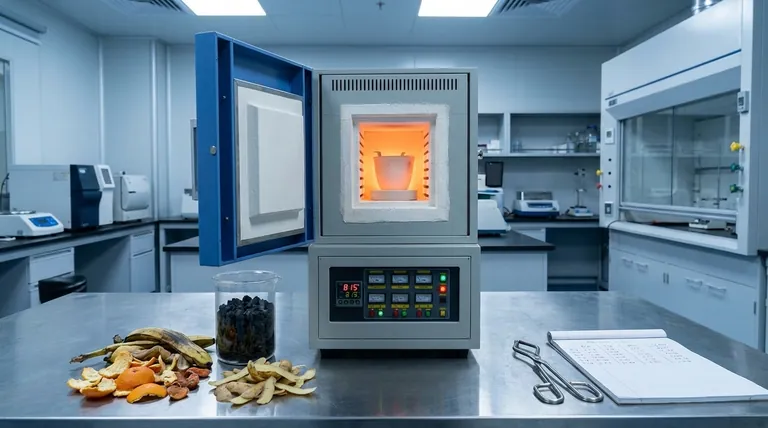
A laboratory muffle furnace serves two critical functions in biochar evaluation: it acts as an analytical tool for determining fuel quality through high-temperature ashing and as a production vessel for the carbonization and activation of raw biomass. Specifically, for fruit and vegetable waste, it provides the thermal stability required to measure inorganic residues or transform organic matter into a porous carbon framework.
Core Takeaway While often used solely for production, the muffle furnace is indispensable for predictive analysis of biochar fuel. It reveals the inorganic ash content that dictates whether a specific fruit or vegetable waste biochar will cause equipment failure (slagging and fouling) during combustion.
Analyzing Biochar Fuel Quality
The primary application of the muffle furnace in this context is quantitative analysis of the biochar's suitability as a fuel source.
Determination of Ash Content
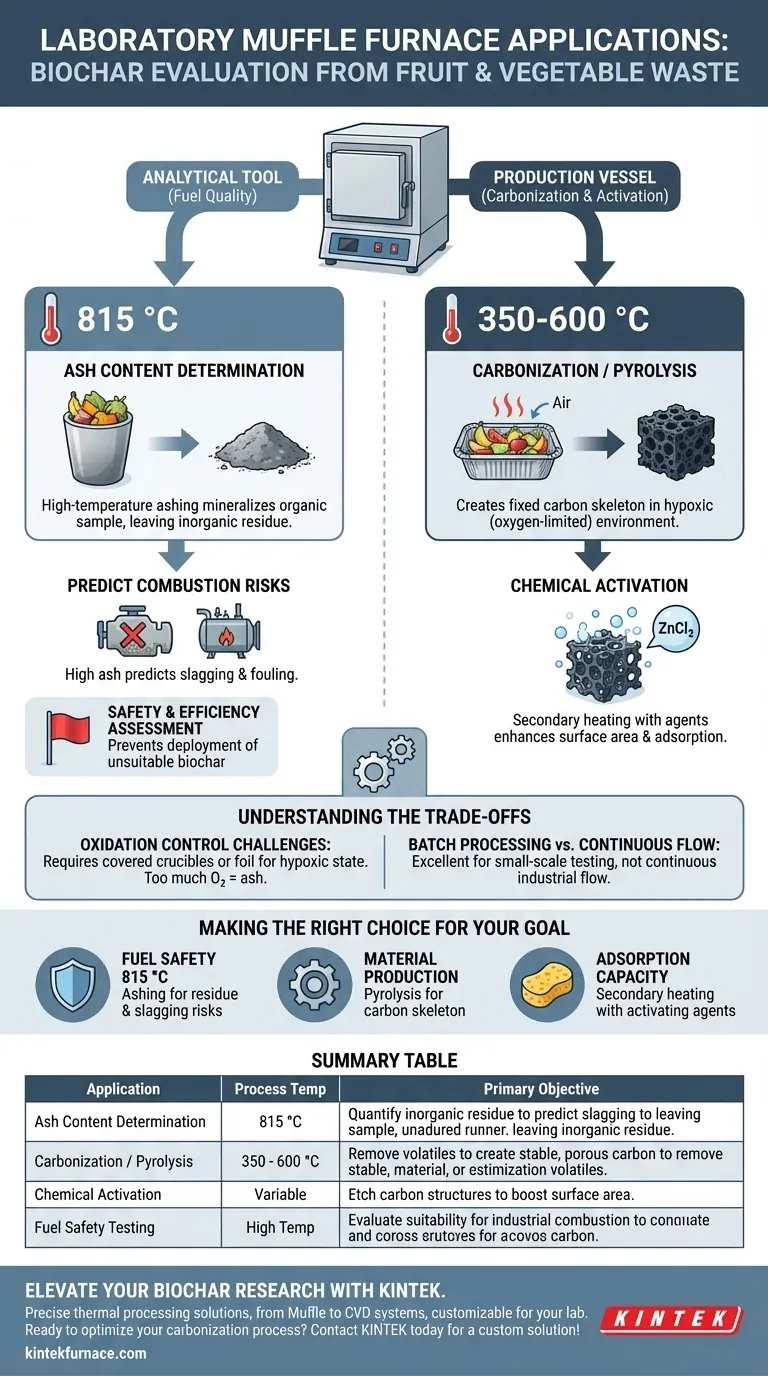
To evaluate the purity of biochar, the furnace is used to perform high-temperature ashing, typically at 815 °C. This extreme heat completely mineralizes the organic sample, leaving behind only the inorganic residue.
Predicting Combustion Risks
High ash content in biomass—common in agricultural residues like pea shells—is a critical red flag. By isolating this residue, you can predict the likelihood of slagging and fouling in combustion engines or boilers.
Safety and Efficiency Assessment
If the muffle furnace reveals a high percentage of inorganic residue, the biochar may be unsuitable for certain high-efficiency energy applications. This step prevents the deployment of biochar that could damage industrial equipment.
Facilitating Carbonization and Pyrolysis
Beyond analysis, the muffle furnace is used to physically create the biochar through controlled thermal decomposition.
Establishing the Carbon Skeleton
For vegetable waste (such as pulse-based biomass), the furnace provides a constant high-temperature environment (e.g., 600 °C) to remove volatile components. This process, known as pyrolysis, transforms the raw plant residue into a fixed carbon skeleton.
Creating a Hypoxic Environment
Unlike open combustion, this process requires oxygen-limited conditions to prevent the sample from burning away. Techniques such as compressing waste into aluminum foil boxes allow the muffle furnace to maintain the necessary hypoxic state for thermochemical conversion.
Chemical Activation and Modification
The furnace is also used for secondary thermal decomposition to enhance the biochar's properties. By heating the char with agents like zinc chloride, the furnace facilitates the etching of the carbon structure to significantly increase its specific surface area and adsorption capabilities.
Understanding the Trade-offs
While versatile, the muffle furnace has specific limitations compared to other laboratory equipment like tube furnaces.
Oxidation Control Challenges
Muffle furnaces generally contain ambient air, making it difficult to achieve a strictly anaerobic environment without using covered crucibles or foil packets. If the sample is exposed to too much oxygen during pyrolysis, it will turn to ash rather than biochar.
Batch Processing vs. Continuous Flow
These furnaces are typically designed for batch processing. This makes them excellent for small-scale evaluating and testing, but less suitable for simulating continuous industrial production flows.
Making the Right Choice for Your Goal
- If your primary focus is Fuel Safety: Prioritize high-temperature ashing at 815 °C to determine the inorganic residue and assess slagging risks.
- If your primary focus is Material Production: Use the furnace at 350–600 °C with oxygen-limiting containers to fix the carbon skeleton and remove volatiles.
- If your primary focus is Adsorption Capacity: Utilize a secondary heating stage with chemical activating agents to etch the pore structure and increase surface area.
The muffle furnace is not just a heater; it is a dual-purpose instrument that allows you to both manufacture the carbon framework and rigorously stress-test its chemical viability.
Summary Table:
| Application | Process Temperature | Primary Objective |
|---|---|---|
| Ash Content Determination | 815 °C | Quantify inorganic residue to predict slagging and fouling risks. |
| Carbonization / Pyrolysis | 350 - 600 °C | Remove volatiles to create a stable, porous carbon skeleton. |
| Chemical Activation | Variable | Etch carbon structures with agents (e.g., ZnCl2) to boost surface area. |
| Fuel Safety Testing | High Temp | Evaluate suitability for industrial combustion engines and boilers. |
Elevate Your Biochar Research with KINTEK
Precise thermal processing is the key to transforming agricultural waste into high-value biochar. Backed by expert R&D and manufacturing, KINTEK offers a comprehensive range of Muffle, Tube, Rotary, Vacuum, and CVD systems, all fully customizable to meet your specific laboratory requirements.
Whether you are performing high-temperature ashing to prevent equipment slagging or developing advanced porous carbons through chemical activation, our high-temp furnaces provide the uniform heating and durability you need.
Ready to optimize your carbonization process? Contact KINTEK today for a custom solution!
Visual Guide
References
- Andreja Škorjanc, Danijela Urbancl. Advancing Energy Recovery: Evaluating Torrefaction Temperature Effects on Food Waste Properties from Fruit and Vegetable Processing. DOI: 10.3390/pr13010208
This article is also based on technical information from Kintek Furnace Knowledge Base .
Related Products
- 1400℃ Muffle Oven Furnace for Laboratory
- 1200℃ Muffle Oven Furnace for Laboratory
- Laboratory Muffle Oven Furnace with Bottom Lifting
- High Temperature Muffle Oven Furnace for Laboratory Debinding and Pre Sintering
- 1800℃ High Temperature Muffle Oven Furnace for Laboratory
People Also Ask
- How does a high-temperature laboratory muffle furnace affect material properties? Transform Anodic Oxide Films Fast
- What is the primary function of a high-temperature laboratory muffle furnace in chemical synthesis? Achieve Precision.
- What is the role of a laboratory high-temperature muffle furnace in H13 steel treatment? Optimize Tool Performance
- What function does a muffle furnace perform in perovskite formation? Optimize Your Thermal Synthesis
- How does a muffle furnace facilitate Ag/ATP catalyst preparation? Optimize Calcination for Superior Performance














