
The primary benefits of a muffle furnace are its ability to deliver precise, uniform high temperatures within a completely isolated, contamination-free environment. This is achieved by separating the material being heated from the furnace's heating elements. This core design makes it an indispensable tool for sensitive scientific analysis, materials research, and quality control processes where purity and repeatability are critical.
The true value of a muffle furnace is not just its capacity for high heat, but its creation of a pristine and stable thermal environment. By separating the sample from the heating source, it guarantees process purity and consistent results that are often impossible with direct-heating methods.
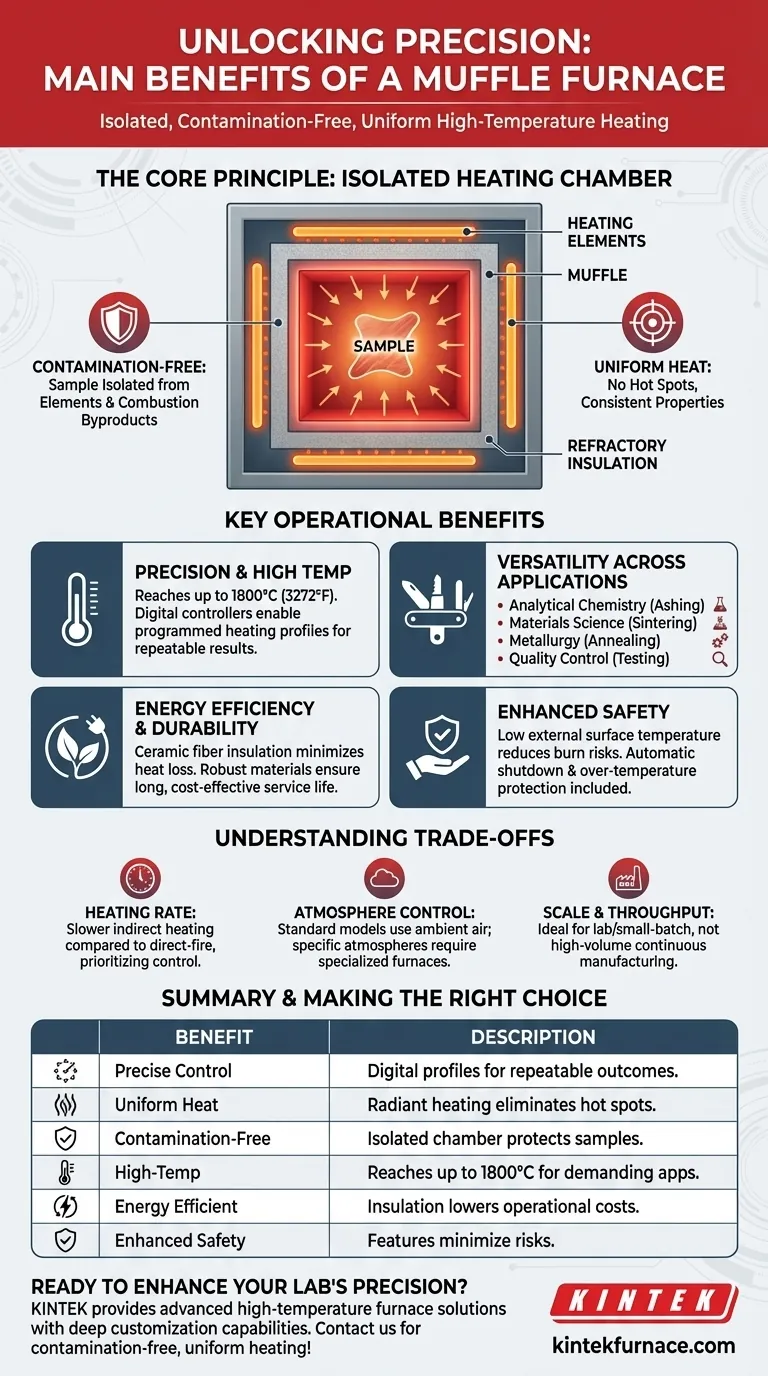
The Core Principle: Understanding the "Muffle"
The key benefits of a muffle furnace all stem from its fundamental design, which features an enclosed chamber—the "muffle"—that isolates the sample.
An Isolated Heating Chamber
A muffle furnace contains heating elements on the outside of a central chamber made from a high-temperature refractory material. The sample is placed inside this chamber.
This means the sample is never in direct contact with the heating elements or any byproducts of combustion, which is the source of its most significant advantages.
Achieving Contamination-Free Results
Because the sample is isolated, it is protected from any potential contaminants. This includes flakes from aging heating elements or, in fuel-fired versions, byproducts from combustion.
This purity is essential for analytical applications like ashing, where the goal is to determine the non-combustible content of a sample, or in materials science where even minor impurities can alter a substance's properties.
Ensuring Uniform Heat Distribution
The walls of the muffle heat up and then radiate thermal energy evenly from all directions onto the sample. This eliminates "hot spots" that can occur in direct-heat furnaces.
This temperature uniformity is crucial for processes like annealing metal or sintering ceramics, where consistent heating ensures the entire part achieves the desired structural properties without warping or defects.
Key Operational Benefits Explained
The isolated chamber design leads directly to several practical advantages in laboratory and industrial settings.
Precision and High-Temperature Capability
Modern muffle furnaces can reach temperatures as high as 1800°C (3272°F), depending on the model and materials.
They are equipped with sophisticated digital controllers that allow for precise temperature management, enabling users to program specific heating rates, dwell times, and cooling profiles for repeatable and accurate results.
Versatility Across Applications
The controlled, clean environment makes the muffle furnace highly versatile. Common uses include:
- Analytical Chemistry: Determining the ash content of food, plastics, or coal.
- Materials Science: Sintering ceramics, testing heat resistance, and developing new alloys.
- Metallurgy: Hardening, tempering, and annealing small steel parts.
- Quality Control: Testing component durability and coatings under extreme heat.
Energy Efficiency and Durability
High-quality ceramic fiber insulation minimizes heat loss, making muffle furnaces more energy-efficient than many conventional heating methods.
They are built with robust, heat-resistant materials, giving them a long service life with minimal maintenance, which contributes to their overall cost-effectiveness.
Enhanced Safety
The heavy insulation means the external surfaces of the furnace remain at a much lower temperature, reducing the risk of burns.
Standard safety features often include automatic shutdown when the door is opened and over-temperature protection to prevent damage to the furnace and its contents.
Understanding the Trade-offs
While highly effective, muffle furnaces are not the universal solution for every heating application. Understanding their limitations is key to using them correctly.
Heating Rate vs. Direct Heat
While some muffle furnaces can reach peak temperature in about an hour, the heating process is indirect. The chamber walls must heat up first before radiating energy to the sample.
In applications where extremely rapid heating is the only priority, a direct-fire furnace may be faster, though it sacrifices control and cleanliness.
Atmosphere Control
A standard muffle furnace operates in an ambient air atmosphere. While it prevents contamination from the heat source, it does not control for reactions with the air itself, such as oxidation.
For processes that require a specific atmosphere (like an inert gas such as argon or a vacuum), you must use a furnace specifically designed with gas-purging ports or a dedicated vacuum furnace.
Scale and Throughput
Muffle furnaces are typically designed for lab-scale work and small-batch production. Their size makes them impractical for high-volume, continuous manufacturing, where larger conveyor furnaces or tunnel kilns are more appropriate.
Making the Right Choice for Your Application
The decision to use a muffle furnace should be guided by your specific need for process purity, temperature uniformity, and scale.
- If your primary focus is analytical testing or quality control: The muffle furnace is essential for its contamination-free environment, ensuring accurate results in processes like gravimetric analysis or ashing.
- If your primary focus is materials research or heat treating: Its uniform heating is critical for achieving consistent material properties during annealing, hardening, or creating ceramics.
- If your primary focus is high-volume production: Evaluate if a batch-style muffle furnace meets your needs, or if a larger, continuous-process industrial furnace is the better investment.
- If your primary focus is processes requiring a specific atmosphere: Ensure the furnace model you choose has ports for gas exchange or consider a specialized retort or vacuum furnace instead.
Ultimately, a muffle furnace is the definitive tool when the integrity of your sample and the consistency of your thermal process are non-negotiable.
Summary Table:
| Benefit | Description |
|---|---|
| Precise Temperature Control | Digital controllers enable accurate heating rates and profiles for repeatable outcomes. |
| Uniform Heat Distribution | Radiant heating eliminates hot spots, ensuring consistent material properties. |
| Contamination-Free Environment | Isolated chamber protects samples from impurities, ideal for sensitive analyses. |
| High-Temperature Capability | Reaches up to 1800°C, suitable for demanding applications like sintering and ashing. |
| Energy Efficiency | Ceramic fiber insulation reduces heat loss, lowering operational costs. |
| Enhanced Safety | Features like automatic shutdown and over-temperature protection minimize risks. |
Ready to enhance your lab's precision and efficiency? Leveraging exceptional R&D and in-house manufacturing, KINTEK provides diverse laboratories with advanced high-temperature furnace solutions. Our product line, including Muffle, Tube, Rotary Furnaces, Vacuum & Atmosphere Furnaces, and CVD/PECVD Systems, is complemented by our strong deep customization capability to precisely meet unique experimental requirements. Contact us today to discuss how our tailored muffle furnaces can deliver contamination-free, uniform heating for your specific applications!
Visual Guide
Related Products
- 1400℃ Muffle Oven Furnace for Laboratory
- 1700℃ High Temperature Muffle Oven Furnace for Laboratory
- 1800℃ High Temperature Muffle Oven Furnace for Laboratory
- 1200℃ Muffle Oven Furnace for Laboratory
- High Temperature Muffle Oven Furnace for Laboratory Debinding and Pre Sintering
People Also Ask
- What is the primary function of a high-temperature laboratory muffle furnace in chemical synthesis? Achieve Precision.
- How does a high-temperature laboratory muffle furnace affect material properties? Transform Anodic Oxide Films Fast
- What is the muffle furnace function in ilmenite oxidative roasting? Enhance Phase Change & Magnetic Separation
- What are the primary objectives of using a muffle furnace in zirconia synthesis? Achieve precision phase control.
- How does a laboratory high-temperature muffle furnace facilitate the homogenization of borosilicate glass samples? Expert Insights



















