
A laboratory muffle furnace functions as a high-precision oxidation chamber designed to isolate the mineral content of plant material. It generates a stable, high-temperature environment—typically up to 600°C—to facilitate the complete combustion of organic matter. By burning away carbon components through a process called "dry ashing," the furnace leaves behind only the inorganic residue necessary for subsequent chemical analysis.
Core Takeaway The muffle furnace is the primary tool for "dry ashing," a purification process that removes the organic "noise" from a sample. By thermally decomposing plant matter into clean ash, it creates the essential baseline required to accurately measure total mineral content and trace elements.

The Mechanism of Plant Sample Analysis
Thermal Decomposition and Oxidation
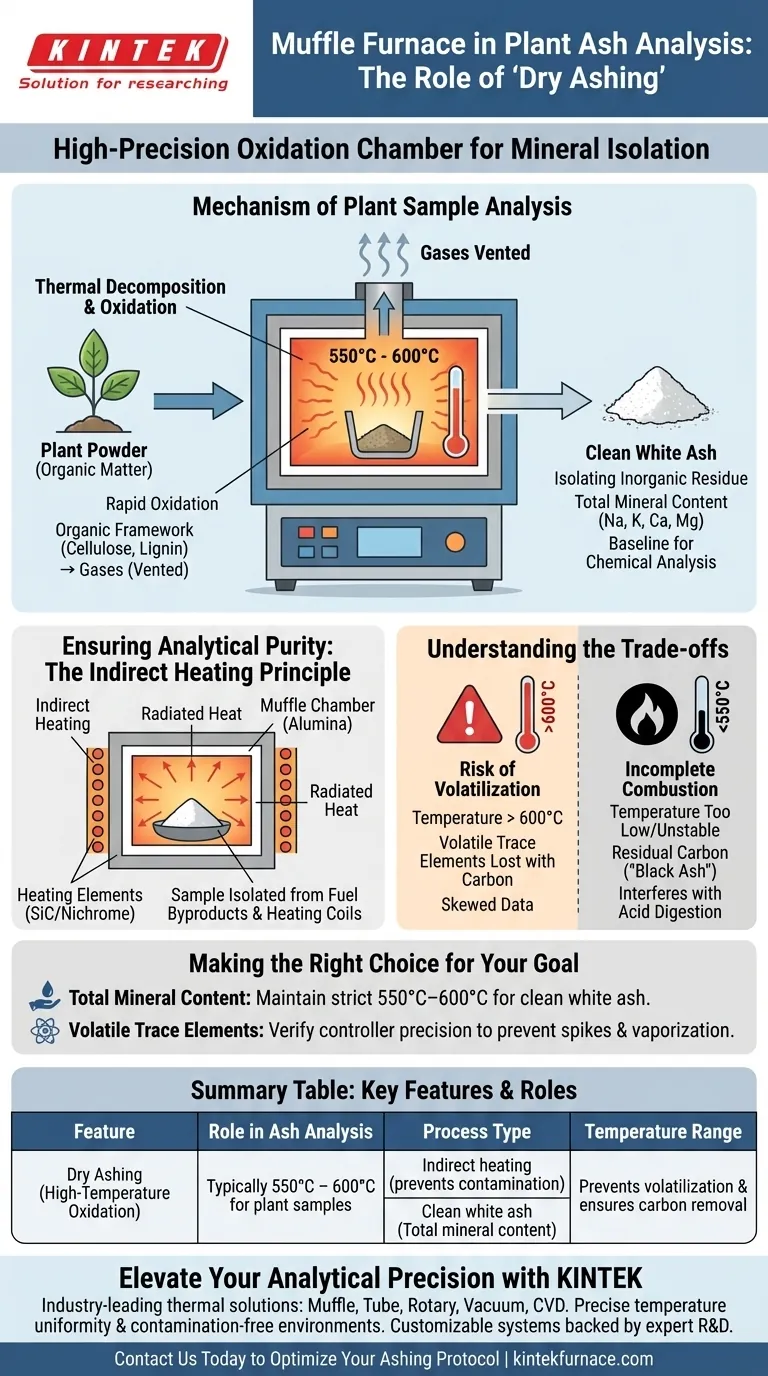
The primary role of the muffle furnace is to facilitate the complete thermal decomposition of plant powders.
When a sample is introduced to the furnace's environment (typically maintained between 550°C and 600°C), the intense heat triggers rapid oxidation.
This process converts the organic framework of the plant—cellulose, lignin, and proteins—into gases that are vented away, effectively removing the carbon matrix.
Isolating the Inorganic Residue
The ultimate output of this process is a substance known as clean white ash.
This ash represents the total inorganic mineral content of the plant sample.
Obtaining this residue is a non-negotiable prerequisite for further analytical steps, specifically the quantification of elements such as sodium, potassium, calcium, and magnesium.
Ensuring Analytical Purity
The Indirect Heating Principle
To ensure the ash analysis is accurate, the sample must never come into direct contact with the heating source.
Muffle furnaces utilize indirect heating, where electric heating elements (often silicon carbide or nichrome) are located outside the inner chamber (the muffle).
The muffle, typically made of high-temperature resistant alumina, absorbs this heat and radiates it evenly onto the sample.
Preventing Contamination
This isolation is the "muffle" in muffle furnace—it muffles or shields the sample from external impurities.
If a sample were exposed to fuel byproducts or direct contact with heating coils, the chemical composition of the ash could be altered.
By separating the combustion chamber from the heating source, the furnace guarantees that the resulting mineral data reflects only the plant sample, not the equipment.
Understanding the Trade-offs
The Risk of Volatilization
While high heat is necessary to remove organics, it presents a risk to certain volatile minerals.
If the furnace temperature exceeds the recommended 600°C threshold, specific trace elements may vaporize and be lost along with the carbon.
Strict adherence to temperature protocols is required to prevent data skewing.
Incomplete Combustion
Conversely, failing to maintain a sufficiently high or stable temperature results in "black ash."
This indicates the presence of residual carbon, which interferes with the subsequent acid digestion and chemical analysis.
The furnace's ability to maintain a constant temperature is just as critical as its maximum heat capability.
Making the Right Choice for Your Goal
To maximize the utility of a muffle furnace in your lab, align your parameters with your specific analytical targets:
- If your primary focus is Total Mineral Content: Ensure the furnace is capable of maintaining a strict 550°C–600°C range to yield clean white ash without black carbon residue.
- If your primary focus is Volatile Trace Elements: Verify the controller's precision to prevent temperature spikes that could cause element loss through vaporization.
The muffle furnace is not just a heater; it is the gatekeeper of purity that ensures your chemical quantification starts with a flawless, contaminant-free baseline.
Summary Table:
| Feature | Role in Ash Analysis |
|---|---|
| Process Type | Dry Ashing (High-Temperature Oxidation) |
| Temperature Range | Typically 550°C – 600°C for plant samples |
| Heating Method | Indirect heating to prevent sample contamination |
| Primary Output | Clean white ash (Total mineral content) |
| Critical Control | Prevents volatilization of trace elements & ensures complete carbon removal |
Elevate Your Analytical Precision with KINTEK
Don't let organic interference or temperature fluctuations compromise your research data. KINTEK provides industry-leading thermal solutions, including Muffle, Tube, Rotary, Vacuum, and CVD systems, all engineered for the rigorous demands of laboratory analysis. Our high-temp furnaces offer the precise temperature uniformity and contamination-free environments essential for perfect dry ashing and mineral quantification.
Backed by expert R&D and manufacturing, we specialize in customizable systems tailored to your unique lab requirements.
Contact Us Today to Optimize Your Ashing Protocol
Visual Guide
References
- Janet Mbaluka Kivuva, Sebastian Chakeredza. Nutritional profiles and phytochemicals of sausage tree (Kigelia Africana) and moringa (Moringa oleifera) at Africa University, Zimbabwe. DOI: 10.22271/27893065.2025.v5.i2a.131
This article is also based on technical information from Kintek Furnace Knowledge Base .
Related Products
- Laboratory Muffle Oven Furnace with Bottom Lifting
- 1400℃ Muffle Oven Furnace for Laboratory
- 1800℃ High Temperature Muffle Oven Furnace for Laboratory
- 1700℃ High Temperature Muffle Oven Furnace for Laboratory
- 1200℃ Muffle Oven Furnace for Laboratory
People Also Ask
- What is the importance of the calcination process? Master High-Purity Calcium Phosphate Nanopowder Production
- Why is a high-temperature muffle furnace required for FeOx-MOx/TiO2? Engineering High-Performance Nanocomposites
- Why is a high-temperature laboratory muffle furnace essential for the alkali fusion process in zeolite synthesis?
- What function does a muffle furnace perform in Ba0.75Ca0.25TiO3 calcination? Ensure Phase Purity & Synthesis
- What are the primary functions of a high-temperature laboratory muffle furnace in the preparation of biosorbent materials?



















