
A programmable muffle furnace improves thin film crystal structure by supplying precise thermal energy to facilitate atomic migration. By maintaining temperatures between 200°C and 300°C, the furnace drives the transition from a disordered amorphous state to a stable anatase phase. This controlled heating process increases grain size while minimizing internal thermal stress and eliminating structural defects.
The Core Insight The improvement in crystal structure is driven by controlled atomic rearrangement. While heat triggers the phase transition, the programmable precision of the furnace is what prevents thermal stress, ensuring the resulting film is dense, uniform, and free of significant defects.
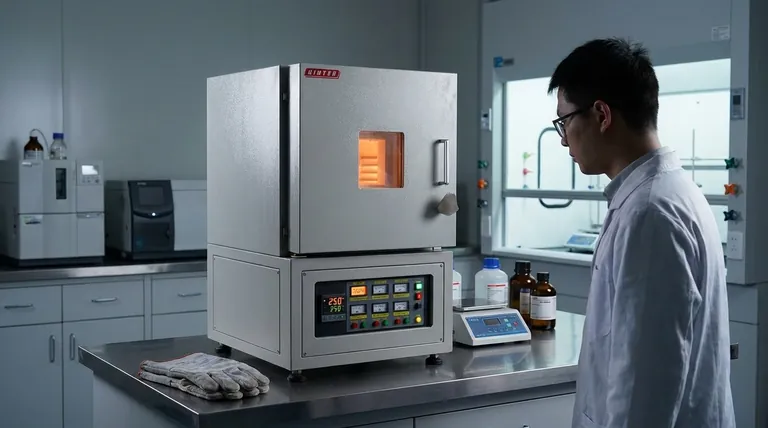
The Mechanics of Atomic Migration
To understand how the furnace improves structure, you must understand what happens to the atoms within the film.
Supplying Activation Energy
As-deposited thin films often lack sufficient energy to form an ordered structure. The muffle furnace provides the necessary thermal energy to break the initial static bonds.
Facilitating Rearrangement
Once energized, atoms gain the mobility required to migrate. They shift from a chaotic, random arrangement into an ordered, crystalline lattice.
The Amorphous-to-Anatase Transition
Specifically, this thermal treatment promotes a phase transition from an amorphous state to an anatase phase. This shift represents a fundamental move toward a more thermodynamically stable structure.
Enhancing Structural Integrity
Beyond simple phase changes, annealing in a muffle furnace actively repairs the material's microstructure.
Increasing Grain Size
As the phase transition occurs, the individual crystalline grains begin to grow. Larger grain size is a key indicator of improved crystallinity and generally leads to better electronic and optical properties.
Eliminating Defects
The atomic migration process fills vacancies and corrects lattice misalignments. This effectively eliminates structural defects that were introduced during the deposition process.
Densifying the Surface
The reduction of defects and the growth of grains result in a tighter packing of atoms. This creates a dense and uniform film surface, which is critical for the film's durability and performance.
The Role of Programmable Control
The "programmable" aspect of the furnace is not a luxury; it is a technical necessity for quality control.
Precise Temperature Cycling
Standard heating can be erratic, but a programmable furnace enforces a specific temperature cycle. This precision allows for the exact temperature maintenance required (e.g., between 200°C and 300°C) without dangerous fluctuations.
Minimizing Thermal Stress
Rapid heating or cooling can shock the thin film, causing cracks or delamination. Programmable control ensures gradual ramp rates, which minimizes internal thermal stress during the process.
Understanding the Trade-offs
While programmable muffle furnaces are highly effective, effective annealing requires balancing specific variables.
The Risk of Incorrect Programming
The precision of the tool relies entirely on the parameters set by the operator. If the ramp rate is too aggressive, the thermal stress reduction benefits are negated, potentially damaging the film.
Temperature Sensitivity
The primary benefit occurs within a specific window (200°C to 300°C for the anatase transition mentioned). Deviating outside this range can fail to trigger the phase transition (too low) or induce unwanted phase changes or material degradation (too high).
Making the Right Choice for Your Goal
To maximize the benefit of a programmable muffle furnace, align your process parameters with your specific structural requirements.
- If your primary focus is Phase Purity (Anatase): Ensure your soak time at the target temperature (200°C–300°C) is sufficient to complete the amorphous-to-crystalline transition.
- If your primary focus is Surface Uniformity: Prioritize a slow, controlled ramp-up and cool-down rate in your program to eliminate internal thermal stress.
Success depends on using the furnace's programmable features to balance sufficient thermal energy with gentle thermal cycling.
Summary Table:
| Improvement Factor | Impact on Thin Film | Annealing Mechanism |
|---|---|---|
| Atomic Mobility | Amorphous to Anatase shift | Supplies activation energy for rearrangement |
| Grain Growth | Larger grain size | Controlled heating promotes crystalline lattice expansion |
| Defect Reduction | Higher structural purity | Atomic migration fills vacancies and corrects lattice |
| Thermal Stress | Prevents cracks/delamination | Gradual programmable ramp rates ensure uniformity |
| Surface Quality | Denser, more durable films | Tight atomic packing via precise temperature maintenance |
Elevate Your Material Research with KINTEK
Precision is the difference between a flawed thin film and a high-performance crystalline structure. KINTEK’s advanced laboratory furnaces—including our customizable Muffle, Tube, and Vacuum systems—are engineered to provide the exact thermal control required for sensitive annealing processes.
Backed by expert R&D and manufacturing, our systems ensure your thin films achieve peak density and phase purity through superior programmable stability. Don't leave your results to chance.
Contact KINTEK Today for a Custom Solution
Visual Guide

References
- P. D. Meena, M. K. Jangid. Investigation of TiO_2 and TiO_2 /Zn Thin Films' Optical and Structural Studies for Optoelectronic Devices. DOI: 10.5109/7342437
This article is also based on technical information from Kintek Furnace Knowledge Base .
Related Products
- Laboratory Muffle Oven Furnace with Bottom Lifting
- 1400℃ Muffle Oven Furnace for Laboratory
- High Temperature Muffle Oven Furnace for Laboratory Debinding and Pre Sintering
- 1800℃ High Temperature Muffle Oven Furnace for Laboratory
- 1700℃ High Temperature Muffle Oven Furnace for Laboratory
People Also Ask
- Why is a high-temperature laboratory muffle furnace essential for the alkali fusion process in zeolite synthesis?
- What is the importance of the calcination process? Master High-Purity Calcium Phosphate Nanopowder Production
- Why is a high-temperature muffle furnace required for FeOx-MOx/TiO2? Engineering High-Performance Nanocomposites
- What function does a muffle furnace perform in Ba0.75Ca0.25TiO3 calcination? Ensure Phase Purity & Synthesis
- What are the primary functions of a high-temperature laboratory muffle furnace in the preparation of biosorbent materials?

















