
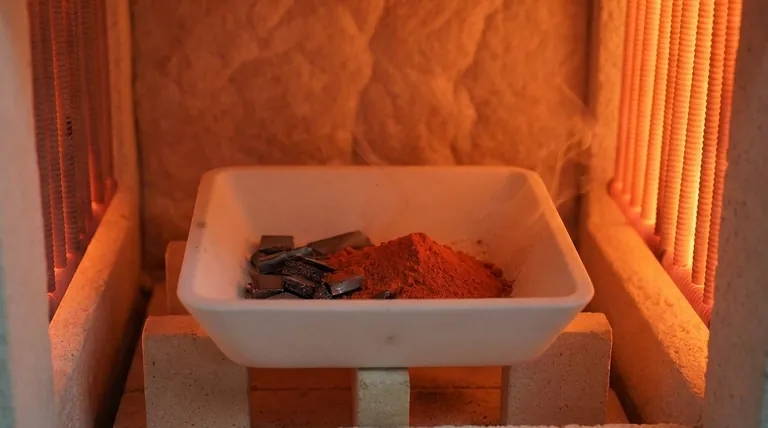
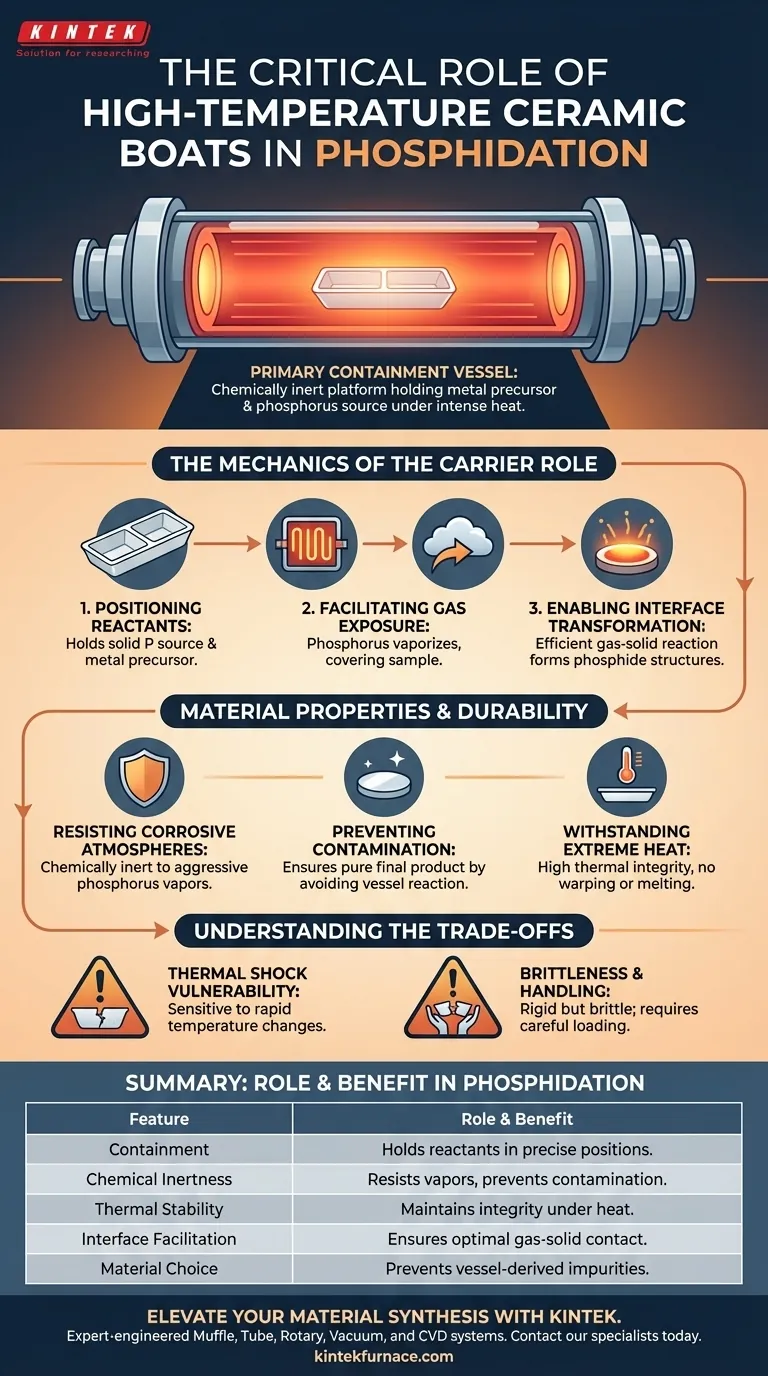
The high-temperature ceramic boat functions as the primary containment vessel for both the metal precursor and the phosphorus source during the phosphidation process. It serves as a chemically inert platform that holds these materials within the furnace, ensuring they remain stable while subjecting them to the intense thermal environment required for reaction.
The ceramic boat acts as a stable, non-reactive stage for chemical transformation. By withstanding corrosive phosphorus vapors and high heat, it allows for the precise, pure transformation of metal precursors without introducing contaminants from the vessel itself.
The Mechanics of the Carrier Role
Positioning the Reactants
In a laboratory furnace, the specific placement of materials is critical. The ceramic boat serves as a carrier, holding the solid phosphorus source and the metal precursor samples in fixed positions.
Facilitating Gas Exposure
As the furnace heats up, the phosphorus source vaporizes. The boat is designed to ensure that the released phosphorus gas covers the sample surfaces accurately.
Enabling Interface Transformation
This targeted exposure is what drives the reaction. The boat facilitates a heterogeneous interface transformation, allowing the gas to react efficiently with the solid metal to form the desired phosphide structures.
Material Properties and Durability
Resisting Corrosive Atmospheres
Phosphidation creates a highly aggressive chemical environment. The ceramic material provides chemical inertness, meaning it will not react with the corrosive phosphorus gas.
Preventing Contamination
If the boat were to react with the gas, it would degrade and release impurities into your sample. The inert nature of the ceramic ensures the final product remains pure.
Withstanding Extreme Heat
The process requires high temperatures to activate the reaction. The boat possesses high thermal stability, allowing it to maintain its structural integrity without warping or melting during the heating cycle.
Understanding the Trade-offs
Thermal Shock Vulnerability
While thermally stable, ceramics can be sensitive to rapid temperature changes. Heating or cooling the furnace too aggressively can cause the boat to crack due to thermal shock.
Brittleness and Handling
Ceramic boats are mechanically rigid but brittle. They require careful handling during loading and unloading, as physical impact can easily shatter the vessel, potentially ruining the experiment and contaminating the furnace tube.
Making the Right Choice for Your Experiment
To ensure the success of your phosphidation process, consider how you utilize the ceramic boat based on your specific experimental goals:
- If your primary focus is Sample Purity: Ensure the ceramic boat is thoroughly cleaned and inspect it for micro-cracks before use to prevent any cross-contamination or reaction with the vessel itself.
- If your primary focus is Reaction Efficiency: Place the phosphorus source and metal precursor within the boat at a distance that optimizes the flow of vapor over the sample surface.
By selecting the correct vessel, you ensure that the only chemistry happening in your furnace is the one you intended.
Summary Table:
| Feature | Role & Benefit in Phosphidation |
|---|---|
| Containment | Holds solid reactants (P source and metal) in precise positions. |
| Chemical Inertness | Resists corrosive phosphorus vapors to prevent sample contamination. |
| Thermal Stability | Maintains structural integrity under extreme heating cycles. |
| Interface Facilitation | Ensures optimal gas-solid contact for efficient surface reaction. |
| Material Choice | Essential for preventing vessel-derived impurities in the final product. |
Elevate Your Material Synthesis with KINTEK
Precision in phosphidation requires more than just high temperatures—it demands reliable, high-performance equipment. KINTEK provides expert-engineered solutions, including Muffle, Tube, Rotary, Vacuum, and CVD systems, all fully customizable to meet your specific laboratory requirements.
Backed by industry-leading R&D and manufacturing, our furnaces ensure the thermal stability and atmospheric control necessary for sensitive chemical transformations. Don't compromise on purity or efficiency. Contact our specialists today to find the perfect high-temperature furnace solution for your research.
Visual Guide
References
- Yu Gao, Xiaoteng Liu. In situ growth of three-dimensional walnut-like nanostructures of W-Ni2P@NiFe LDH/NF as efficient bifunctional electrocatalysts for water decomposition. DOI: 10.1007/s42114-024-01176-y
This article is also based on technical information from Kintek Furnace Knowledge Base .
Related Products
- 1700℃ High Temperature Laboratory Tube Furnace with Alumina Tube
- 1400℃ High Temperature Laboratory Tube Furnace with Alumina Tube
- High Temperature Muffle Oven Furnace for Laboratory Debinding and Pre Sintering
- Vertical Laboratory Quartz Tube Furnace Tubular Furnace
- 2200 ℃ Graphite Vacuum Heat Treat Furnace
People Also Ask
- How does zone-melting in tube furnaces synthesize bismuth micro-wires? Master Single-Crystal Thermoelectric Growth
- How are high-temp tube furnaces used to measure diffusion coefficients per Fick's law? Master Precision Annealing
- How are high-temperature laboratory tube furnaces applied in long-term vacuum homogenization heat treatments for intermetallic samples?
- How do high-temperature laboratory tube furnaces ensure environmental stability? Precision Thermal Reduction Tips
- How are high-temperature tube furnaces applied in testing ceramic-supported alloy membranes? Insights




