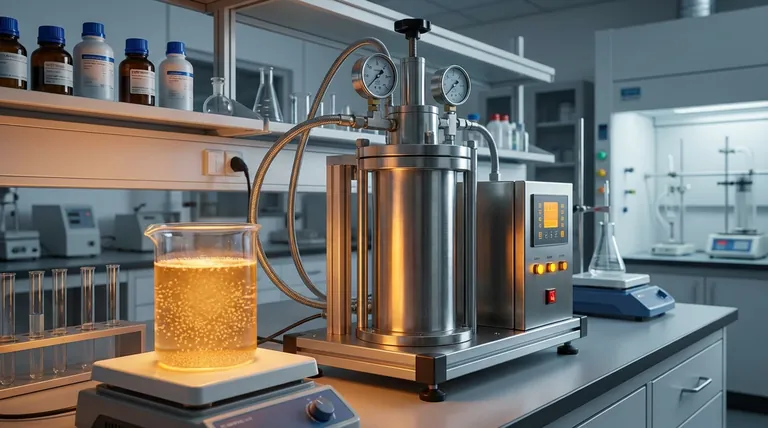
The high-pressure autoclave acts as the essential vessel for creating the subcritical environment needed to synthesize HE-MARIMO precursors. It serves as an airtight, stainless steel chamber that allows the reaction to reach temperatures between 200 and 300 °C without solvent loss. This specific environment alters solvent behavior to drive the precipitation and structural formation of the material.
The autoclave's primary function is to enforce a closed, high-pressure system that lowers solvent polarity. This chemical shift is the specific catalyst required to precipitate metal salts and engineer uniform, micron-scale spherical structures.
Creating Subcritical Conditions
The Necessity of a Closed System
The synthesis relies on solvothermal processing, which requires temperatures significantly higher than the solvent's standard boiling point.
The stainless steel autoclave provides a completely airtight seal. This prevents the solvent from escaping, allowing the internal pressure to build naturally as the temperature rises.
Achieving the Subcritical State
Inside the autoclave, the reaction mixture is subjected to temperatures ranging from 200 to 300 °C.
Because the vessel is sealed, these temperatures push the solvent into a subcritical state. This state is distinct from standard liquid or gas phases and allows for unique chemical behaviors that are impossible under ambient conditions.
Driving Chemical Transformations
Decreasing Solvent Polarity
The most critical chemical change induced by the autoclave is the decrease in solvent polarity.
Under subcritical high-pressure and high-temperature conditions, the solvent's ability to dissolve certain substances changes. This reduction in polarity is the trigger for the next stage of the synthesis.
Triggering Precipitation
As the solvent's polarity drops, dissolved polar additives and metal salts can no longer remain in solution.
Consequently, these components precipitate out of the liquid phase. This forced precipitation allows the chemical reaction between the additives and salts to occur efficiently.
Ensuring Structural Uniformity
Facilitating Emulsification
The high-pressure environment inside the autoclave plays a direct role in the physical morphology of the precursor.
The conditions facilitate emulsification, a process where liquids that usually don't mix form a dispersed system. This mechanism is vital for controlling the shape of the final product.
Forming Spherical Secondary Structures
The ultimate goal of using this equipment is to achieve specific structural geometry.
Through the emulsification process enabled by the autoclave, the material forms uniform micron-scale spherical secondary structures. The airtight nature of the vessel ensures these structures develop consistently without disruption from solvent evaporation.
Understanding the Operational Requirements
The Criticality of the Airtight Seal
The success of this synthesis is entirely dependent on the integrity of the autoclave's seal.
If the "airtight nature" is compromised, the solvent will escape at the 200–300 °C operating range. Losing solvent prevents the system from reaching the necessary pressure to lower polarity, resulting in a failed reaction or poor structural formation.
Making the Right Choice for Your Synthesis
To ensure successful HE-MARIMO precursor synthesis, you must focus on the specific variables the autoclave controls.
- If your primary focus is Chemical Composition: Ensure the autoclave can safely maintain temperatures above 200 °C to sufficiently lower solvent polarity for precipitation.
- If your primary focus is Morphology (Shape): Verify the vessel's pressure retention capabilities, as stable high pressure is required for the emulsification that creates uniform spheres.
The high-pressure autoclave is not just a container, but an active tool that manipulates solvent physics to engineer precise spherical microstructures.
Summary Table:
| Process Variable | Role in HE-MARIMO Synthesis | Impact on Material |
|---|---|---|
| Airtight Seal | Prevents solvent loss at 200-300 °C | Enables natural pressure build-up |
| Subcritical State | Lowers solvent polarity | Triggers precipitation of metal salts |
| High Pressure | Facilitates emulsification | Ensures uniform micron-scale spheres |
| Temperature Control | Maintains range (200-300 °C) | Drives the solvothermal chemical reaction |
Elevate Your Solvothermal Synthesis with KINTEK
Precise control over pressure and temperature is the foundation of High-Entropy Marimo innovation. KINTEK provides industry-leading high-pressure autoclaves designed to maintain the rigorous subcritical environments required for uniform precursor formation.
Backed by expert R&D and world-class manufacturing, we offer a comprehensive range of lab high-temp solutions, including Muffle, Tube, Rotary, Vacuum, and CVD systems—all fully customizable to meet your unique synthesis needs. Whether you are engineering complex morphologies or scaling up metal salt precipitation, our equipment ensures the airtight integrity your research demands.
Ready to achieve superior structural uniformity?
Contact KINTEK today to discuss your custom furnace or autoclave requirements!
References
- Ayano Taniguchi, Kazuya Kobiro. Low-temperature synthesis of porous high-entropy (CoCrFeMnNi)<sub>3</sub>O<sub>4</sub> spheres and their application to the reverse water–gas shift reaction as catalysts. DOI: 10.1039/d3dt04131j
This article is also based on technical information from Kintek Furnace Knowledge Base .
Related Products
- High Pressure Laboratory Vacuum Tube Furnace
- 9MPa Air Pressure Vacuum Heat Treat and Sintering Furnace
- Vacuum Hot Press Furnace Machine Heated Vacuum Press
- Vacuum Hot Press Furnace Machine Heated Vacuum Press Tube Furnace
- Vacuum Hot Press Furnace Machine for Lamination and Heating
People Also Ask
- What are the different types of tube furnaces available? Find the Perfect Fit for Your Lab's Needs
- What is the role of a vacuum tube furnace during the final thermal treatment stage of Fe3O4@CSAC catalysts?
- What are the main advantages of vacuum tube furnaces in the market? Achieve Purity and Precision in Material Processing
- What parameters must be controlled when calcining freeze-dried oxide precursors in a laboratory tube furnace? A Guide
- What role does a laboratory tube furnace play in geological and mineralogical research? Unlock Earth's Secrets with Precision