
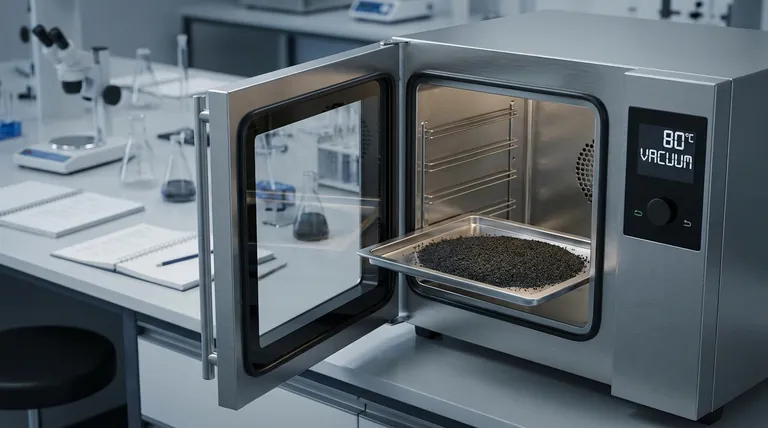
The primary purpose of using a vacuum oven during the synthesis of Fe-N-C precursors is to achieve the complete and controlled removal of organic solvents, such as methanol, at relatively low temperatures (typically around 80 °C). This critical step ensures the liquid solution containing ferrous chloride, 1,10-phenanthroline, and carbon black transforms into a uniform solid mixture, stabilizing the material before it undergoes high-temperature treatment.
Core Insight Vacuum drying serves as a stabilizing bridge between wet chemistry and high-temperature pyrolysis. By removing solvents gently under vacuum, you prevent the violent volatilization that occurs during rapid heating, thereby protecting the precursor's physical structure from collapsing and ensuring the active components remain evenly distributed.
Preserving Structural Integrity
The transition from a liquid solution to a solid precursor is the most vulnerable stage in synthesis. The vacuum oven addresses specific physical risks during this phase.
Preventing Structural Collapse
If residual solvents or moisture remain in the precursor during high-temperature pyrolysis, they volatilize rapidly.
This rapid expansion can cause the material's structure to collapse or burst. Vacuum drying removes these volatiles beforehand, ensuring the precursor enters the pyrolysis stage in a stable, dry state.
Ensuring Component Homogeneity
The synthesis relies on a precise mixture of ferrous chloride and 1,10-phenanthroline on a carbon black support.
Vacuum treatment facilitates the formation of a uniform solid mixture. It locks the components in place as the solvent evaporates, preventing the separation or segregation that leads to uneven catalytic sites in the final product.
Optimizing Chemical and Physical Properties
Beyond structural support, the vacuum environment influences the chemical quality of the precursor.
Mitigating Oxidation
Heating materials in standard air, even at low temperatures, introduces the risk of oxidation.
A vacuum environment effectively eliminates oxygen during the drying process. This preserves the chemical integrity of the precursor components, preventing premature degradation or unwanted reactions before the calcination step.
Preventing Agglomeration
Drying in a non-vacuum environment can often lead to the material caking or forming hard clumps.
Vacuum drying helps maintain the precursor powder in a loose, non-agglomerated state. A loose powder is essential for ensuring uniform heat distribution during the subsequent pyrolysis process, whereas large agglomerates can lead to inconsistent carbonization.
Understanding the Trade-offs
While vacuum drying is essential, it requires careful control of process parameters to be effective.
Temperature vs. Solvent Removal
The temperature (e.g., 80 °C) must be high enough to drive off the solvent but low enough to avoid reacting the precursors.
If the temperature is set too high, you risk altering the coordination between the iron and nitrogen sources before the solvent is fully removed.
Vacuum Depth and Efficiency
The efficiency of the process relies heavily on maintaining a consistent vacuum.
Insufficient vacuum levels may leave trace solvents deep within the carbon pores. These residuals can create significant internal pressure during pyrolysis, potentially damaging the microporous structure you are trying to create.
Making the Right Choice for Your Goal
- If your primary focus is maximizing active site density: Ensure the vacuum drying completely removes solvents to prevent component segregation, keeping the Fe and N atoms uniformly dispersed.
- If your primary focus is preserving pore architecture: prioritize a lower-temperature vacuum cycle to gently evacuate solvents from the carbon support without causing pore collapse or blockage.
Vacuum drying is not merely a drying step; it is a structural stabilization technique that defines the quality of the final catalyst.
Summary Table:
| Benefit | Impact on Fe-N-C Precursor |
|---|---|
| Structural Stability | Prevents pore collapse and bursting during high-temp pyrolysis. |
| Component Homogeneity | Ensures uniform distribution of iron and nitrogen on carbon black. |
| Oxidation Mitigation | Protects chemical integrity by eliminating oxygen during drying. |
| Agglomeration Control | Maintains a loose powder state for even heat distribution. |
| Solvent Removal | Safely extracts volatiles like methanol at low temperatures (80°C). |
Elevate Your Material Synthesis with KINTEK
Precise thermal processing is the difference between a high-performance catalyst and a failed synthesis. KINTEK provides industry-leading laboratory solutions—including Vacuum Ovens, Muffle, Tube, and CVD systems—engineered to meet the rigorous demands of Fe-N-C precursor development.
Backed by expert R&D and specialized manufacturing, our high-temperature furnaces are fully customizable to ensure your materials maintain structural integrity and chemical homogeneity. Don't compromise on your research results.
Contact KINTEK today to find your custom thermal solution
Visual Guide

References
- Han Zheng, Weimeng Si. Decorating Ti3C2 MXene Nanosheets with Fe-Nx-C Nanoparticles for Efficient Oxygen Reduction Reaction. DOI: 10.3390/inorganics13060188
This article is also based on technical information from Kintek Furnace Knowledge Base .
Related Products
- Vacuum Heat Treat Sintering and Brazing Furnace
- Vacuum Heat Treat Sintering Furnace Molybdenum Wire Vacuum Sintering Furnace
- Dental Porcelain Zirconia Sintering Ceramic Vacuum Press Furnace
- Vacuum Hot Press Furnace Machine for Lamination and Heating
- Vacuum Hot Press Furnace Machine Heated Vacuum Press
People Also Ask
- What are the benefits of using vacuum heat treating furnaces for metal alloys? Achieve Superior Metal Properties and Performance
- What is one of the most important uses of vacuum heat treating furnaces in aerospace? Achieve Superior Strength in Aircraft Alloys
- How does vacuum heat treating affect the grain structure of metal alloys? Achieve Precise Microstructure Control
- What is the temperature of a vacuum furnace brazing? Optimize Your Joint Strength and Cleanliness
- What are the steps involved in a typical vacuum brazing treatment? Master the Process for Strong, Clean Joints



















