
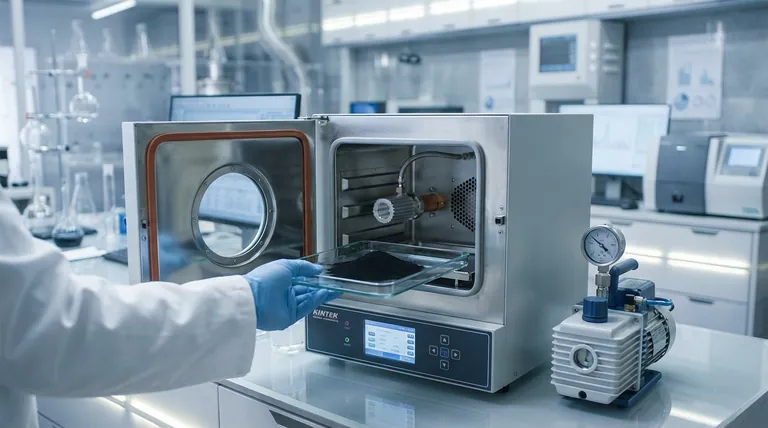
The primary advantage of using a laboratory vacuum drying oven over a standard oven is the ability to dry graphene-based composite powders rapidly at significantly lower temperatures by manipulating pressure rather than relying solely on heat.
This process eliminates air from the chamber, preventing the secondary oxidation of the material surface and ensuring the chemical stability of reduced graphene is maintained throughout the drying phase.
Core Takeaway Standard ovens rely on heat and air circulation, which can compromise the chemical and physical properties of sensitive nanomaterials. By contrast, vacuum drying lowers the boiling point of solvents, allowing for evaporation without thermal degradation or oxidation, effectively locking in the material’s intended microscopic structure.
Preserving Chemical Integrity
Preventing Secondary Oxidation
Graphene-based composites, particularly reduced graphene, are highly susceptible to reacting with oxygen.
Standard ovens expose materials to heated air, which often leads to secondary oxidation. Vacuum ovens operate in an oxygen-deprived environment, ensuring the chemical stability of the powder is preserved.
Low-Temperature Solvent Removal
In a vacuum environment, the boiling points of solvents like ethanol, methanol, or water are significantly reduced.
This allows these solvents to volatilize rapidly at mild temperatures (e.g., 60 °C). This prevents the thermal degradation that frequently occurs when sensitive nanomaterials are subjected to the high heat required by standard ovens.
Protecting Microscopic Structure
Maintaining Porosity and Active Sites
Graphene composites often rely on a specific internal pore structure for performance, especially in electrocatalytic applications.
Vacuum drying facilitates the rapid removal of trace liquids from within particle pores. This prevents pore closure or structural collapse, preserving the high specific surface area and active sites necessary for ion transport.
Preventing Hard Agglomeration
Drying at ambient pressure can cause particles to clump together due to capillary forces as the liquid evaporates slowly.
The negative pressure of a vacuum oven removes moisture quickly, preventing severe hard agglomeration. This ensures the MoS2/C or graphene powder maintains high dispersibility rather than fusing into unusable clusters.
Operational Advantages for Fine Powders
Eliminating Material Loss
Graphene nanoplatelets and composite powders are often ultra-lightweight.
Standard ovens typically utilize airflow or convection currents, which can blow fine powders away or cause secondary stacking. Vacuum ovens eliminate airflow interference, ensuring zero yield loss and preserving the original morphology of the filler.
Deep Moisture Extraction
Standard drying often fails to remove moisture trapped deep within porous agglomerates.
The vacuum environment creates a pressure differential that effectively pulls residual moisture and air bubbles out of the powder clusters. This ensures thorough drying and excellent quality stability for subsequent molding or processing steps.
Understanding the Trade-offs
While vacuum drying is chemically and physically superior for graphene, it does introduce specific operational constraints.
Batch Processing Limitations
Unlike some industrial conveyor ovens, vacuum drying is inherently a batch process. This effectively caps your throughput speed, making it potentially slower for large-scale production volumes despite the faster drying time per batch.
Equipment Complexity
Vacuum systems require pumps, seals, and pressure gauges that demand higher maintenance than standard thermal ovens. If the vacuum seal fails or the pump degrades, the drying consistency can be immediately compromised.
Making the Right Choice for Your Goal
To determine if the switch to vacuum drying is necessary for your specific application, consider your performance metrics:
- If your primary focus is Electrical Conductivity: You must use vacuum drying to prevent oxidation, which destroys the conductive network of reduced graphene.
- If your primary focus is Catalytic Performance: Vacuum drying is essential to prevent pore collapse and preserve the maximum number of active surface sites.
- If your primary focus is Material Yield: The vacuum environment is required to prevent ultra-fine, lightweight powders from being lost to convection currents.
By choosing vacuum drying, you are prioritizing the microscopic fidelity and chemical purity of your composite over the simplicity of standard thermal processing.
Summary Table:
| Feature | Standard Oven | Vacuum Drying Oven |
|---|---|---|
| Oxidation Risk | High (exposure to heated air) | Low (oxygen-deprived environment) |
| Drying Temp | High (standard boiling points) | Low (reduced pressure boiling points) |
| Material Loss | High (due to air convection) | Negligible (no airflow interference) |
| Structure | Potential pore collapse/clumping | Preserved porosity and high surface area |
| Moisture Removal | Surface-level drying | Deep extraction from porous clusters |
Protect Your Material Integrity with KINTEK
Don't let oxidation or structural collapse compromise your graphene-based research. At KINTEK, we understand that advanced nanomaterials require precision handling. Backed by expert R&D and manufacturing, we offer high-performance Vacuum Drying Ovens alongside our extensive range of Muffle, Tube, Rotary, and CVD systems—all fully customizable to meet your unique laboratory needs.
Ready to achieve superior chemical purity and material dispersibility?
Contact our specialists today to find your perfect thermal solution!
References
- Sivarajakrishnan Anandabaskaran, K. Krishnasamy. Photocatalytic and Antimicrobial Activities of WO3, NdWO3 and rGO/NdWO3 Nanoparticles for Environmental and Health Applications. DOI: 10.14233/ajchem.2025.33928
This article is also based on technical information from Kintek Furnace Knowledge Base .
Related Products
- 1200℃ Muffle Oven Furnace for Laboratory
- High Temperature Muffle Oven Furnace for Laboratory Debinding and Pre Sintering
- 1700℃ High Temperature Muffle Oven Furnace for Laboratory
- Laboratory Vacuum Tilt Rotary Tube Furnace Rotating Tube Furnace
- Vacuum Heat Treat Sintering and Brazing Furnace
People Also Ask
- What is the primary function of a high-temperature laboratory muffle furnace in chemical synthesis? Achieve Precision.
- How does a high-temperature laboratory muffle furnace affect material properties? Transform Anodic Oxide Films Fast
- How is a laboratory muffle furnace used in 3D-printed PP-CF cross-linking? Achieve Thermal Stability at 150 °C
- Why is a laboratory high-temperature muffle furnace used for BaTiO3? Achieve Optimal Tetragonal Crystalline Phases
- What is the role of a laboratory high-temperature muffle furnace in iron analysis? Key to Precise Sample Mineralization









