
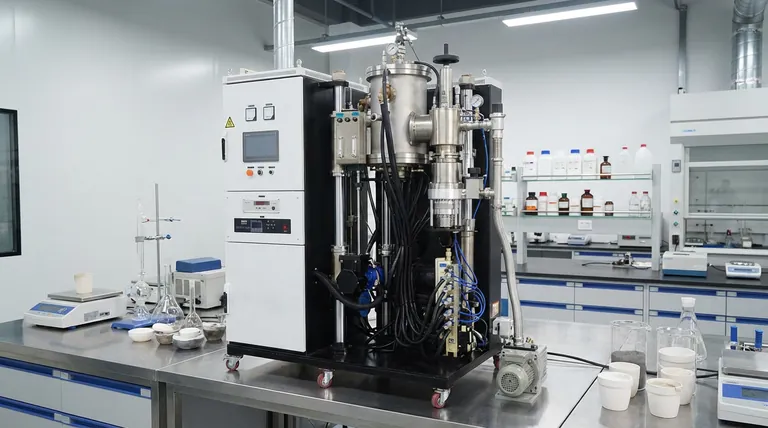
Laboratory vacuum drying ovens offer superior material control by creating a low-pressure environment that significantly reduces the boiling point of solvents. This allows ceramic powders to be dried thoroughly at much lower temperatures than conventional methods, effectively preventing thermal degradation, surface oxidation, and the formation of hard agglomerates that compromise subsequent forming and sintering stages.
The core advantage lies in decoupling heat from evaporation; by reducing pressure, you eliminate the need for high thermal energy to drive off moisture, thereby preserving the delicate microstructure and surface chemistry essential for high-performance ceramics.
Preservation of Chemical and Thermal Stability
Lowering Thermal Stress
Conventional drying relies on heat to evaporate solvents, which can degrade sensitive organic additives or the ceramic powder itself. Vacuum drying lowers the system pressure, allowing solvents like water or ethanol to boil off at significantly reduced temperatures (often 60°C – 80°C). This protects the material from heat-induced structural collapse or loss of functional groups.
Prevention of Surface Oxidation
Many high-performance ceramic powders are sensitive to oxygen, especially at elevated temperatures. Because the vacuum chamber evacuates air, it creates an oxygen-depleted environment. This eliminates the risk of surface oxidation during the drying process, ensuring the purity required for advanced applications.
Enhancement of Microstructure and Sintering
Prevention of Hard Agglomeration
In standard drying, the evaporation of liquid can create strong "liquid bridge" forces between particles, leading to hard clumps (agglomerates). Vacuum drying mitigates this by altering the evaporation dynamics. By preventing these hard agglomerates, the powder retains high surface activity, which facilitates better densification during the final sintering steps.
Deep Pore Solvent Removal
Ceramic powders often exist as porous clusters where moisture is trapped deep inside. Vacuum forces draw these trace solvents out from the interior of the agglomerates more effectively than heat alone. This prevents issues like air bubbles or structural defects appearing during the molding or pressing stages.
Eliminating the Capillary Effect
When drying at atmospheric pressure, rapid surface evaporation can draw active components (like metal salts) from the center of the material to the surface—a phenomenon known as the capillary effect. Vacuum drying accelerates solvent escape from deep pores, preventing this migration. This ensures a uniform distribution of active components throughout the dried precursor.
Operational and Physical Integrity
Elimination of Powder Loss
Conventional ovens often use air convection (fans) to distribute heat, which can blow away ultra-fine nanosized powders. Vacuum ovens operate without turbulent airflow. This maximizes yield and prevents the physical loss of valuable material caused by airflow disturbances.
Prevention of Cross-Contamination
Because the system is sealed and does not rely on circulating external air, there is no risk of airborne contaminants entering the drying chamber. This is critical for maintaining the strict purity standards required in laboratory research and high-tech ceramic production.
Understanding the Trade-offs
Batch Processing Limitations
While vacuum ovens offer superior quality, they are typically batch-process devices rather than continuous. This means that while the rate of drying per batch is faster due to the vacuum, the overall throughput volume may be lower compared to industrial continuous conveyor ovens used for lower-grade materials.
Equipment Complexity
Achieving and maintaining a stable vacuum requires a vacuum pump and high-integrity seals. This adds a layer of complexity and maintenance (such as oil changes or pump servicing) that is not present in simple convection ovens.
Making the Right Choice for Your Goal
To maximize the value of your equipment selection, align the drying method with your specific material requirements:
- If your primary focus is preventing oxidation: Choose a vacuum oven to exclude oxygen entirely, protecting sensitive non-oxide ceramics or metallic precursors.
- If your primary focus is microstructural uniformity: Rely on vacuum drying to prevent the "capillary effect" and component migration, ensuring active ingredients remain evenly distributed.
- If your primary focus is sintering density: Use vacuum drying to avoid hard agglomerates, preserving the powder's surface activity for better compaction and densification later.
The vacuum drying oven transforms drying from a blunt thermal process into a precise tool for microstructure engineering.
Summary Table:
| Feature | Vacuum Drying Oven | Conventional Drying Oven |
|---|---|---|
| Drying Temperature | Low (boiling point reduction) | High (requires thermal energy) |
| Oxidation Risk | Near Zero (oxygen-depleted) | High (exposure to air/heat) |
| Material Integrity | No hard agglomerates; preserves surface activity | Risk of hard clumps and degradation |
| Component Migration | Prevented (no capillary effect) | High (solutes move to surface) |
| Powder Loss | Zero (no turbulent airflow) | High (due to air convection) |
| Purity Control | High (sealed system) | Variable (circulating air risk) |
Elevate Your Ceramic Research with KINTEK Precision
Don't let thermal stress or contamination compromise your material performance. Backed by expert R&D and manufacturing, KINTEK offers specialized Muffle, Tube, Rotary, Vacuum, and CVD systems designed to preserve delicate microstructures and ensure maximum purity. Whether you are drying nanosized powders or processing high-performance non-oxide ceramics, our laboratory high-temp furnaces are fully customizable to meet your unique research needs.
Ready to optimize your drying process? Contact our technical experts today to find the perfect solution for your lab.
References
- Muthukumaran Ramasamy, Hamad A. Al‐Lohedan. Characterization on properties of Al7050/TiC/BN hybrid metal matrix composite. DOI: 10.1063/5.0204280
This article is also based on technical information from Kintek Furnace Knowledge Base .
Related Products
- 1200℃ Muffle Oven Furnace for Laboratory
- High Temperature Muffle Oven Furnace for Laboratory Debinding and Pre Sintering
- 1700℃ High Temperature Muffle Oven Furnace for Laboratory
- Laboratory Vacuum Tilt Rotary Tube Furnace Rotating Tube Furnace
- Vacuum Heat Treat Sintering and Brazing Furnace
People Also Ask
- What is the primary function of a high-temperature laboratory muffle furnace in chemical synthesis? Achieve Precision.
- How does a high-temperature laboratory muffle furnace affect material properties? Transform Anodic Oxide Films Fast
- How is a laboratory muffle furnace used in 3D-printed PP-CF cross-linking? Achieve Thermal Stability at 150 °C
- What is the role of a laboratory high-temperature muffle furnace in iron analysis? Key to Precise Sample Mineralization
- What is the critical role of a laboratory high-temperature muffle furnace in TiO2/LDH? Unlock Superior Crystallization









