
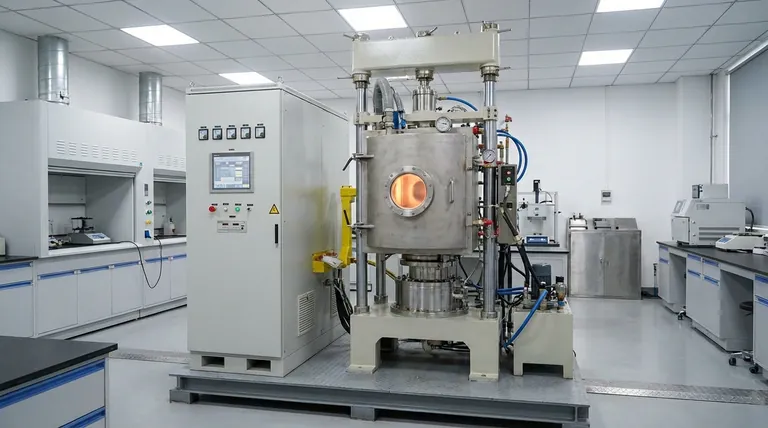
The vacuum distillation apparatus is the critical purification engine within the Kroll process, necessary to separate metallic zirconium from the chemical byproducts of its creation. Specifically, it removes residual magnesium and magnesium chloride from the reaction mass by exploiting their volatility under high-temperature and high-vacuum conditions.
Without this specific distillation step, the zirconium would remain trapped in a dense matrix of salts and unreacted reductants. The apparatus is responsible for converting this contaminated reaction product into the pure, porous "sponge" structure required for usable metal.
The Challenge: Post-Reduction Contamination
The Nature of the Reaction Mass
When the initial reduction reaction in the Kroll process is complete, the result is not pure metal. It is a dense reaction mass containing metallic zirconium mixed with significant amounts of residual magnesium and byproduct magnesium chloride.
Why Mechanical Separation Fails
You cannot simply wash or mechanically separate these byproducts effectively at this stage. The impurities are intimately mixed with the zirconium, requiring a separation method that operates at the molecular level without altering the zirconium itself.
How Vacuum Distillation Solves It
Utilizing Volatility Differences
The apparatus solves the contamination issue by applying high temperatures while maintaining a high-vacuum environment. Magnesium and magnesium chloride are far more volatile than zirconium.
The Sublimation Process
Under these specific conditions, the magnesium and magnesium chloride undergo sublimation. They transition directly from solid to gas and are drawn away from the mixture, while the zirconium—which has a much lower vapor pressure—remains behind.
Transformation into "Sponge"
This process does more than just clean the metal; it structures it. As the salts and magnesium vaporize and leave the dense reaction mass, they leave behind voids. This transforms the material into a sintered, porous structure known as zirconium sponge.
Understanding the Trade-offs and Risks
The Impact on Ductility
The primary trade-off in this process is time and energy versus material quality. If the distillation is rushed or the vacuum is insufficient, residual salts will remain trapped in the sponge. These residues severely negatively affect the ductility of the final metal, making it brittle and potentially unusable.
Downstream Consequences
While the primary reference focuses on ductility, it is worth noting that effective removal of volatiles is also critical for subsequent processing steps. High levels of retained volatiles can cause issues such as "splashing" during later melting stages, disrupting the homogeneity of the final ingot.
Making the Right Choice for Your Goal
To ensure high-quality zirconium production, you must view the vacuum distillation apparatus not just as a cleaning step, but as a structural conditioning step.
- If your primary focus is Material Ductility: Ensure the vacuum distillation cycle completely removes magnesium chloride salts, as their presence is the leading cause of embrittlement.
- If your primary focus is Processing Efficiency: Recognize that thorough vacuum distillation creates the necessary porous structure that facilitates easier melting and handling in subsequent fabrication steps.
The vacuum distillation apparatus is the bridge between a dirty chemical reaction and a high-performance engineering material.
Summary Table:
| Feature | Vacuum Distillation Role | Impact on Zirconium Quality |
|---|---|---|
| Impurity Removal | Eliminates Mg and MgCl₂ via sublimation | Prevents material embrittlement |
| Structural Change | Creates voids as volatiles escape | Forms the necessary porous "sponge" structure |
| Environment | High temperature + high vacuum | Ensures low vapor pressure metal remains intact |
| Final Property | Optimizes ductility and purity | Facilitates easier downstream melting and fabrication |
Elevate Your Zirconium Processing with KINTEK
Precision in the Kroll process demands uncompromising thermal and vacuum performance. KINTEK provides industry-leading Vacuum, CVD systems, and high-temperature lab furnaces designed to meet the rigorous standards of metallurgy and material science.
Whether you are refining zirconium sponge or developing advanced alloys, our expert R&D and manufacturing teams offer customizable systems tailored to your unique specifications. Ensure maximum ductility and purity in your production today.
Contact KINTEK for a Custom Solution
References
- М.М. Pylypenko, A.О. Drobyshevska. MAGNESIUM-THERMAL METHOD OF SPONGE ZIRCONIUM OBTAINING. DOI: 10.46813/2024-149-052
This article is also based on technical information from Kintek Furnace Knowledge Base .
Related Products
- Dental Porcelain Zirconia Sintering Ceramic Vacuum Press Furnace
- Magnesium Extraction and Purification Condensing Tube Furnace
- Chairside Dental Porcelain Zirconia Sintering Furnace with Transformer for Ceramic Restorations
- Molybdenum Vacuum Heat Treat Furnace
- Vacuum Heat Treat Sintering Furnace with Pressure for Vacuum Sintering
People Also Ask
- What factors determine the quality of sintered zirconia restorations? Master Material, Equipment, and Technique
- How do conventional vs rapid sintering in dental furnaces affect zirconia? Optimize Efficiency Without Sacrificing Strength
- What is the purpose of dental sintering furnaces? Transform Zirconia into Durable, High-Quality Dental Restorations
- What precautions should be taken when sintering zirconia in the Fast Slow Dental Sintering Furnace? Master Key Steps for Perfect Results
- What temperature range is used for sintering zirconia ceramics? Achieve Optimal Strength and Translucency






