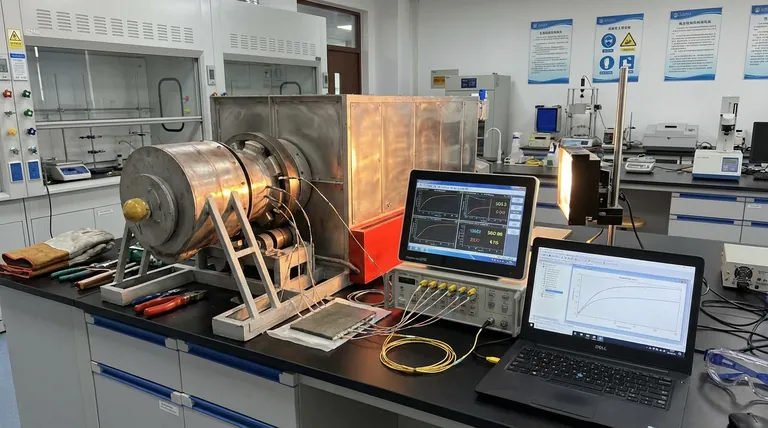
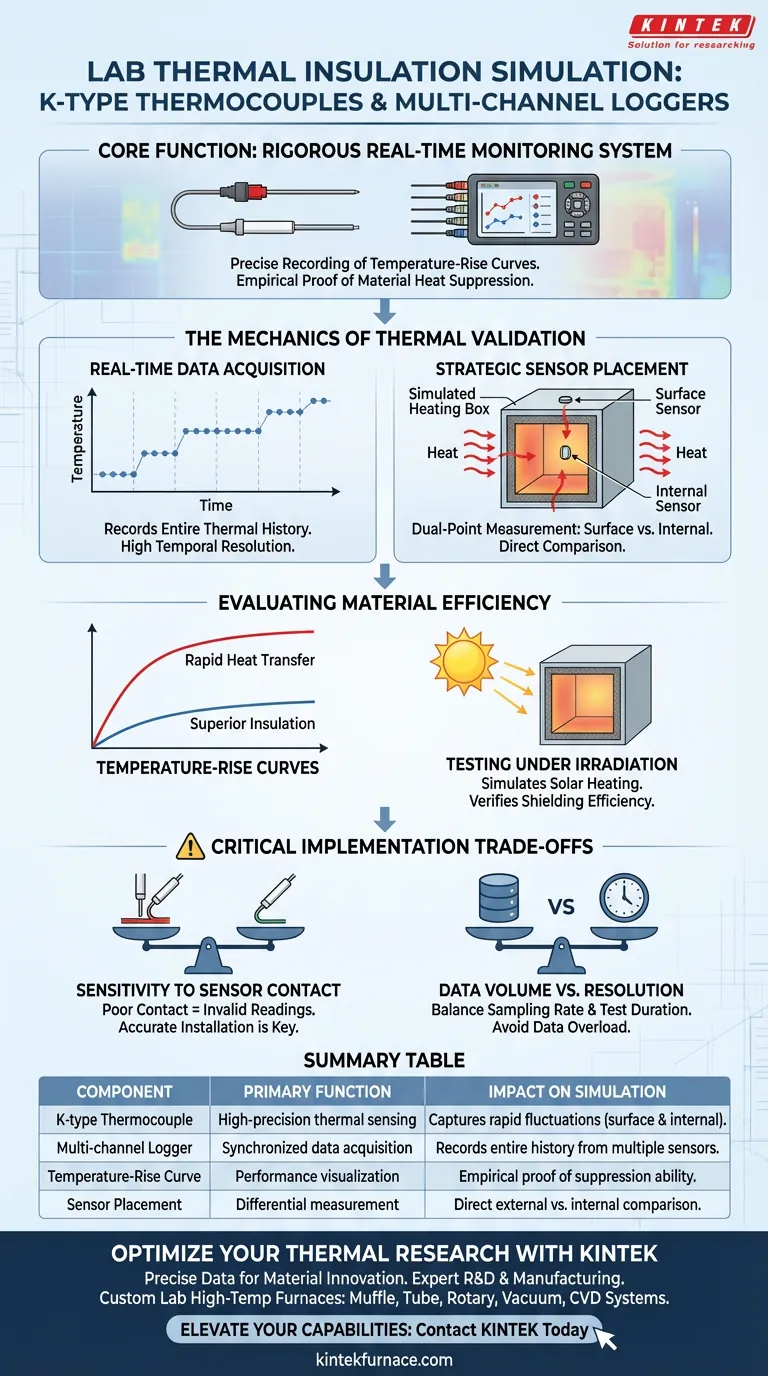
The primary function of K-type thermocouples and multi-channel loggers is to establish a rigorous, real-time thermal monitoring system. In laboratory settings, specifically when testing materials like GFPP composites, this setup records precise temperature-rise curves. By monitoring both the internal and surface temperatures of a simulated heating box, the system provides empirical proof of a material's ability to suppress heat buildup under intense light irradiation.
By capturing high-resolution data over time, this system transforms abstract material properties into visible performance metrics. It allows researchers to quantify exactly how effectively an insulation barrier prevents external heat from penetrating a protected volume.
The Mechanics of Thermal Validation
Real-Time Data Acquisition
The core value of combining K-type thermocouples with a multi-channel logger is the ability to track thermal changes as they happen.
Rather than relying on static measurements before and after a test, this system records the entire thermal history. This ensures that the rate of temperature change is captured with high temporal resolution.
Strategic Sensor Placement
To accurately evaluate insulation, data must be collected from multiple specific locations simultaneously.
The standard protocol involves positioning sensors both inside the simulated heating box and on the surface of the material. This dual-point measurement allows for a direct comparison between the heat source intensity and the internal environment.
Evaluating Material Efficiency
Visualizing Performance with Curves
The raw data collected by the logger is used to generate temperature-rise curves.
These curves are the definitive evidence of performance. A flatter curve for the internal sensor indicates superior insulation, while a steep curve suggests rapid heat transfer.
Testing Under Irradiation
This monitoring setup is specifically designed to validate materials under stress, such as intense light irradiation.
By subjecting the heating box to high-intensity light, the system simulates real-world solar heating. The logger then verifies the actual efficiency of the composite material in shielding the internal space from this external energy source.
Critical Implementation Trade-offs
Sensitivity to Sensor Contact
The accuracy of the temperature-rise curve is heavily dependent on the physical installation of the thermocouples.
If a surface sensor does not have perfect thermal contact with the composite, the logger will record air temperature rather than material temperature. This leads to understated surface heat readings and invalid efficiency calculations.
Data Volume vs. Resolution
While high temporal resolution is desired, it requires capable logging hardware to handle the data influx.
Users must balance the sampling rate with the duration of the test. Extremely high sampling rates over long irradiation periods can overwhelm storage or complicate data processing without adding significant value to the trend analysis.
How to Apply This to Your Project
If your primary focus is material validation: Ensure your sensors are placed to capture the differential between the exposed surface and the protected internal volume to prove suppression efficiency.
If your primary focus is detailed thermal analysis: Prioritize the temporal resolution of your multi-channel logger to capture minute fluctuations in the temperature-rise curve during the initial phases of irradiation.
The ultimate goal of this setup is to move beyond theoretical insulation values and provide a direct, data-driven demonstration of how a material performs under thermal stress.
Summary Table:
| Component | Primary Function | Impact on Simulation |
|---|---|---|
| K-type Thermocouple | High-precision thermal sensing | Captures rapid temperature fluctuations at surface and internal points. |
| Multi-channel Logger | Synchronized data acquisition | Records the entire thermal history from multiple sensors simultaneously. |
| Temperature-Rise Curve | Performance visualization | Provides empirical proof of a material's ability to suppress heat buildup. |
| Sensor Placement | Differential measurement | Allows direct comparison between external intensity and internal protection. |
Optimize Your Thermal Research with KINTEK
Precise data is the backbone of material innovation. Backed by expert R&D and manufacturing, KINTEK offers a comprehensive range of high-performance thermal solutions, including Muffle, Tube, Rotary, Vacuum, and CVD systems. Whether you are simulating intense solar irradiation or testing advanced GFPP composites, our lab high-temp furnaces are fully customizable to meet your unique research needs.
Ready to elevate your laboratory's thermal validation capabilities?
Contact KINTEK Today to Discuss Your Custom Project
Visual Guide
References
- Glass Fiber-Reinforced Polypropylene Composites with High Solar Reflectance for Thermal Insulation Applications. DOI: 10.3390/polym17030274
This article is also based on technical information from Kintek Furnace Knowledge Base .
Related Products
- Multi Heating Zones CVD Tube Furnace Machine for Chemical Vapor Deposition Equipment
- Multi Zone Laboratory Quartz Tube Furnace Tubular Furnace
- High Temperature Muffle Oven Furnace for Laboratory Debinding and Pre Sintering
- Vertical Laboratory Quartz Tube Furnace Tubular Furnace
- 1700℃ High Temperature Muffle Oven Furnace for Laboratory
People Also Ask
- What is the function of a multi-zone tube furnace in CVD synthesis? Master 2D In2Se3 Nanosheet Precision
- What temperature-related capabilities make multi zone tube furnaces valuable for research? Unlock Precision Thermal Control
- What environmental protection applications utilize multi zone tube furnaces? Unlock Precision in Waste Treatment and Green Tech
- What role do multi zone tube furnaces play in new energy research? Unlock Precise Thermal Control for Innovation
- Why are multi zone tube furnaces particularly useful for nanomaterial research? Unlock Precise Thermal Control for Advanced Synthesis