Accurate thermal monitoring in gas heating systems relies on the specific synergy between robust sensors and measurement isolation. K-type thermocouples are utilized for their ability to handle wide temperature ranges with a linear response, making them essential for tracking exhaust heat. High-temperature sealants complement these sensors by maintaining an airtight seal, preventing leaks that would distort pressure balance and corrupt heat loss data.
The combination of K-type thermocouples and high-temperature sealants ensures data integrity by pairing reliable high-heat sensing with an airtight environment, preventing external airflow from skewing critical exhaust and pressure measurements.
The Role of K-Type Thermocouples
Handling Extreme Conditions
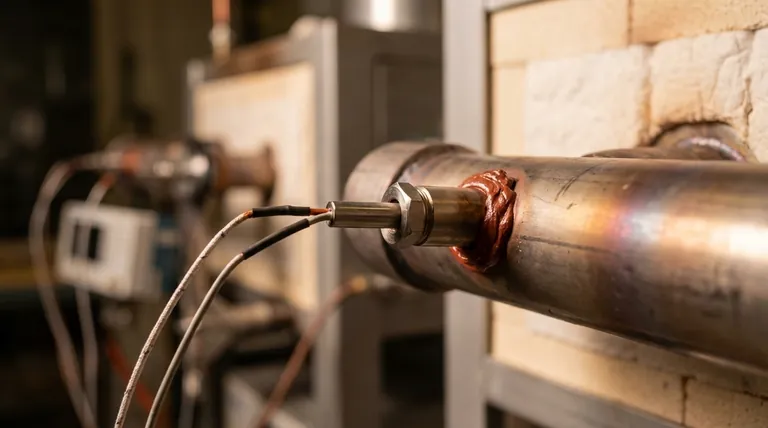
Gas heating systems generate significant heat, particularly in the exhaust outflow. K-type thermocouples are specifically selected because they possess a wide temperature range, allowing them to survive and operate effectively in these harsh environments.
Ensuring Data Consistency
Beyond mere survival, the quality of the signal matters. These thermocouples offer a linear response to temperature changes. This linearity ensures that the monitoring of exhaust temperatures remains consistent and predictable across the operating range of the system.
The Critical Function of High-Temperature Sealants
Maintaining System Integrity
When inserting a sensor into a gas system, you create a potential breach in the containment. High-temperature sealants are required to ensure these measurement points remain airtight.
Preventing Environmental Interference
The sealant acts as a barrier against air ingress or gas leaks. Without this barrier, the internal environment of the heating system would be exposed to the outside atmosphere, invalidating the test conditions.
Understanding the Risks of Improper Sealing
The Impact on Data Accuracy
The primary risk of a poor seal is the corruption of exhaust heat loss data. If outside air enters the system or exhaust gas escapes, the thermal readings will no longer reflect the true performance of the heating unit.
Compromised Pressure Dynamics
Gas heating systems rely on a delicate internal equilibrium. A leak at the measurement point can interfere with the system's pressure balance. This disruption creates unstable conditions that make it impossible to obtain a true assessment of the system's efficiency.
Ensuring Measurement Reliability
To achieve accurate results in gas heating analysis, you must prioritize both sensor selection and installation method.
- If your primary focus is thermal precision: Select K-type thermocouples to leverage their linear response and ability to withstand the wide temperature variance of exhaust gases.
- If your primary focus is data integrity: Apply high-temperature sealants to all measurement points to prevent air ingress from altering pressure balance and skewing heat loss calculations.
By securing the measurement point against leaks, you transform a simple sensor reading into actionable, high-fidelity engineering data.
Summary Table:
| Component | Primary Function | Key Advantage |
|---|---|---|
| K-Type Thermocouple | High-heat sensing & exhaust monitoring | Wide temperature range & linear response |
| High-Temp Sealant | Airtight isolation at measurement points | Prevents air ingress & gas leaks |
| System Synergy | Data integrity & pressure stability | Reliable heat loss data & consistent testing |
Optimize Your Thermal Process Integrity with KINTEK
Precise data starts with superior equipment. Backed by expert R&D and manufacturing, KINTEK offers a comprehensive range of high-performance Muffle, Tube, Rotary, Vacuum, and CVD systems, alongside specialized high-temperature lab furnaces. Whether you are conducting critical gas heating analysis or require a custom-built thermal solution, our systems are designed for the most demanding research and industrial needs.
Ready to elevate your lab's measurement accuracy? Contact us today to discover how KINTEK’s customizable high-temperature solutions can enhance your efficiency and data reliability.
Visual Guide

References
- Jianguo Lv, Yinke Dou. Numerical Simulation Study on the Performance of a New Gas Burner for Radiant Heating. DOI: 10.3390/fluids10090245
This article is also based on technical information from Kintek Furnace Knowledge Base .
Related Products
- Multi Heating Zones CVD Tube Furnace Machine for Chemical Vapor Deposition Equipment
- High Temperature Muffle Oven Furnace for Laboratory Debinding and Pre Sintering
- Multi Zone Laboratory Quartz Tube Furnace Tubular Furnace
- Vertical Laboratory Quartz Tube Furnace Tubular Furnace
- 1200℃ Muffle Oven Furnace for Laboratory
People Also Ask
- What is the function of a multi-zone tube furnace in CVD synthesis? Master 2D In2Se3 Nanosheet Precision
- What environmental protection applications utilize multi zone tube furnaces? Unlock Precision in Waste Treatment and Green Tech
- What role do multi zone tube furnaces play in new energy research? Unlock Precise Thermal Control for Innovation
- What temperature-related capabilities make multi zone tube furnaces valuable for research? Unlock Precision Thermal Control
- Why are multi zone tube furnaces particularly useful for nanomaterial research? Unlock Precise Thermal Control for Advanced Synthesis