
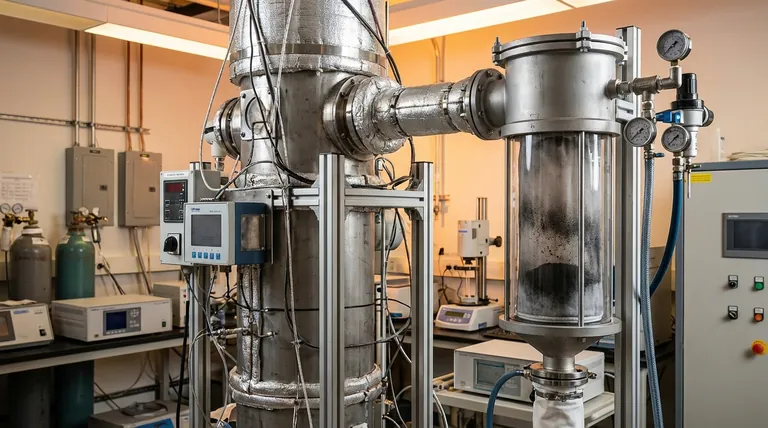
The primary purpose of a bag filter at the outlet of a Drop Tube Furnace (DTF) is to function as a high-efficiency solid-gas separation device. By capturing solid residues such as unburned char and ash from the flue gas, it prevents laboratory contamination and secures the physical samples required for critical experimental analysis.
By isolating solid particulates from the exhaust stream, the bag filter transforms a combustion experiment into a quantifiable scientific study. It safeguards the integrity of mass balance calculations while ensuring the laboratory environment remains free of hazardous dust emissions.
The Role of Solid Capture in Experimental Data
The installation of a bag filter is not merely a safety compliance measure; it is a fundamental requirement for accurate data collection.
Validating Mass Balance
To understand a combustion process, you must account for all matter entering and exiting the system.
The bag filter captures the total mass of solid residues. This allows researchers to perform precise mass balance calculations, ensuring that the total input mass equals the total output mass plus gas emissions.
Assessing Combustion Efficiency
The efficiency of a furnace is determined by how completely it burns fuel.
By collecting unburned char, researchers can analyze the residual carbon content. This data is the direct indicator of combustion efficiency, revealing how much fuel was wasted versus how much was converted to energy.
Enabling Micro-Level Analysis
Beyond basic weight measurements, the bag filter enables deep material characterization.
Recovering Micron-Scale Particles
Supplementary data indicates that these filters, often using precision 142 mm filter paper, are designed to capture micron and sub-micron particles.
This high level of filtration ensures that even the finest particulate matter, which might escape a standard cyclone separator, is retained for analysis.
Facilitating Chemical and Structural Analysis
The collected solids are not waste; they are valuable specimens.
Researchers use these captured residues—including complex components like molten salts and ash—to study chemical composition and microstructure. This analysis reveals the physical transformation of the fuel during the drop tube process.
Operational Safety and Environment
While data is critical, the immediate physical environment of the laboratory must be protected.
Preventing Laboratory Pollution
A Drop Tube Furnace generates exhaust gases laden with dust and particulates.
The bag filter acts as the final barrier, stripping these contaminants from the gas before discharge. This prevents the accumulation of hazardous dust in the lab and protects sensitive equipment nearby.
Understanding the Trade-offs
While essential, the use of a bag filter introduces specific operational constraints that must be managed.
Thermal Limitations
Standard filter papers cannot withstand the peak temperatures of a DTF.
Therefore, the filter must be positioned downstream of a water-cooled end cap. Failure to sufficiently cool the exhaust gas before it reaches the filter can result in the destruction of the filter media and the loss of the sample.
Backpressure and Flow Restriction
High-efficiency filters naturally create resistance to gas flow.
As the filter cake (the layer of collected ash) builds up, pressure drops across the device increase. This requires careful monitoring to ensure it does not alter the gas velocity profile inside the furnace, which could skew residence time data.
Making the Right Choice for Your Goal
The specific configuration of your filtration system should align with your primary experimental objectives.
- If your primary focus is Mass Balance: Ensure your filter housing is perfectly sealed to prevent any loss of fine ash, as even minor leaks will invalidate your closure calculations.
- If your primary focus is Microstructure Analysis: Select a filter medium (such as specific 142 mm paper) that is chemically inert and allows for easy retrieval of samples without fiber contamination.
- If your primary focus is Safety: Prioritize filters with high sub-micron capture efficiency to ensure the cleanest possible exhaust discharge into the laboratory ventilation system.
A bag filter is the critical checkpoint that converts raw combustion byproducts into accurate, reliable scientific data.
Summary Table:
| Feature | Primary Function | Scientific Benefit |
|---|---|---|
| Solid-Gas Separation | Captures unburned char and ash | Enables precise mass balance calculations |
| Micron Filtration | Retains sub-micron particulates | Provides samples for microstructure analysis |
| Emission Control | Filters exhaust gases | Prevents hazardous dust and lab pollution |
| Efficiency Tracking | Collects residual carbon | Measures combustion and fuel conversion rates |
Optimize Your Thermal Research with KINTEK
Precision in combustion analysis starts with the right equipment. Backed by expert R&D and manufacturing, KINTEK offers high-performance Tube, Muffle, Rotary, Vacuum, and CVD systems, all fully customizable to meet your unique laboratory needs. Whether you require advanced filtration for mass balance or specialized high-temp furnaces for material characterization, our team is ready to provide the technical expertise you deserve.
Ready to elevate your experimental accuracy? Contact us today to discuss your custom furnace solution.
Visual Guide

References
- Garikai T. Marangwanda, Daniel M. Madyira. Evaluating Combustion Ignition, Burnout, Stability, and Intensity of Coal–Biomass Blends Within a Drop Tube Furnace Through Modelling. DOI: 10.3390/en18061322
This article is also based on technical information from Kintek Furnace Knowledge Base .
Related Products
- Vacuum Sealed Continuous Working Rotary Tube Furnace Rotating Tube Furnace
- Magnesium Extraction and Purification Condensing Tube Furnace
- Slide PECVD Tube Furnace with Liquid Gasifier PECVD Machine
- Custom Made Versatile CVD Tube Furnace Chemical Vapor Deposition CVD Equipment Machine
- 1400℃ High Temperature Laboratory Tube Furnace with Alumina Tube
People Also Ask
- What is the purpose of rotary tube furnaces? Achieve Uniform Heat Treatment for Powders and Granules
- What are the key advantages of using a rotary tube furnace? Achieve Dynamic, Uniform Heating for Powders
- How does the amount of material processed vary between batch and continuous rotary tube furnaces? Scale Your Production Efficiently
- What are the advantages of rotary tube furnaces in fuel compatibility? Boost Efficiency and Cut Costs
- What is the temperature range of some rotary tube furnaces? Achieve Uniform Heating Up to 1200°C















