
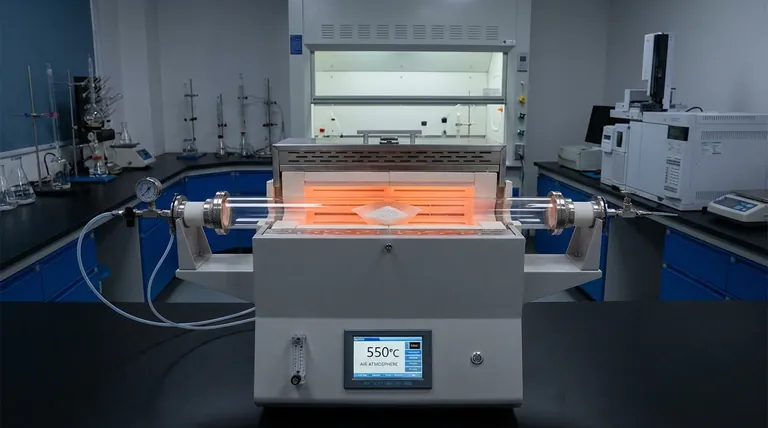
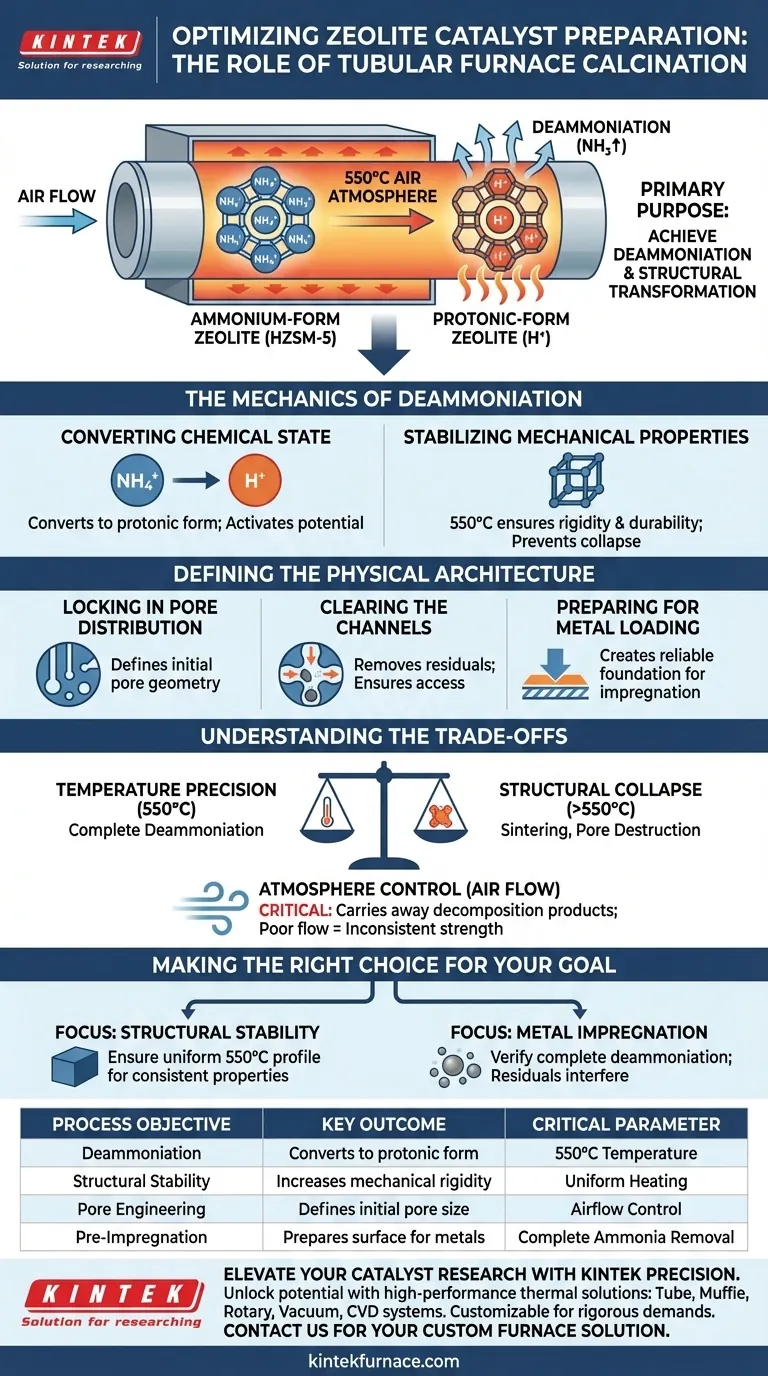
The primary purpose of utilizing a tubular furnace for the initial calcination of ammonium-form zeolites is to achieve deammoniation. By subjecting the material, such as HZSM-5, to 550°C in an air atmosphere, the furnace facilitates the thermal decomposition of ammonium ions. This critical step stabilizes the zeolite's mechanical properties and rigidly defines the initial pore distribution size.
Core Takeaway Initial calcination is not merely a drying step; it is a structural transformation. It converts the zeolite from a precursor state into a mechanically stable support with defined pore architecture, establishing the essential foundation required for subsequent metal impregnation.
The Mechanics of Deammoniation
Converting the Chemical State
The tubular furnace provides the thermal energy required to drive the deammoniation reaction. This process converts the ammonium-form zeolite into its protonic (hydrogen) form. This chemical shift is the prerequisite for activating the material's potential as a catalyst support.
Stabilizing Mechanical Properties
According to the primary technical data, a key outcome of this heat treatment is mechanical stabilization. The 550°C environment ensures the zeolite framework becomes rigid and durable. Without this stabilization, the material would likely lack the physical integrity to withstand downstream processing steps.
Defining the Physical Architecture
Locking in Pore Distribution
The thermal environment of the tubular furnace does more than alter surface chemistry; it defines the physical geometry of the catalyst. This specific calcination step determines the initial pore distribution size.
Clearing the Channels
While the primary goal is deammoniation, this high-temperature treatment also serves to clear micro-pores. As noted in supplementary data regarding similar zeolite synthesis, thermal treatment helps remove residual organic agents or blockages. This ensures the pore channels are open and accessible.
Preparing for Metal Loading
The ultimate goal of this initial calcination is preparation. By fixing the pore size and stabilizing the structure, the furnace creates a reliable foundation. This structural certainty is required for the successful impregnation of active metals in later stages of catalyst production.
Understanding the Trade-offs
Temperature Precision vs. Structural Collapse
Operating at the prescribed 550°C is a calculated balance. The temperature must be high enough to ensure complete deammoniation and the removal of impurities. However, excessive heat beyond this target can lead to the collapse of the zeolite framework or sintering, which would permanently destroy the pore structure and reduce surface area.
Atmosphere Control
The process relies on an air atmosphere within the tubular furnace. The flow and composition of this atmosphere are critical for carrying away decomposition products (such as ammonia gas). Poor airflow can lead to incomplete calcination, resulting in a catalyst with inconsistent mechanical strength and blocked pores.
Making the Right Choice for Your Goal
To maximize the effectiveness of your catalyst preparation, focus on the specific outcome you need from the tubular furnace:
- If your primary focus is Structural Stability: Ensure the furnace maintains a uniform 550°C profile to prevent thermal shock and guarantee consistent mechanical properties across the batch.
- If your primary focus is Metal Impregnation: Verify complete deammoniation has occurred, as residual ammonium ions will interfere with the uptake and distribution of metal precursors in the next step.
The tubular furnace transforms your zeolite from a raw chemical compound into a precisely engineered architectural support ready for activation.
Summary Table:
| Process Objective | Key Outcome | Critical Parameter |
|---|---|---|
| Deammoniation | Converts ammonium-form to protonic form | 550°C Temperature |
| Structural Stability | Increases mechanical rigidity and durability | Uniform Heating |
| Pore Engineering | Defines initial pore distribution and size | Airflow Control |
| Pre-Impregnation | Prepares surface for active metal loading | Complete Ammonia Removal |
Elevate Your Catalyst Research with KINTEK Precision
Unlock the full potential of your zeolite synthesis with KINTEK’s high-performance thermal solutions. Backed by expert R&D and manufacturing, we provide high-precision Tube, Muffle, Rotary, Vacuum, and CVD systems tailored for the rigorous demands of catalyst calcination.
Whether you need to stabilize mechanical properties or ensure uniform deammoniation, our customizable lab furnaces provide the temperature accuracy and atmospheric control essential for your unique research needs. Contact us today to find your custom furnace solution.
Visual Guide
References
- Marco F. Paucar-Sánchez, M.A. Martín‐Lara. Impact of Metal Impregnation of Commercial Zeolites in the Catalytic Pyrolysis of Real Mixture of Post-Consumer Plastic Waste. DOI: 10.3390/catal14030168
This article is also based on technical information from Kintek Furnace Knowledge Base .
Related Products
- Vertical Laboratory Quartz Tube Furnace Tubular Furnace
- Multi Zone Laboratory Quartz Tube Furnace Tubular Furnace
- High Pressure Laboratory Vacuum Tube Furnace
- Laboratory Quartz Tube Furnace RTP Heating Tubular Furnace
- 1700℃ High Temperature Laboratory Tube Furnace with Alumina Tube
People Also Ask
- What are the key differences between single-zone and multi-zone vertical tube furnaces? Choose the Right Furnace for Your Lab
- What are the main characteristics of vertical tube furnaces? Optimize Your Lab with Space-Saving, Uniform Heating
- How are metal support wires selected for sample suspension? Expert Guide to High-Temp Furnace Materials
- How do heat treatment processes influence the configuration of a vertical tube furnace? Optimize for Quenching, Annealing, and More
- Why is a vertical tube furnace preferred for quenching tests? Achieve Rapid, Repeatable Cooling for Accurate Results



















