
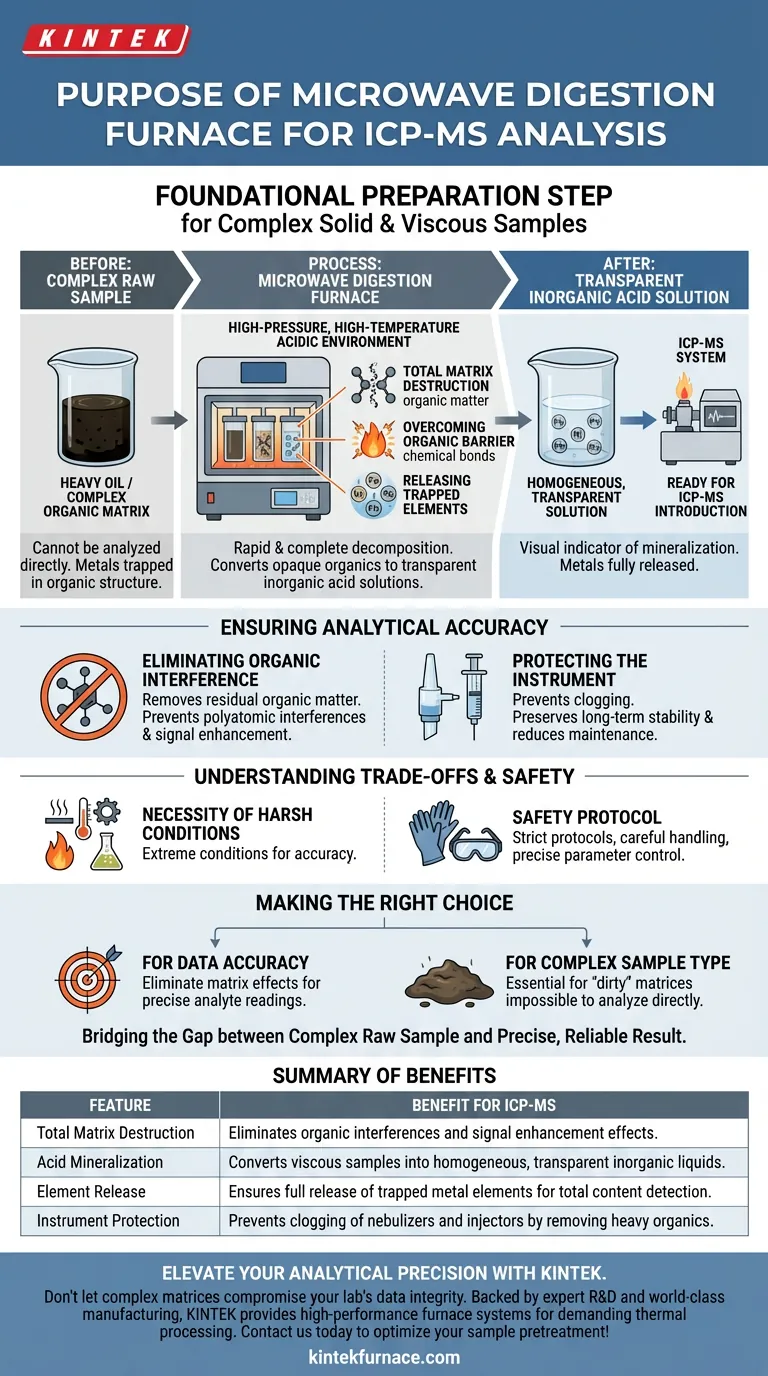
A microwave digestion furnace serves as the foundational preparation step for converting complex solid or viscous samples into a state compatible with high-sensitivity instruments. Specifically, it utilizes a high-pressure, high-temperature acidic environment to rapidly and completely decompose heavy oil organic matrices. This transforms difficult organic samples into transparent inorganic acid solutions that can be directly introduced into an Inductively Coupled Plasma Mass Spectrometry (ICP-MS) system.
The primary function of this device is total matrix destruction. It ensures that metal elements are fully released from the organic structure into the liquid phase, eliminating organic interferences that would otherwise compromise the accuracy of your trace element analysis.
The Mechanism of Decomposition
Overcoming the Organic Barrier
Samples such as heavy oils possess complex organic matrices that cannot be analyzed directly. The microwave digestion furnace applies intense thermal energy and pressure to these matrices. This harsh environment breaks the strong chemical bonds holding the organic matter together.
Creating a Homogeneous Solution
The result of this process is a physical transformation of the sample. The furnace converts the opaque, viscous organic material into a transparent inorganic acid solution. This clarity is the visual indicator that the organic components have been successfully mineralized.
Releasing Trapped Elements
Metal elements are often bound tightly within the organic structure of the sample. By completely decomposing the matrix, the furnace ensures these metals are fully released into the liquid phase. This guarantees that the subsequent analysis detects the total metal content, not just a fraction of it.
Ensuring Analytical Accuracy
Eliminating Organic Interference
One of the greatest threats to ICP-MS accuracy is interference from residual organic matter. If organic carbon remains in the sample, it can cause polyatomic interferences or signal enhancement effects. The digestion furnace removes this variable by destroying the organic matter before it ever reaches the instrument.
Protecting the Instrument
Injecting heavy organics directly into an ICP-MS would quickly clog the nebulizer and injector. By converting the sample into a thin, inorganic acid solution, the furnace protects the delicate sample introduction system. This preserves the instrument's long-term stability and reduces maintenance downtime.
Understanding the Trade-offs
The Necessity of Harsh Conditions
To achieve the "transparent solution" required for accuracy, the furnace must operate under extreme conditions. This involves the use of concentrated acids combined with high heat and pressure.
Safety and Protocol
Because the environment inside the digestion vessels is so aggressive, strict safety protocols are non-negotiable. While the process guarantees the best analytical results, it requires careful handling of vessels and precise control of temperature and pressure parameters to prevent venting or vessel failure.
Making the Right Choice for Your Goal
When evaluating the role of microwave digestion in your workflow, consider your specific analytical objectives:
- If your primary focus is Data Accuracy: Rely on digestion to completely eliminate organic matrix effects, ensuring your ICP-MS reads only the target analytes.
- If your primary focus is Sample Type: Use this method specifically for "dirty" or complex matrices (like heavy oil) that are impossible to analyze without prior decomposition.
Ultimately, the microwave digestion furnace bridges the gap between a complex raw sample and a precise, reliable result.
Summary Table:
| Feature | Benefit for ICP-MS Analysis |
|---|---|
| Total Matrix Destruction | Eliminates organic interferences and signal enhancement effects. |
| Acid Mineralization | Converts viscous samples into homogeneous, transparent inorganic liquids. |
| Element Release | Ensures full release of trapped metal elements for total content detection. |
| Instrument Protection | Prevents clogging of nebulizers and injectors by removing heavy organics. |
Elevate Your Analytical Precision with KINTEK
Don't let complex matrices compromise your lab's data integrity. Backed by expert R&D and world-class manufacturing, KINTEK provides high-performance furnace systems—including Muffle, Tube, and Vacuum furnaces—tailored to meet the most demanding thermal processing and sample preparation needs. Whether you require a standard system or a customized solution for unique lab workflows, our team is ready to help you achieve consistent, reliable results.
Ready to optimize your sample pretreatment? Contact us today to discuss your application requirements with our technical experts!
Visual Guide
References
- Influence of Oil-Soluble Catalyst on Composition and Structure of Heavy Oil from Samara Region Field. DOI: 10.3390/chemengineering9010011
This article is also based on technical information from Kintek Furnace Knowledge Base .
Related Products
- High Temperature Muffle Oven Furnace for Laboratory Debinding and Pre Sintering
- Multi Heating Zones CVD Tube Furnace Machine for Chemical Vapor Deposition Equipment
- Magnesium Extraction and Purification Condensing Tube Furnace
- 1200℃ Muffle Oven Furnace for Laboratory
- Vacuum Dental Porcelain Sintering Furnace for Dental Laboratories
People Also Ask
- What thermal phenomena occur during polymer binder burnout in ceramic green bodies? Lab Furnace Guide
- What role does a high-temperature muffle furnace play in STFO synthesis? Achieve Pure Perovskite Results
- Why is controlled heat treatment in a muffle furnace necessary for calcined clay? Achieve Optimal Pozzolanic Activity
- How does a high-temperature muffle furnace facilitate the formation of LaNbxAl1−xO3+δ perovskite structures? Key Roles
- What role does a high-temperature muffle furnace play in the formation of biochar catalysts? Master Catalyst Synthesis

















