
A high-temperature continuous flow fixed-bed reactor creates a precise, simulated industrial environment. It operates between 500°C and 550°C for up to 150 hours with a Weight Hourly Space Velocity (WHSV) of 7500 mL/g·h. This specific configuration, utilizing quartz reaction tubes and K-type thermocouple controls, allows researchers to measure how Zn-Cr catalysts withstand long-term thermochemical stress.
This testing environment bridges the gap between lab-scale experimentation and industrial reality. By maintaining rigorous thermochemical conditions over an extended period, it isolates the effects of heat and flow on catalyst structure and carbon deposition.
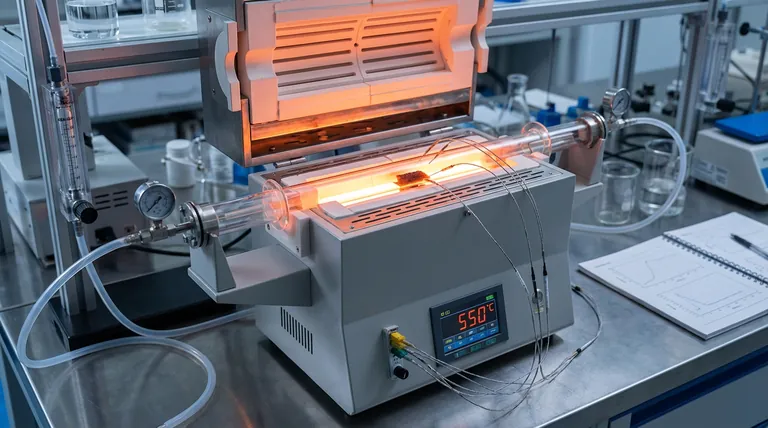
Simulation of Industrial Stress
Temperature Ranges and Control
The system maintains temperatures between 500°C and 550°C, which are critical for testing thermal degradation in Zn-Cr systems. K-type thermocouples ensure high-precision temperature regulation, preventing thermal runaway or fluctuations that could skew stability data.
The Importance of Temporal Stability
The reactor supports continuous flow for up to 150 hours. This duration is essential for identifying slow-onset structural changes or the gradual accumulation of carbon that shorter tests might miss.
Kinetic and Material Parameters
Standardized Weight Hourly Space Velocity (WHSV)
A constant WHSV of 7500 mL/g·h is maintained throughout the evaluation process. This consistency ensures that any observed deactivation is a result of catalyst instability rather than variations in contact time or reactant flow.
Quartz Tube Integrity
The use of quartz reaction tubes minimizes unwanted catalytic wall effects. This ensures that the observed chemical reactions and carbon resistance data are purely a reflection of the atomic synergistic active sites within the catalyst.
Understanding Potential Trade-offs
Limitations of the 150-Hour Window
While 150 hours is a rigorous benchmark, it may not capture deactivation mechanisms that only emerge after thousands of hours of industrial use. Researchers must extrapolate these results carefully when predicting the multi-year lifespan of a catalyst.
Fixed-Bed Constraints
The fixed-bed design provides excellent stability data but may not fully simulate the mechanical stresses found in fluidized bed environments. Catalyst attrition or physical fragmentation might be underestimated in this static configuration compared to more dynamic reactor types.
Implementing These Conditions for Catalyst Development
To maximize the utility of this reactor setup, align your experimental goals with the specific capabilities of the system.
- If your primary focus is structural integrity: Prioritize the full 150-hour duration at the upper temperature limit of 550°C to stress the atomic synergistic sites.
- If your primary focus is carbon resistance: Maintain the 7500 mL/g·h WHSV strictly to observe how flow dynamics influence coke formation on the catalyst surface.
By replicating industrial-grade thermochemical stress, this reactor setup provides the definitive data required to validate catalyst durability for large-scale applications.
Summary Table:
| Feature | Experimental Condition Specification |
|---|---|
| Temperature Range | 500°C to 550°C |
| Test Duration | Up to 150 hours (continuous) |
| Flow Rate (WHSV) | 7500 mL/g·h |
| Temperature Control | K-type thermocouples for high precision |
| Reaction Vessel | High-integrity quartz tubes |
| Primary Goal | Evaluate thermal stability & carbon resistance |
Elevate Your Catalyst Research with KINTEK
Precision in thermal stability testing requires equipment that can withstand rigorous industrial simulation. KINTEK provides industry-leading Muffle, Tube, Rotary, Vacuum, and CVD systems, all engineered to deliver the exact thermochemical environments your research demands.
Backed by expert R&D and world-class manufacturing, our lab high-temperature furnaces are fully customizable to meet your unique experimental parameters. Ensure your catalysts are ready for industrial scale-up with our reliable heating solutions.
Ready to optimize your lab's performance? Contact us today to discuss your custom furnace needs!
References
- Ji Yang, Ji Su. Atomically synergistic Zn-Cr catalyst for iso-stoichiometric co-conversion of ethane and CO2 to ethylene and CO. DOI: 10.1038/s41467-024-44918-8
This article is also based on technical information from Kintek Furnace Knowledge Base .
Related Products
- Custom Made Versatile CVD Tube Furnace Chemical Vapor Deposition CVD Equipment Machine
- MPCVD Machine System Reactor Bell-jar Resonator for Lab and Diamond Growth
- Vertical Laboratory Quartz Tube Furnace Tubular Furnace
- Slide PECVD Tube Furnace with Liquid Gasifier PECVD Machine
- Laboratory Quartz Tube Furnace RTP Heating Tubular Furnace
People Also Ask
- What is a CVD tube furnace and what is its primary function? Discover Precision Thin-Film Deposition
- Why are CVD tube furnace sintering systems indispensable for 2D material research and production? Unlock Atomic-Scale Precision
- How does CVD tube furnace sintering enhance graphene growth? Achieve Superior Crystallinity and High Electron Mobility
- Which industries and research fields benefit from CVD tube furnace sintering systems for 2D materials? Unlock Next-Gen Tech Innovations
- What are the practical applications of gate media prepared by CVD tube furnaces? Unlock Advanced Electronics and More



















