
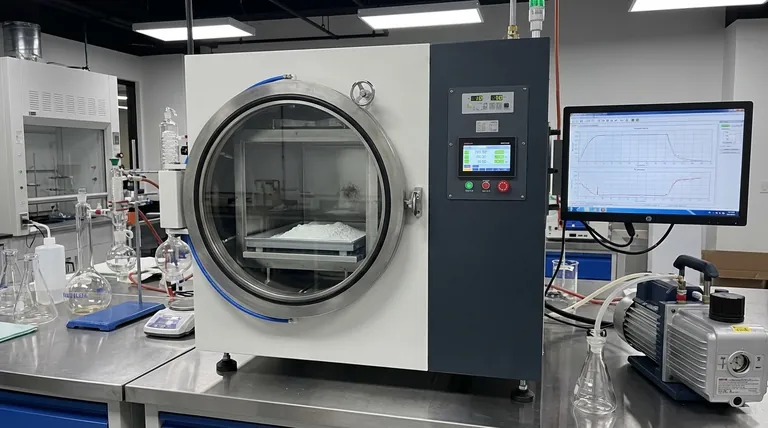
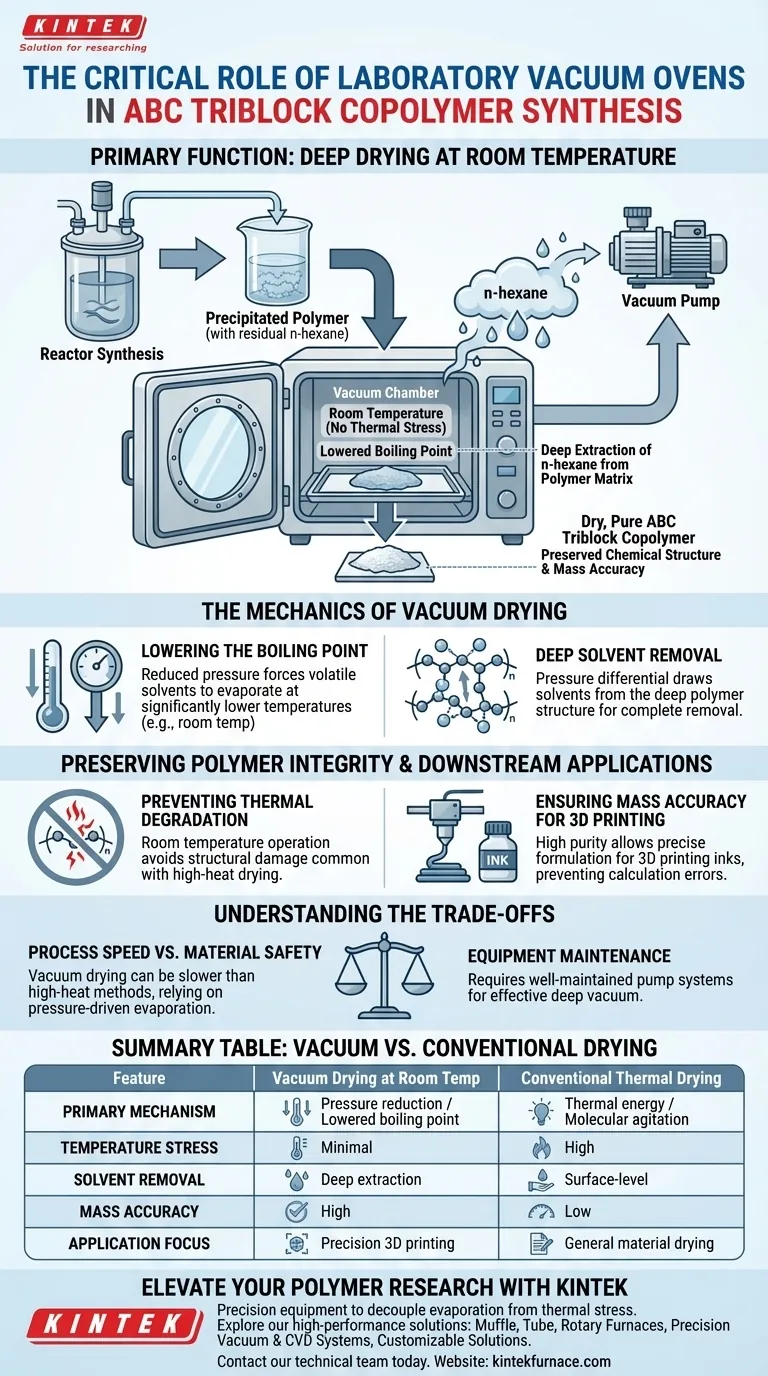
The primary function of a laboratory vacuum oven in the synthesis of ABC triblock copolymers is the deep drying of the precipitated polymer. This process is specifically designed to remove residual solvents, such as n-hexane, from the polymer matrix. By operating under vacuum conditions at room temperature, the oven ensures the polymer is dried thoroughly without being exposed to thermal stress.
Core Takeaway: Vacuum drying decouples the process of evaporation from high heat. This critical separation ensures the polymer retains its original chemical structure and mass accuracy, preventing degradation that would compromise downstream applications like 3D printing inks.
The Critical Role of Vacuum Conditions
Lowering the Boiling Point
The fundamental advantage of using a vacuum oven is its ability to lower the boiling point of solvents.
By reducing the pressure surrounding the polymer, the vacuum environment forces volatile solvents to evaporate at much lower temperatures.
This allows for effective drying without the need to heat the chamber, which is the standard method in non-vacuum ovens.
Deep Removal of Solvents
In the specific case of ABC triblock copolymers, the goal is to remove residual n-hexane.
Solvents trapped deep within the polymer matrix can be difficult to extract under standard atmospheric pressure.
The vacuum environment creates a pressure differential that draws these trapped solvents out from the "deep" structure of the material, ensuring the final product is solvent-free.
Preserving Polymer Integrity
Preventing Thermal Degradation
The most significant risk during the drying phase of polymer synthesis is heat damage.
The primary reference highlights that this process occurs at room temperature to avoid the structural changes or degradation often caused by heating.
While other materials (like electrode sheets or catalysts) may tolerate temperatures of 60°C to 90°C, ABC triblock copolymers require a strictly non-thermal approach to maintain their molecular architecture.
Ensuring Mass Accuracy
Accurate mass measurement is vital for the subsequent preparation of 3D printing inks.
If a polymer degrades or retains invisible solvent weight, the concentration calculations for the ink formulation will be incorrect.
Deep vacuum drying guarantees high purity, allowing for precise formulation based on the true mass of the polymer components.
Understanding the Trade-offs
Process Speed vs. Material Safety
While vacuum drying is safer for the material, it can be a slower process compared to high-heat drying methods.
Operating at room temperature relies entirely on the vacuum pressure to drive evaporation, which may take longer than methods that utilize thermal energy to accelerate molecular movement.
Equipment Maintenance
Achieving the necessary "deep" vacuum requires a well-maintained pump system.
If the vacuum seal is compromised or the pump is underpowered, the solvent removal will be incomplete, negating the benefits of the process and potentially leaving impurities in the polymer.
Making the Right Choice for Your Synthesis
To ensure the success of your ABC triblock copolymer synthesis, apply the vacuum oven based on your specific purity requirements.
- If your primary focus is Structural Integrity: strict adherence to room temperature settings is required to prevent polymer chain degradation.
- If your primary focus is Ink Formulation: ensure the drying cycle is long enough to achieve complete solvent removal, guaranteeing the mass accuracy needed for precise 3D printing recipes.
Ultimately, the vacuum oven serves as a preservation tool, ensuring that the chemistry you synthesized in the reactor is exactly what you recover after drying.
Summary Table:
| Feature | Vacuum Drying at Room Temp | Conventional Thermal Drying |
|---|---|---|
| Primary Mechanism | Pressure reduction / Lowered boiling point | Thermal energy / Molecular agitation |
| Temperature Stress | Minimal (Room Temperature) | High (Risk of degradation) |
| Solvent Removal | Deep extraction of n-hexane | Surface-level evaporation |
| Mass Accuracy | High (Pure polymer) | Low (Residual solvent or mass loss) |
| Application Focus | Precision 3D printing inks | General material drying |
Elevate Your Polymer Research with KINTEK
Precision in ABC triblock copolymer synthesis demands equipment that can decouple evaporation from thermal stress. KINTEK provides advanced, high-performance vacuum ovens designed to maintain the structural integrity of your most sensitive materials.
Backed by expert R&D and manufacturing, we offer a comprehensive range of laboratory high-temperature and vacuum systems, including:
- Muffle, Tube, and Rotary Furnaces
- Precision Vacuum & CVD Systems
- Customizable Solutions tailored for unique synthesis and 3D printing ink requirements.
Ensure your synthesized chemistry remains pristine from reactor to recovery. Contact our technical team today to find your perfect laboratory drying solution.
Visual Guide
References
- Xu Liu, Theoni K. Georgiou. Graphene inks for printing based on thermoresponsive ABC triblock terpolymer gels. DOI: 10.1039/d5lp00071h
This article is also based on technical information from Kintek Furnace Knowledge Base .
Related Products
- Laboratory Muffle Oven Furnace with Bottom Lifting
- 1200℃ Muffle Oven Furnace for Laboratory
- High Temperature Muffle Oven Furnace for Laboratory Debinding and Pre Sintering
- 1400℃ Muffle Oven Furnace for Laboratory
- Laboratory Vacuum Tilt Rotary Tube Furnace Rotating Tube Furnace
People Also Ask
- Why is a high-temperature muffle furnace required for FeOx-MOx/TiO2? Engineering High-Performance Nanocomposites
- What function does a muffle furnace perform in Ba0.75Ca0.25TiO3 calcination? Ensure Phase Purity & Synthesis
- Why is a high-temperature laboratory muffle furnace essential for the alkali fusion process in zeolite synthesis?
- What is the importance of the calcination process? Master High-Purity Calcium Phosphate Nanopowder Production
- What are the primary functions of a high-temperature laboratory muffle furnace in the preparation of biosorbent materials?













