
Vacuum-pressure treatment is required because atmospheric pressure cannot overcome the physical resistance of wood's microscopic structure. Simple immersion fails to penetrate the nanometer-scale voids found in cell walls, leaving the core of the veneer untreated. To successfully impregnate wood with high-molecular-weight resins, you must mechanically force the solution into spaces too small for gravity or capillary action to reach alone.
Wood cell wall voids are extremely small, often measuring just 2–4 nanometers. Achieving deep impregnation requires a two-step mechanical process: evacuating air to create space, then applying high pressure to drive resin into the cellular structure.
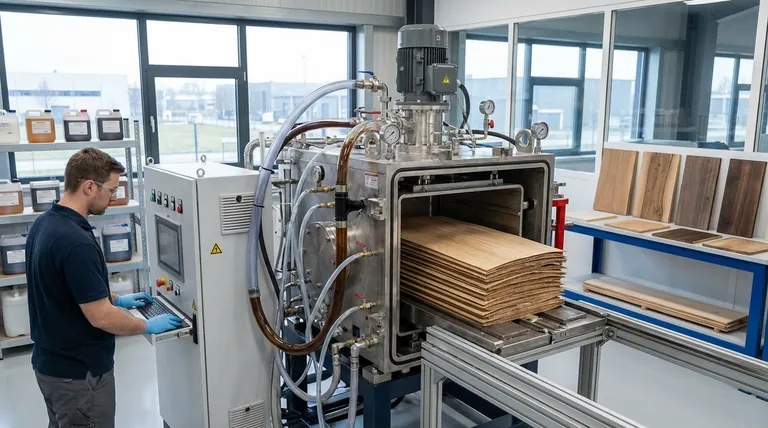
The Microscopic Barrier to Impregnation
The Problem of Scale
The fundamental challenge lies in the anatomy of the wood itself. The voids within the cell walls are microscopic; in species like Scots pine, these voids are as small as 2–4 nanometers (nm).
Why Atmospheric Immersion Fails
Under normal atmospheric conditions, resin solutions cannot penetrate these tiny spaces. The surface tension of the liquid and the trapped air inside the wood act as barriers.
The Limitation of "Soaking"
Simply soaking the veneer results in superficial coating rather than true impregnation. Without external force, the resin is physically blocked from entering the deeper cellular structures.
The Mechanics of Vacuum-Pressure Treatment
Step 1: Evacuation via Vacuum
The first stage of the process utilizes a vacuum system. This step is critical for removing air trapped within the cell interstices (the spaces between cells).
Creating the Void
By extracting the air, the equipment creates a pressure differential and opens up the physical space necessary for the resin to occupy.
Step 2: Injection via Pressure
Once the air is removed, the system applies significant mechanical pressure, typically around 11 bar.
Driving the Solution
This pressure is the engine of impregnation. It provides the force required to physically drive the resin solution deep into the cell lumens (the hollow centers of the cells) and the dense cell walls.
The Impact on Performance
Achieving High Weight Percent Gain (WPG)
The vacuum-pressure method is the only way to achieve a high Weight Percent Gain (WPG). WPG is the primary metric for verifying that a significant amount of resin has been successfully embedded into the wood matrix.
Superior Water Resistance
Deep impregnation alters the wood's interaction with moisture. By filling the cell lumens and walls with resin, the treatment provides superior water resistance that surface treatments cannot match.
Understanding the Operational Trade-offs
Equipment Complexity
While effective, this method requires specialized, heavy-duty machinery capable of sustaining high pressures (11 bar) safely. This represents a higher capital investment compared to dip-tanks or spray lines.
Process Intensity
This is not a continuous, rapid-pass process. It is a batch process that requires time to pull the vacuum and sustain the pressure cycle to ensure complete saturation.
Making the Right Choice for Your Goal
To determine if this level of processing is necessary for your specific application, evaluate your performance requirements.
- If your primary focus is dimensional stability and durability: You must use vacuum-pressure treatment to ensure the resin penetrates the cell walls, offering actual structural reinforcement and water resistance.
- If your primary focus is merely changing the surface color: A simple atmospheric dip or spray coating is likely sufficient and more cost-effective.
Deep impregnation is not just a chemical process; it is a mechanical conquest of the wood's density.
Summary Table:
| Feature | Atmospheric Immersion | Vacuum-Pressure Treatment |
|---|---|---|
| Penetration Depth | Superficial (Surface only) | Deep (Cell lumen & cell walls) |
| Mechanism | Gravity & Capillary action | Mechanical evacuation & 11-bar force |
| Micro-Void Access | Blocked by trapped air | 2–4 nm void penetration |
| Performance Goal | Color & aesthetics | Stability & water resistance |
| Equipment Type | Simple dip tanks | High-pressure industrial systems |
Elevate Your Material Performance with KINTEK
Don't settle for superficial coatings when your application demands structural integrity. Backed by expert R&D and manufacturing, KINTEK offers high-performance vacuum and pressure systems designed to conquer the microscopic barriers of wood density.
Our range of customizable lab and industrial solutions—including vacuum systems and high-temperature furnaces—is engineered to meet your unique processing needs. Whether you are optimizing resin uptake or developing next-generation composites, KINTEK provides the precision equipment necessary for true deep impregnation.
Ready to achieve superior Weight Percent Gain (WPG) in your products? Contact us today to discuss your custom solution!
References
- Johannes Karthäuser, Holger Militz. Modification of plywood with phenol–formaldehyde resin: substitution of phenol by pyrolysis cleavage products of softwood kraft lignin. DOI: 10.1007/s00107-023-02029-z
This article is also based on technical information from Kintek Furnace Knowledge Base .
Related Products
- Vacuum Hot Press Furnace Machine for Lamination and Heating
- Vacuum Heat Treat Sintering Furnace with Pressure for Vacuum Sintering
- Vacuum Hot Press Furnace Machine Heated Vacuum Press
- 9MPa Air Pressure Vacuum Heat Treat and Sintering Furnace
- Vacuum Hot Press Furnace Machine Heated Vacuum Press Tube Furnace
People Also Ask
- What are the primary components of a vacuum hot press furnace? Master the Core Systems for Precise Material Processing
- What are the benefits of the vacuum environment system in a vacuum hot press furnace? Unlock High-Density Sintering
- What safety features are incorporated in vacuum hot press furnaces? Ensure Operator and Equipment Protection
- What industries benefit from the use of vacuum hot press furnaces? Unlock High-Performance Materials for Your Industry
- Which process parameters must be optimized for specific materials in a vacuum hot press furnace? Achieve Optimal Density and Microstructure








