
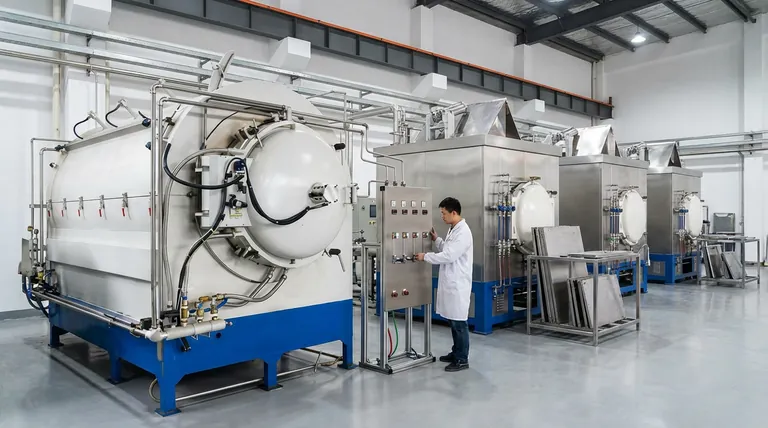
Vacuum high-temperature furnaces allow for the creation of superior metallurgical bonds by maintaining a high-vacuum, oxygen-free environment. This technology prevents the oxidation of metal components while enabling precise thermal control to ensure nickel-based solders penetrate deeply into the sandwich panel structure.
Core Takeaway The defining advantage of vacuum brazing is the elimination of chemical barriers. By removing oxygen and surface contaminants, the furnace allows the filler metal to physically diffuse into the base material, transforming a simple mechanical joint into a uniform, continuous metallurgical interface.
Eliminating Chemical Barriers
Creating an Oxygen-Free Environment
The primary function of these furnaces is to generate a high-vacuum environment, typically maintained at 10⁻⁶ mbar.
This oxygen-free state is critical for preventing the oxidation of metal wires and panels during the heating process.
Without this vacuum, high temperatures would cause rapid oxidation, compromising the structural integrity of the sandwich panel.
Removal of Existing Contaminants
Beyond preventing new oxidation, the high-vacuum environment actively cleans the materials.
It aids in removing existing oxide films and moisture from the surface of components like stainless steel.
This creates a pristine surface, which is a non-negotiable physical condition for successful brazing.
Optimizing Filler Metal Behavior
When the environment is chemically clean, the brazing filler metal functions more effectively.
The vacuum ensures that the filler achieves optimal wetting and spreading characteristics.
This prevents the secondary oxidation of the filler metal itself, ensuring it flows exactly where it is needed.
Precision Thermal Control
Exact Regulation of Heat
Vacuum furnaces allow for rigorous control over heating rates, specific brazing temperatures (often reaching 1050°C), and holding times.
This precision is necessary to manage the melting point of nickel-based solders accurately.
It ensures the solder melts completely without overheating or degrading the base materials.
Ensuring Deep Penetration
The combination of heat control and vacuum pressure drives the molten solder into the microscopic gaps of the assembly.
The solder is able to fully penetrate the contact points between the panel and the metal wires.
This deep penetration is essential for sandwich panels, which often have complex, hard-to-reach internal geometries.
Achieving Structural Integrity
Mutual Element Diffusion
The ultimate goal of this process is not just adhesion, but diffusion.
The process facilitates the mutual diffusion of elements between the filler and the base metal.
This results in a uniform and continuous metallurgical bonding interface, rather than a superficial surface bond.
High Reproducibility and Strength
Because the environment is strictly controlled, the process yields a high level of reproducibility.
Manufacturers can expect consistent results batch after batch, which is vital for industrial production.
The resulting brazed joints exhibit significantly increased strength, improving the overall quality and durability of the panel.
Understanding the Trade-offs
Process Cycle Time
While vacuum brazing produces superior results, it is generally a slower process than atmospheric brazing.
Pumping down to a high vacuum (10⁻⁶ mbar) and cooling down in a vacuum takes significant time.
This can impact throughput speed in high-volume manufacturing environments.
Equipment Complexity
Achieving and maintaining a high-vacuum environment requires sophisticated equipment.
Operators must maintain complex pumping systems and seals to prevent leaks that would ruin the "oxygen-free" status.
This increases both the initial capital investment and the ongoing maintenance requirements compared to standard furnaces.
Making the Right Choice for Your Project
The decision to use vacuum high-temperature furnaces should be driven by your specific quality requirements.
- If your primary focus is Structural Durability: Prioritize this method for its ability to create a continuous metallurgical bond through element diffusion.
- If your primary focus is Geometric Complexity: Rely on this technology to ensure solder penetrates deep, hard-to-access contact points in intricate sandwich panels.
- If your primary focus is Material Consistency: Use this process to remove existing oxide films and guarantee reproducible results across large production batches.
Ultimately, vacuum brazing is the requisite choice when the bond between the panel and wire must be as strong as the materials themselves.
Summary Table:
| Advantage | Technical Benefit | Impact on Sandwich Panels |
|---|---|---|
| High Vacuum (10⁻⁶ mbar) | Prevents oxidation & removes oxide films | Pristine surfaces for maximum joint integrity |
| Precision Heat Control | Exact regulation of 1050°C+ temps | Prevents material degradation; melts solder perfectly |
| Capillary Flow | Optimizes wetting and spreading | Deep penetration into complex internal geometries |
| Mutual Diffusion | Element exchange at the interface | Creates a continuous, uniform metallurgical bond |
| Reproducibility | Consistent, controlled environment | High-strength results across all production batches |
Elevate Your Manufacturing with KINTEK Precision
Don't settle for superficial bonds. Backed by expert R&D and manufacturing, KINTEK offers high-performance Muffle, Tube, Rotary, Vacuum, and CVD systems, all fully customizable for your unique material needs. Whether you are developing complex sandwich panels or advanced aerospace components, our vacuum furnace technology ensures the structural integrity and durability your project demands.
Ready to optimize your brazing process? Contact us today to consult with our specialists and discover the KINTEK advantage.
References
- Wei Zhang, Xin Xue. Experimental Investigation of the Three-Point Bending Property of a Sandwich Panel with a Metal Rubber Core. DOI: 10.3390/met14040383
This article is also based on technical information from Kintek Furnace Knowledge Base .
Related Products
- 2200 ℃ Tungsten Vacuum Heat Treat and Sintering Furnace
- 2200 ℃ Graphite Vacuum Heat Treat Furnace
- Molybdenum Vacuum Heat Treat Furnace
- Vacuum Heat Treat Sintering Furnace Molybdenum Wire Vacuum Sintering Furnace
- Vacuum Hot Press Furnace Machine Heated Vacuum Press Tube Furnace
People Also Ask
- How does a tungsten-heated vacuum sintering furnace prepare (TbxY1-x)2O3 ceramics? Achieve 99%+ Density & Purity
- How do compaction pressure and vacuum sintering optimize porous ceramics? Maximize Density & Toughness
- What wear-resistance enhancements are achieved by powder coating? The Role of Vacuum Sintering Furnaces
- What role does a high-temperature vacuum sintering furnace play in the densification of WC-10(Ni, Ni/Co) alloys?
- How does high-temp vacuum sintering influence Y-TZP mechanical properties? Achieve Max Toughness



















