
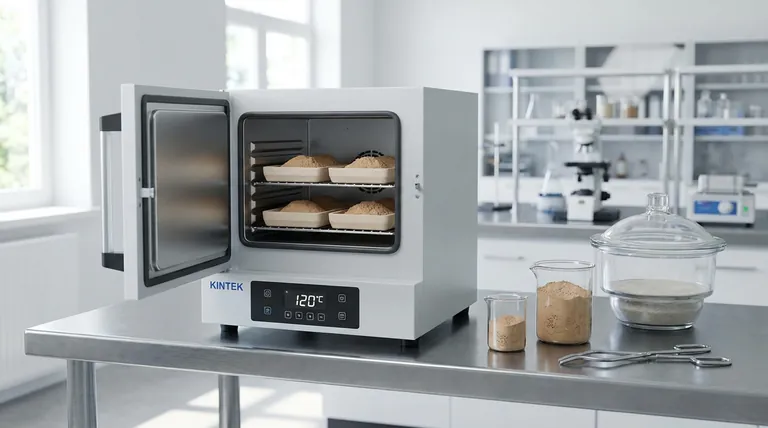
A laboratory blast oven serves as a critical stabilization tool in the processing of clay powders. Its primary function is to establish a uniform thermal field, typically maintained at 120°C, to gently and effectively remove residual volatile substances. This controlled "devolatilization" is a mandatory preparatory step before the material is subjected to higher temperatures.
By eliminating volatiles at a moderate temperature, the blast oven prevents the structural collapse of clay particles. It ensures that moisture does not escape violently during subsequent high-temperature calcination, thereby preserving the structural integrity of the powder.
The Mechanics of Thermal Stabilization
Uniform Heating at 120°C
The blast oven is designed to provide a consistent thermal environment.
By maintaining a steady temperature of approximately 120°C, the oven ensures that every particle within the batch is subjected to the same drying conditions. This uniformity is vital for consistent material properties.
Controlled Volatile Removal
Clay powders often contain residual moisture and other volatile substances.
The blast oven functions to drive these substances off slowly. This is a gentle extraction process designed to purify the powder without subjecting it to thermal shock or extreme stress.
Why Pre-Treatment Prevents Failure
Avoiding Rapid Expansion Risks
If clay powders are immediately exposed to high-temperature calcination without this step, the results can be catastrophic for the material.
High heat causes any remaining volatiles or moisture to expand and escape rapidly. This violent off-gassing can damage the internal structure of the material.
Preserving Particle Structure
The core purpose of using the blast oven is to ensure structural integrity.
By removing volatiles early, you prevent the "collapse" of the particle structure that occurs when internal pressure builds up too quickly. This ensures the powder retains its intended form and physical characteristics during the harsher calcination phase.
Operational Considerations and Trade-offs
The Necessity of Process Time
Using a blast oven adds time to the overall processing workflow.
While it may be tempting to accelerate production by moving directly to calcination, skipping this devolatilization stage creates a high risk of material rejection due to structural defects.
Temperature Precision
The effectiveness of this step relies on the oven's ability to maintain the target temperature (120°C).
Deviations in temperature can lead to incomplete devolatilization (if too low) or premature structural changes (if too high), undermining the safety net this step provides for the calcination process.
Making the Right Choice for Your Goal
To ensure the highest quality output for your clay powder processing, consider the following:
- If your primary focus is structural integrity: Ensure the blast oven is calibrated to exactly 120°C and allow sufficient time for complete devolatilization before moving to calcination.
- If your primary focus is process efficiency: Do not attempt to speed up the line by bypassing this oven; instead, focus on optimizing batch loading to maintain throughput without sacrificing this critical drying phase.
A well-executed devolatilization step is the invisible foundation of a high-quality final ceramic product.
Summary Table:
| Feature | Function in Devolatilization | Benefit to Clay Powder |
|---|---|---|
| Temperature Target | Constant 120°C Thermal Field | Ensures uniform drying across all particles |
| Volatile Removal | Gentle extraction of moisture/gases | Prevents violent off-gassing and expansion |
| Structural Safety | Pre-treatment before calcination | Eliminates the risk of internal particle collapse |
| Process Stability | Controlled thermal stabilization | Guarantees integrity for final high-temp stages |
Optimize Your Thermal Processing with KINTEK
Don't risk structural failure in your materials due to inadequate pre-treatment. Backed by expert R&D and manufacturing, KINTEK offers a comprehensive range of Muffle, Tube, Rotary, Vacuum, and CVD systems, along with specialized laboratory blast ovens—all customizable for your unique research and production needs.
Ready to achieve superior material integrity? Our experts are here to help you select the perfect high-temperature solution. Contact KINTEK today to discuss your requirements!
Visual Guide

References
- Princessruth Temidayo Temofeh, Bamidele Honesty Akpeji. Application of Zeolite in the Catalytic Cracking of Waste Vegetable Oil for the Production of highly Volatile Liquid Fuel. DOI: 10.37745/bjmas.2022.0467
This article is also based on technical information from Kintek Furnace Knowledge Base .
Related Products
- Laboratory Muffle Oven Furnace with Bottom Lifting
- 1800℃ High Temperature Muffle Oven Furnace for Laboratory
- 1200℃ Muffle Oven Furnace for Laboratory
- 1700℃ High Temperature Muffle Oven Furnace for Laboratory
- 1400℃ Muffle Oven Furnace for Laboratory
People Also Ask
- What function does a muffle furnace perform in Ba0.75Ca0.25TiO3 calcination? Ensure Phase Purity & Synthesis
- Why is a high-temperature laboratory muffle furnace essential for the alkali fusion process in zeolite synthesis?
- Why is a high-temperature muffle furnace required for FeOx-MOx/TiO2? Engineering High-Performance Nanocomposites
- What is the importance of the calcination process? Master High-Purity Calcium Phosphate Nanopowder Production
- What are the primary functions of a high-temperature laboratory muffle furnace in the preparation of biosorbent materials?














