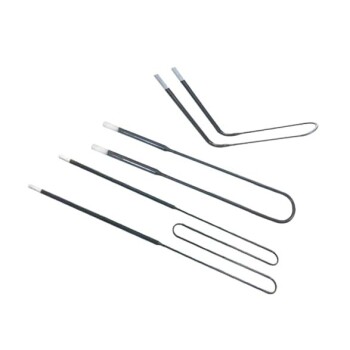
Tungsten-rhenium thermocouples serve as the primary high-temperature sensing units required to map the thermal field during directional crystallization. By withstanding environments exceeding 1500°C, these sensors record real-time cooling curves of liquid metal as it solidifies. This data is essential for calculating the temperature gradient and the movement rate of the crystallization front, allowing engineers to control the microstructural integrity of the final component.
The core function of tungsten-rhenium thermocouples is to provide high-precision, real-time thermal data in environments where standard sensors fail. This data allows for the quantification of crystallization dynamics, which is the only way to ensure uniform grain growth and prevent structural defects.
Capturing High-Temperature Thermal Profiles
Resilience in Extreme Thermal Environments
Directional crystallization often occurs at temperatures that would melt or degrade most metallic sensors. Tungsten-rhenium (W-Re) alloys are utilized because they maintain structural integrity and measurement accuracy well above 1500°C, and in some applications, up to 2300°C.
Axial Real-Time Monitoring
To monitor the progression of the solid-liquid interface, multiple thermocouples are placed along the axial direction of the ceramic mold. This arrangement allows for the continuous recording of cooling curves as the metal transitions from a liquid to a solid state.
Stability in Specialized Atmospheres
Beyond simple heat resistance, these thermocouples are valued for their stability in reducing or inert atmospheres. This is critical in directional solidification, where oxygen must often be excluded to prevent the oxidation of the alloy or the sensor itself.
Quantifying Crystallization Dynamics
Calculating the Temperature Gradient (G)
The temperature gradient (G) represents the variation in temperature over a specific distance ahead of the solidification front. Accurate G-values, derived from thermocouple data, determine the stability of the solidification interface and the refinement of the grain structure.
Determining the Front Movement Rate (R)
The crystallization front movement rate (R) is the velocity at which the solid-liquid interface travels through the mold. By analyzing the time-stamps of temperature drops across the axial thermocouple array, processors can calculate R to ensure it stays within optimal limits.
Optimizing Process Parameters
The ratio of G/R and the product G*R (cooling rate) directly influence the morphology of the crystals, such as whether they become dendritic or cellular. Thermocouple feedback allows for the "on-the-fly" adjustment of heater power or mold withdrawal speeds to maintain these critical ratios.
Understanding the Trade-offs
Sensitivity to Oxidation
While W-Re thermocouples are exceptionally durable at high temperatures, they are highly susceptible to oxidation if exposed to even trace amounts of oxygen. They must be used in a vacuum or a high-purity inert gas environment to prevent premature sensor failure.
Physical Brittleness After Heating
Once subjected to extreme temperatures, tungsten-rhenium wires undergo recrystallization and become extremely brittle. This makes them difficult to move or reuse after a single crystallization cycle, often necessitating their replacement.
Chemical Compatibility
At ultra-high temperatures, there is a risk of chemical interaction between the thermocouple sheath and the ceramic mold or the alloy. Selection of the correct protective sleeve is vital to prevent contamination of the melt or "drift" in the temperature readings.
How to Apply This to Your Project
When integrating tungsten-rhenium thermocouples into a directional solidification setup, your approach should vary based on your specific quality requirements.
- If your primary focus is Grain Morphology Control: Use a dense array of axial thermocouples to maximize the resolution of your Temperature Gradient (G) calculations.
- If your primary focus is Process Repeatability: Prioritize the use of high-purity inert atmospheres to prevent sensor drift and ensure consistent thermal feedback across multiple batches.
- If your primary focus is Cost Efficiency: Invest in high-quality protective sheathing to extend the life of the brittle W-Re elements across the duration of long cooling cycles.
Precise thermal mapping via tungsten-rhenium sensors is the foundation of modern directional solidification, turning a volatile thermal process into a controlled engineering science.
Summary Table:
| Key Feature | Functional Role | Impact on Process |
|---|---|---|
| Extreme Heat Resistance | Operates from 1500°C to 2300°C | Enables monitoring in temperatures where standard sensors fail. |
| Thermal Field Mapping | Records axial cooling curves | Provides real-time data for calculating temperature gradients (G). |
| Atmospheric Stability | Resists reducing/inert environments | Ensures sensor accuracy in specialized, oxygen-free conditions. |
| Interface Tracking | Determines movement rate (R) | Allows for precise control over grain morphology and structural integrity. |
Precision Thermal Control for Your Advanced Materials
Achieving perfect grain morphology requires more than just high temperatures—it demands precise, reliable thermal mapping. KINTEK specializes in high-performance laboratory equipment and consumables, offering an extensive range of high-temperature furnaces (muffle, tube, rotary, vacuum, CVD, atmosphere, dental, induction melting).
Our systems are fully customizable to meet your unique directional crystallization needs, ensuring you have the stable environments and accurate feedback required for superior results.
Ready to optimize your crystallization dynamics? Contact our technical experts today to find the ideal furnace and sensing solution for your laboratory.
References
- Alexander Balitskii, Jakub Dowejko. Improvement of Hydrogen-Resistant Gas Turbine Engine Blades: Single-Crystal Superalloy Manufacturing Technology. DOI: 10.3390/ma17174265
This article is also based on technical information from Kintek Furnace Knowledge Base .
Related Products
- Silicon Carbide SiC Thermal Heating Elements for Electric Furnace
- Vertical Laboratory Quartz Tube Furnace Tubular Furnace
- Multi Zone Laboratory Quartz Tube Furnace Tubular Furnace
- Small Vacuum Heat Treat and Tungsten Wire Sintering Furnace
- 2200 ℃ Tungsten Vacuum Heat Treat and Sintering Furnace
People Also Ask
- How do the different types of silicon carbide heating elements compare in terms of applications? Find the Best Fit for Your High-Temp Needs
- What are the temperature capabilities and mounting options for silicon carbide heating elements? Unlock High-Temp Flexibility and Durability
- What are the advantages of using silicon carbide heating elements in industrial furnaces? Boost Efficiency and Durability
- How do silicon carbide heating elements enhance the heat treatment of alloys? Achieve Superior Temperature Control
- What are the unique properties of silicon carbide heating elements? Key Benefits for High-Temp Performance