
In the preparation of ZnZrOx and InZrOx catalysts via the impregnation method, the industrial constant temperature drying oven acts as a critical stabilization vessel. Its primary function is to subject the amorphous zirconia carrier—previously impregnated with metal nitrate solutions—to continuous thermal treatment at 110°C for 12 hours. This specific regimen is necessary to evaporate moisture while ensuring the active metal precursors are uniformly physically adsorbed and fixed within the zirconia’s pore structure.
The drying oven serves as the essential bridge between wet impregnation and high-temperature crystallization. By maintaining a steady 110°C environment, it removes water at a controlled rate to "lock" metal precursors into place, preventing the macroscopic segregation or structural collapse that often results from rapid, uncontrolled drying.
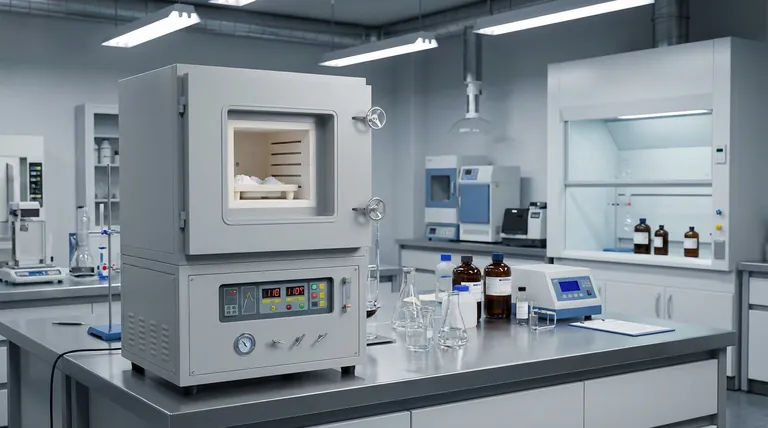
The Mechanics of Catalyst Stabilization
Controlled Moisture Evaporation
The primary role of the oven is to facilitate the complete removal of the solvent (water) used during the equal-volume impregnation process.
By holding the temperature at 110°C for a prolonged period (12 hours), the oven ensures that moisture evaporation occurs gradually rather than explosively.
Uniform Precursor Adsorption
As the solvent evaporates, the metal nitrate precursors (Zinc or Indium) must settle onto the support surface.
The constant temperature environment ensures these active metal precursors are physically adsorbed uniformly throughout the pore structure of the amorphous zirconia, rather than migrating to the outer surface.
Preparation for Crystallization
This drying step is a prerequisite for the subsequent crystallization phase.
By ensuring the precursors are dry and evenly distributed, the oven establishes the physical foundation required for the formation of the correct crystal phases during later high-temperature treatments.
Preventing Structural Defects
Avoiding Pore Structure Collapse
If the wet catalyst were immediately exposed to high calcination temperatures, the rapid vaporization of water would create massive internal pressure.
The drying oven prevents this by removing water gently, thereby avoiding tablet cracking or the collapse of the delicate pore structure that provides the catalyst with its surface area.
Immobilization of Active Components
Without a dedicated drying phase, active metal salts remain mobile and can migrate uncontrollably.
The oven effectively "pre-fixes" these components within the pores, preventing them from agglomerating or segregating, which would severely degrade the final catalytic activity.
Understanding the Trade-offs
While the industrial constant temperature oven is the standard for this process, it is important to recognize its operational constraints compared to other drying methods.
Process Duration
The requirement for a 12-hour cycle at 110°C represents a significant bottleneck in the production line compared to rapid convective drying methods.
Solute Migration Risks
While superior to uncontrolled drying, standard thermal drying can still allow for minor solute migration toward the surface due to capillary action.
Unlike vacuum drying, which utilizes pressure gradients to minimize movement, a standard oven relies entirely on thermal evaporation, meaning precise temperature control is non-negotiable to prevent uneven "egg-shell" distributions.
How to Apply This to Your Project
To ensure high-performance ZnZrOx and InZrOx catalysts, align your drying protocol with your specific structural goals:
- If your primary focus is pore stability: Strictly adhere to the 110°C limit to prevent rapid vaporization that cracks the amorphous zirconia structure.
- If your primary focus is active site dispersion: Ensure the full 12-hour duration is met to allow complete immobilization of metal nitrates before increasing the temperature for calcination.
The drying oven is not merely a dehydration tool; it is the device that defines the final spatial distribution of your active catalytic sites.
Summary Table:
| Process Stage | Function of Drying Oven (110°C, 12h) | Impact on Catalyst Quality |
|---|---|---|
| Moisture Removal | Controlled evaporation of solvents | Prevents pore collapse and tablet cracking |
| Precursor Fixation | Physical adsorption of Zn/In nitrates | Ensures uniform distribution within pore structures |
| Structural Prep | Stabilization of amorphous zirconia | Foundation for high-temperature crystallization |
| Activity Retention | Prevention of component migration | Avoids metal agglomeration and active site loss |
Elevate Your Catalyst Synthesis with KINTEK
Precision is the foundation of high-performance catalysts. Backed by expert R&D and manufacturing, KINTEK offers high-performance drying ovens, Muffle, Tube, Rotary, and Vacuum systems—all customizable to your unique research or production needs. Whether you are preparing ZnZrOx catalysts or advanced nanomaterials, our equipment ensures the thermal stability and uniform heat distribution your project demands.
Ready to optimize your lab's thermal processing? Contact KINTEK today to find your perfect custom solution!
References
- Shohei Tada, Ryuji Kikuchi. Difference in reaction mechanism between ZnZrO<sub><i>x</i></sub> and InZrO<sub><i>x</i></sub> for CO<sub>2</sub> hydrogenation. DOI: 10.1039/d4cp00635f
This article is also based on technical information from Kintek Furnace Knowledge Base .
Related Products
- High Temperature Muffle Oven Furnace for Laboratory Debinding and Pre Sintering
- 1200℃ Muffle Oven Furnace for Laboratory
- 1700℃ High Temperature Muffle Oven Furnace for Laboratory
- 1800℃ High Temperature Muffle Oven Furnace for Laboratory
- 1400℃ Muffle Oven Furnace for Laboratory
People Also Ask
- What thermal phenomena occur during polymer binder burnout in ceramic green bodies? Lab Furnace Guide
- Why is controlled heat treatment in a muffle furnace necessary for calcined clay? Achieve Optimal Pozzolanic Activity
- What role does a high-temperature muffle furnace play in STFO synthesis? Achieve Pure Perovskite Results
- How does a high-temperature muffle furnace facilitate the formation of LaNbxAl1−xO3+δ perovskite structures? Key Roles
- What role does a high-temperature muffle furnace play in the formation of biochar catalysts? Master Catalyst Synthesis





