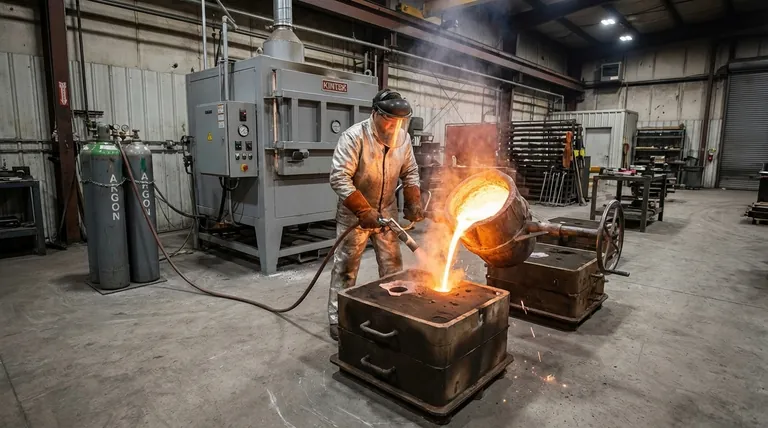
The use of a high-purity Argon atmosphere is a critical quality control measure during the casting of H13 steel. Its primary purpose is to physically isolate the molten metal from the surrounding air, creating an inert environment that effectively blocks chemical contamination. Specifically, it prevents secondary oxidation and restricts the absorption of atmospheric nitrogen, both of which are detrimental to the steel's final properties.
Core Insight: The value of an Argon atmosphere extends beyond simple surface protection; it is essential for internal structural integrity. By preventing the formation of oxide inclusions and uncontrolled nitrogen uptake, Argon allows for precise adherence to chemical specifications and superior mechanical performance.
Mechanisms of Protection
Isolating Molten Steel
Molten H13 steel is highly reactive when exposed to the atmosphere.
High-purity Argon acts as a barrier gas, displacing the air surrounding the mold and the pour.
This isolation ensures that the liquid metal does not interact with environmental gases during its most vulnerable state.
Preventing Secondary Oxidation
When molten steel contacts oxygen, it forms oxides that become trapped within the solidifying metal.
These trapped oxides create non-metallic inclusions, which act as stress concentration points and weaken the steel.
Argon shielding eliminates the oxygen source, significantly reducing the presence of these harmful inclusions.
Controlling Nitrogen Absorption
Atmospheric air contains a high concentration of nitrogen, which molten steel can easily absorb.
Uncontrolled nitrogen uptake alters the chemical composition of the H13 alloy, potentially deviating from the required specifications.
By excluding air, Argon prevents this absorption, allowing metallurgists to maintain precise control over the final nitrogen content.
Operational Considerations
The Requirement for High Purity
It is not enough to simply use any inert gas; the reference specifically highlights high-purity Argon.
If the Argon supply contains moisture or trace impurities, the protective barrier is compromised.
Using lower-grade gas can inadvertently introduce the very contaminants—oxygen and hydrogen—that the process aims to exclude.
Material Consistency
The goal of H13 casting is often to produce tool steels that require high fatigue strength and toughness.
Variations in the casting atmosphere lead to inconsistencies in the steel's microstructure.
Argon ensures a repeatable, stable environment, guaranteeing that every batch meets the same rigorous standards.
Achieving Casting Precision
To ensure the highest quality H13 steel, the atmospheric conditions must be managed as strictly as the alloy mix itself.
- If your primary focus is Chemical Stability: Use high-purity Argon to strictly prevent atmospheric nitrogen from altering the alloy's designed composition.
- If your primary focus is Mechanical Toughness: Rely on Argon shielding to minimize oxide inclusions, which are the leading cause of structural weakness in cast parts.
Mastering the casting atmosphere is the defining step in separating high-performance tool steel from standard grade metal.
Summary Table:
| Mechanism | Primary Benefit | Impact on H13 Steel Quality |
|---|---|---|
| Physical Isolation | Blocks atmospheric air | Prevents chemical contamination and impurities |
| Oxidation Prevention | Reduces oxide inclusions | Enhances mechanical toughness and fatigue strength |
| Nitrogen Control | Limits nitrogen absorption | Ensures precise adherence to chemical specifications |
| High-Purity Gas | Eliminates trace moisture | Guarantees repeatable, stable material consistency |
Optimize Your Casting and Heat Treatment with KINTEK
Achieve unmatched material integrity and structural precision for your H13 tool steel projects. Backed by expert R&D and manufacturing, KINTEK offers a wide range of high-performance Muffle, Tube, Rotary, Vacuum, and CVD systems. Our high-temperature lab furnaces are fully customizable to meet your unique atmospheric and thermal needs, ensuring every batch reaches its maximum performance potential.
Ready to elevate your metallurgical results? Contact our technical experts today!
Visual Guide

References
- Xiaolin Sun, Shuo Zhao. Effects of Ti and N Contents on the Characteristic Evolution and Thermal Stability of MC Carbonitrides Holding at 1250 °C in H13 Die Steel. DOI: 10.3390/met14030317
This article is also based on technical information from Kintek Furnace Knowledge Base .
Related Products
- Controlled Inert Nitrogen Hydrogen Atmosphere Furnace
- 1200℃ Controlled Inert Nitrogen Atmosphere Furnace
- 1700℃ Controlled Inert Nitrogen Atmosphere Furnace
- Mesh Belt Controlled Atmosphere Furnace Inert Nitrogen Atmosphere Furnace
- Multi Heating Zones CVD Tube Furnace Machine for Chemical Vapor Deposition Equipment
People Also Ask
- How does hydrogen furnace annealing assist in preparing mechanically alloyed powders for compaction?
- How does atmospheric annealing in a controlled hydrogen furnace affect the cold compaction behavior of metal powders?
- What are the characteristics and uses of hydrogen atmosphere in furnaces? Achieve Superior Surface Purity and Bonding
- What are the characteristics and uses of hydrogen atmospheres in furnaces? Unlock Clean Metal Processing
- What controlled-atmosphere furnace conditions are required for sintering powder metallurgy copper alloy compacts? Ideal Setup