
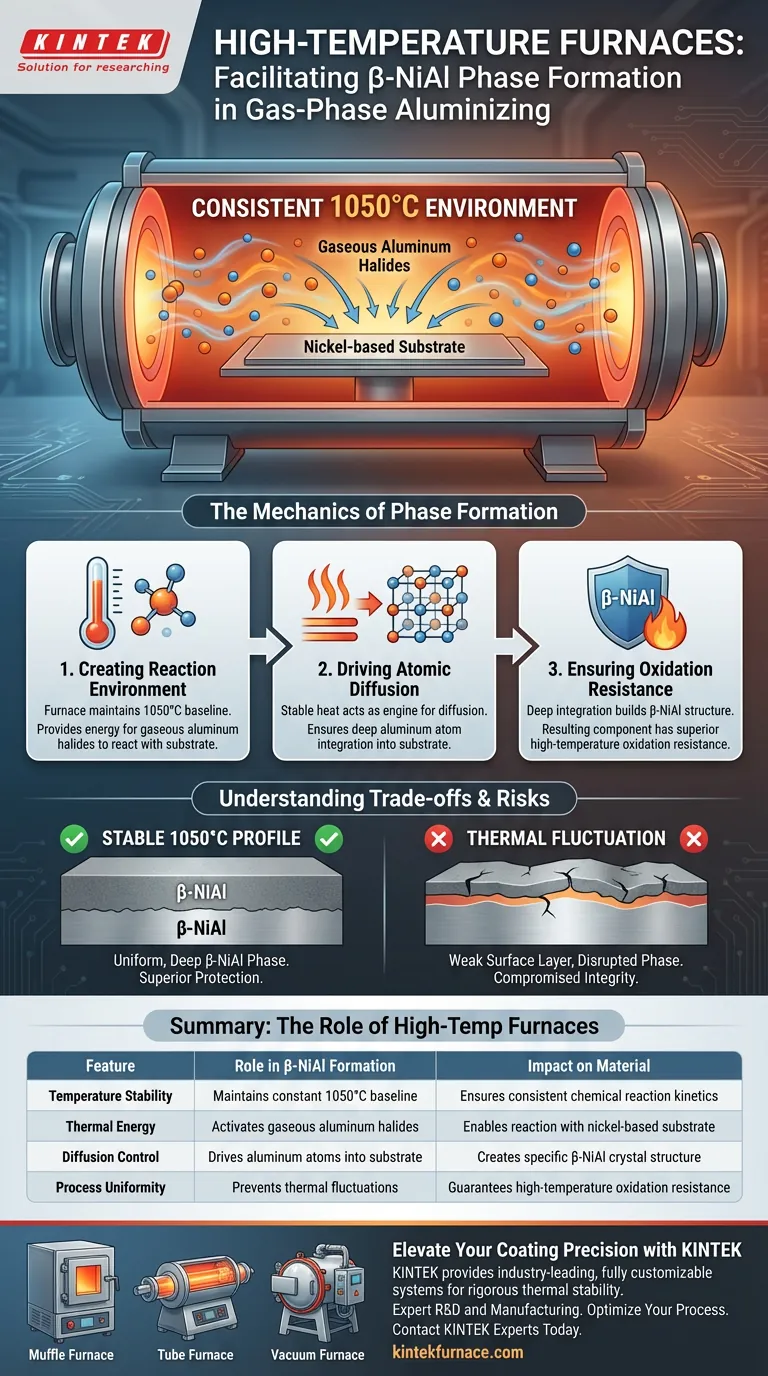
High-temperature furnaces serve as the critical catalyst for creating the $\beta$-NiAl phase by maintaining a precise and consistent environment at 1050°C. This specific thermal profile enables the necessary chemical reaction between gaseous aluminum halides and the nickel-based substrate, driving the aluminum diffusion required to form the correct crystal structure.
The success of gas-phase aluminizing relies fundamentally on thermal stability. A consistent 1050°C environment is not just a catalyst but a structural requirement to drive the diffusion that ensures high-temperature oxidation resistance.
The Mechanics of Phase Formation
Creating the Reaction Environment
The primary function of the furnace is to establish a consistent 1050°C baseline.
This temperature is non-negotiable for the process. It provides the energy required for gaseous aluminum halides to chemically react effectively with the nickel-based substrate.
Driving Atomic Diffusion
Heat acts as the engine for diffusion in this process.
The furnace’s stable heat profile ensures that aluminum atoms do not just sit on the surface but diffuse correctly into the substrate. This deep atomic integration is what builds the specific $\beta$-NiAl crystal structure.
Ensuring Oxidation Resistance
The ultimate goal of this thermal process is material longevity.
By strictly maintaining the crystal structure through controlled heat, the furnace ensures the resulting component has superior high-temperature oxidation resistance.
Understanding the Trade-offs
The Risk of Thermal Fluctuation
If the furnace fails to maintain a stable 1050°C profile, the integrity of the coating is compromised.
Temperature dips can prevent the aluminum from diffusing deep enough, resulting in a weak surface layer. Conversely, excessive fluctuations may disrupt the formation of the uniform $\beta$-NiAl phase, reducing the component's lifespan.
Making the Right Choice for Your Process
To ensure the highest quality aluminizing results, focus on the thermal capabilities of your equipment.
- If your primary focus is coating integrity: Ensure your furnace can maintain a strictly stable heat profile to guarantee correct atomic diffusion.
- If your primary focus is reaction efficiency: Verify the system can sustain the 1050°C baseline required to activate the gaseous aluminum halides.
Precision in thermal management is the defining factor between a standard coating and superior surface protection.
Summary Table:
| Feature | Role in β-NiAl Formation | Impact on Material |
|---|---|---|
| Temperature Stability | Maintains a constant 1050°C baseline | Ensures consistent chemical reaction kinetics |
| Thermal Energy | Activates gaseous aluminum halides | Enables reaction with nickel-based substrate |
| Diffusion Control | Drives aluminum atoms into the substrate | Creates the specific $\beta$-NiAl crystal structure |
| Process Uniformity | Prevents thermal fluctuations | Guarantees high-temperature oxidation resistance |
Elevate Your Coating Precision with KINTEK
Don't let thermal fluctuations compromise your coating integrity. KINTEK provides industry-leading Muffle, Tube, and Vacuum furnace systems specifically engineered to maintain the rigorous thermal stability required for gas-phase aluminizing.
Backed by expert R&D and manufacturing, our high-temperature solutions are fully customizable to meet your unique diffusion and CVD needs. Ensure superior oxidation resistance for your components with equipment designed for precision.
Contact KINTEK Experts Today to Optimize Your Process
Visual Guide
References
- Effect of Ni-Based Superalloy on the Composition and Lifetime of Aluminide Coatings. DOI: 10.3390/ma18133138
This article is also based on technical information from Kintek Furnace Knowledge Base .
Related Products
- 1400℃ High Temperature Laboratory Tube Furnace with Alumina Tube
- 1800℃ High Temperature Muffle Oven Furnace for Laboratory
- 1700℃ High Temperature Laboratory Tube Furnace with Alumina Tube
- 1700℃ High Temperature Muffle Oven Furnace for Laboratory
- 1700℃ Controlled Inert Nitrogen Atmosphere Furnace
People Also Ask
- How are high-temperature laboratory tube furnaces applied in long-term vacuum homogenization heat treatments for intermetallic samples?
- How do high-temperature laboratory tube furnaces ensure environmental stability? Precision Thermal Reduction Tips
- How are high-temp tube furnaces used to measure diffusion coefficients per Fick's law? Master Precision Annealing
- How are high-temperature tube furnaces applied in testing ceramic-supported alloy membranes? Insights
- What is the function of a furnace in CuAlMn alloy treatment? Achieve Perfect Microstructural Homogenization



















