
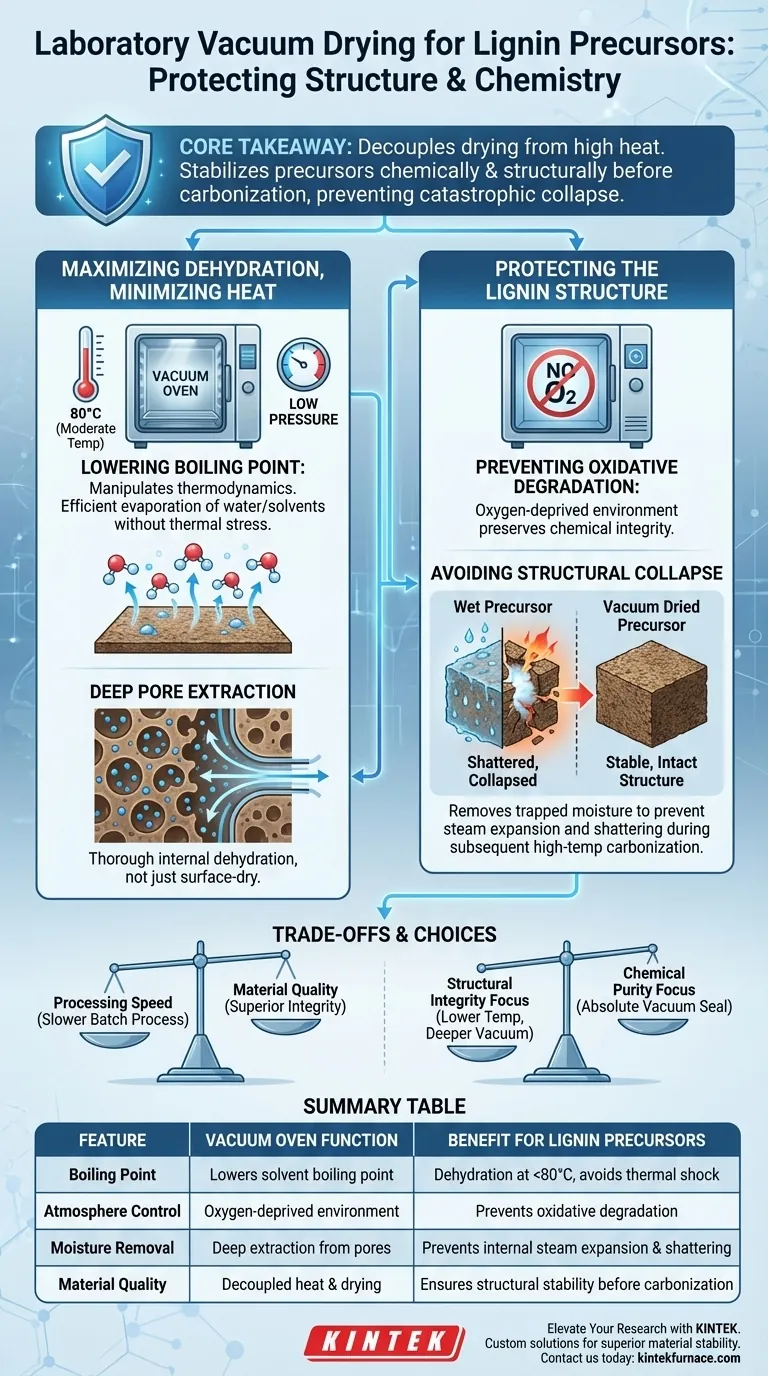
A laboratory vacuum drying oven serves a critical protective function in treating lignin-based precursors by creating a low-pressure environment that allows for deep dehydration at moderate temperatures (typically around 80°C). By lowering the boiling point of water and solvents, the oven removes moisture from within porous structures without exposing the sensitive lignin material to the oxidative degradation or thermal shock associated with standard high-temperature drying.
Core Takeaway The vacuum drying oven acts as a stabilization stage, decoupling the drying process from high heat. It ensures the precursor is chemically stable and structurally sound before carbonization, preventing the catastrophic structural collapse that occurs when residual internal moisture rapidly expands at high temperatures.
Maximizing Dehydration While Minimizing Heat
Lowering the Boiling Point
The fundamental advantage of this equipment is its ability to manipulate thermodynamics. By reducing the chamber pressure, the oven significantly lowers the boiling point of water and volatile solvents.
This allows the precursors to be dried thoroughly at temperatures as low as 80°C. You achieve efficient evaporation without subjecting the material to thermal stress that could alter its fundamental properties.
Deep Pore Extraction
Lignin-based precursors often possess complex, porous architectures. Standard drying methods frequently fail to remove moisture trapped deep within these pores.
The vacuum environment effectively pulls residual moisture and organic solvents from the core of the material. This ensures that the precursor is not just surface-dry, but thoroughly dehydrated internally.
Protecting the Lignin Structure
Preventing Oxidative Degradation
Lignin is highly susceptible to chemical changes when exposed to oxygen at elevated temperatures. A standard air oven can inadvertently trigger oxidation, altering the chemical composition of the precursor before the main reaction takes place.
A vacuum oven operates in an oxygen-deprived environment. This prevents unnecessary oxidative degradation, ensuring the chemical integrity of the lignin is preserved for the subsequent synthesis or carbonization steps.
Avoiding Structural Collapse
The most critical role of this drying phase is preparing the material for high-temperature carbonization. If moisture remains trapped inside the pores, the rapid heating during carbonization will cause that water to flash into steam.
This sudden expansion can shatter the material's internal structure. By removing this moisture beforehand, the vacuum oven prevents structural collapse, maintaining the precursor's intended morphology and porosity.
Understanding the Trade-offs
Processing Speed vs. Material Quality
While superior for quality, vacuum drying is generally slower than forced-air convection drying. It is a batch process that prioritizes structural integrity over throughput speed.
Equipment Sensitivity
Vacuum drying requires precise control over pressure seals and pump maintenance. Unlike simple heating ovens, inconsistent pressure levels can lead to uneven drying or incomplete solvent removal, potentially compromising the batch.
Making the Right Choice for Your Goal
To maximize the utility of a vacuum drying oven for lignin precursors, align your settings with your specific objectives:
- If your primary focus is Structural Integrity: Prioritize a lower temperature setting with a deeper vacuum to gently extract moisture without collapsing fine pores.
- If your primary focus is Chemical Purity: Ensure the vacuum seal is absolute to eliminate all oxygen exposure, preventing any pre-carbonization oxidation.
The vacuum drying oven is not merely a drying tool; it is a prerequisite for high-performance carbon materials, ensuring that the precursor entering your furnace is pure, stable, and dry.
Summary Table:
| Feature | Vacuum Drying Oven Function | Benefit for Lignin Precursors |
|---|---|---|
| Boiling Point | Lowers boiling point of solvents | Dehydration at <80°C to avoid thermal shock |
| Atmosphere Control | Oxygen-deprived environment | Prevents oxidative degradation of chemical bonds |
| Moisture Removal | Deep extraction from porous cores | Prevents internal steam expansion and shattering |
| Material Quality | Decoupled heat and drying stages | Ensures structural stability before carbonization |
Elevate Your Precursor Research with KINTEK
Don't let moisture compromise your high-performance carbon materials. KINTEK provides expert-engineered laboratory solutions designed to preserve the chemical and structural integrity of your sensitive precursors.
Backed by industry-leading R&D and manufacturing, we offer a comprehensive range of Muffle, Tube, Rotary, Vacuum, and CVD systems. Whether you are drying lignin-based materials or conducting high-temperature synthesis, our lab furnaces are fully customizable to meet your unique research needs.
Ready to achieve superior material stability? Contact us today to find your custom solution.
Visual Guide
References
- Yuebin Xi, Binpeng Zhang. Production of Lignin-Derived Functional Material for Efficient Electromagnetic Wave Absorption with an Ultralow Filler Ratio. DOI: 10.3390/polym16020201
This article is also based on technical information from Kintek Furnace Knowledge Base .
Related Products
- Vacuum Heat Treat Sintering and Brazing Furnace
- Vacuum Heat Treat Sintering Furnace Molybdenum Wire Vacuum Sintering Furnace
- Dental Porcelain Zirconia Sintering Ceramic Vacuum Press Furnace
- Molybdenum Vacuum Heat Treat Furnace
- Vacuum Hot Press Furnace Machine Heated Vacuum Press
People Also Ask
- What are the benefits of using vacuum heat treating furnaces for metal alloys? Achieve Superior Metal Properties and Performance
- What is one of the most important uses of vacuum heat treating furnaces in aerospace? Achieve Superior Strength in Aircraft Alloys
- How does vacuum heat treating affect the grain structure of metal alloys? Achieve Precise Microstructure Control
- What is the temperature of a vacuum furnace brazing? Optimize Your Joint Strength and Cleanliness
- What are the steps involved in a typical vacuum brazing treatment? Master the Process for Strong, Clean Joints












