
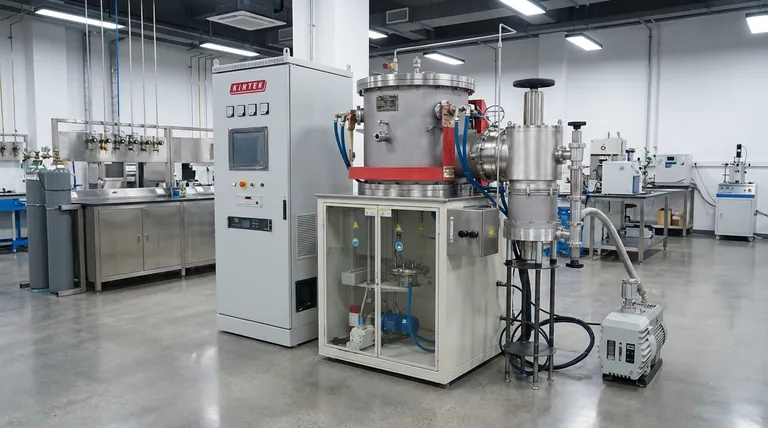
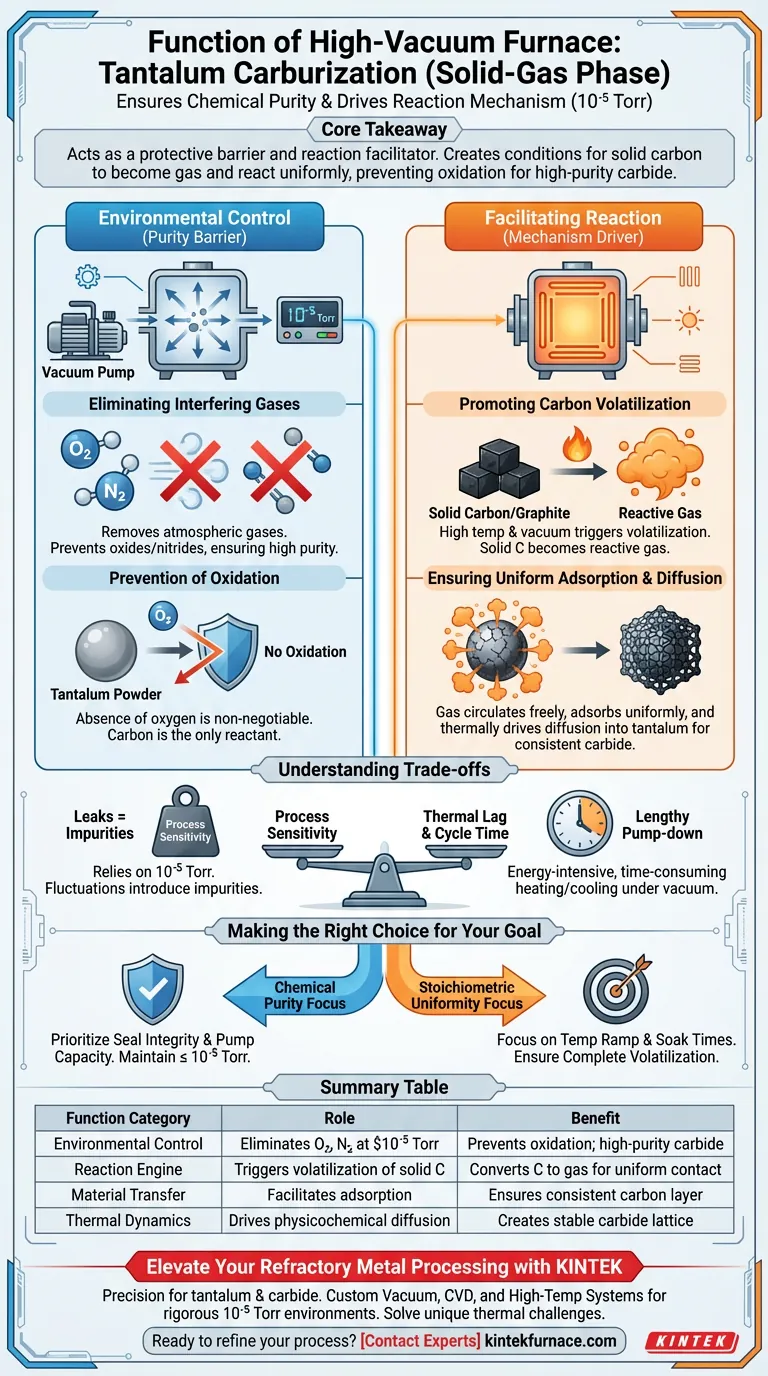
In the solid-gas phase carburization of tantalum powder, the high-vacuum furnace serves two distinct but interrelated functions: it ensures chemical purity and drives the reaction mechanism. Specifically, it establishes an ultra-low pressure environment (typically $10^{-5}$ Torr) to eliminate contaminants while simultaneously promoting the volatilization of carbon sources to allow for uniform diffusion into the tantalum substrate.
Core Takeaway The high-vacuum furnace acts as both a protective barrier and a reaction facilitator. It creates the necessary conditions for solid carbon to transform into a gas and react uniformly with tantalum powder, preventing oxidation and ensuring a high-purity carbide structure.
The Role of Environmental Control
Eliminating Interfering Gases
The primary role of the furnace is to create an "exclusion zone" for impurities. Tantalum is a refractory metal that is highly sensitive to interstitial impurities like oxygen and nitrogen.
By achieving a high vacuum around $10^{-5}$ Torr, the furnace removes atmospheric gases that would otherwise react with the tantalum. This ensures that the final tantalum carbide retains high purity, free from oxides or nitrides that would degrade its performance.
Prevention of Oxidation
Similar to processes used for Titanium or Ruthenium powders, the absence of oxygen is non-negotiable.
If oxygen were present during the high-temperature phase, the tantalum powder would oxidize rather than carburize. The vacuum environment guarantees that carbon is the only element reacting with the metal.
Facilitating the Reaction Mechanism
Promoting Carbon Volatilization
In solid-gas phase carburization, the carbon source is initially a solid, such as activated carbon or graphite.
The high-temperature vacuum environment triggers the volatilization of these carbon-containing agents. This phase change—converting solid carbon into a reactive gas—is the engine of the entire process.
Ensuring Uniform Adsorption
Once the carbon source volatilizes, the gas circulates freely around the tantalum powder particles.
The vacuum environment allows these gases to physically and chemically adsorb onto the surface of the tantalum powder without physical barriers. This ensures that every particle is exposed to the reactant equally.
Driving Physicochemical Diffusion
After adsorption, the carbon atoms must penetrate the tantalum metal to form the carbide lattice.
The thermal energy provided by the furnace drives this diffusion process. Because the environment is controlled, the diffusion occurs uniformly across the powder's surface, resulting in a consistent carbide layer and predictable material properties.
Understanding the Trade-offs
Process Sensitivity
While a high-vacuum furnace provides superior purity, it introduces significant process sensitivity.
The system relies on maintaining the $10^{-5}$ Torr threshold. Any fluctuation in pressure or minor leaks in the vacuum seal will immediately introduce impurities, likely ruining the batch by causing partial oxidation.
Thermal Lag and Cycle Time
Achieving and maintaining high vacuum at high temperatures is energy-intensive and time-consuming.
Unlike atmospheric furnaces, vacuum furnaces require lengthy pump-down cycles before heating can begin, and cooling must often occur under vacuum to prevent post-process oxidation. This reduces throughput compared to continuous atmosphere processes.
Making the Right Choice for Your Goal
To optimize the carburization of tantalum powder, focus on these operational parameters:
- If your primary focus is Chemical Purity: Prioritize the integrity of the vacuum seals and pump capacity to strictly maintain pressures at or below $10^{-5}$ Torr to exclude all interfering gases.
- If your primary focus is Stoichiometric Uniformity: Focus on the temperature ramp rates and soak times to ensure complete volatilization of the graphite/carbon agents for even diffusion.
The high-vacuum furnace is not merely a heating vessel; it is a precision tool that orchestrates the phase change of carbon to engineer the surface chemistry of tantalum.
Summary Table:
| Function Category | Role in Tantalum Carburization | Benefit to Process |
|---|---|---|
| Environmental Control | Eliminates oxygen and nitrogen at $10^{-5}$ Torr | Prevents oxidation; ensures high-purity carbide |
| Reaction Engine | Triggers volatilization of solid carbon sources | Converts carbon to gas for uniform surface contact |
| Material Transfer | Facilitates physical and chemical adsorption | Ensures consistent carbon layer across all powder particles |
| Thermal Dynamics | Drives physicochemical diffusion | Creates a stable, predictable carbide lattice structure |
Elevate Your Refractory Metal Processing with KINTEK
Precision is paramount when working with tantalum and carbide structures. KINTEK provides industry-leading Vacuum, CVD, and High-Temperature Muffle Systems specifically engineered to maintain the rigorous $10^{-5}$ Torr environments required for sensitive gas-solid reactions.
Backed by expert R&D and world-class manufacturing, our systems are fully customizable to solve your unique thermal processing challenges. Whether you need to optimize stoichiometric uniformity or ensure absolute chemical purity, our lab-grade furnaces offer the control you need.
Ready to refine your carburization process? Contact our technical experts today to find the perfect furnace for your application.
Visual Guide
References
- Seon-Min Hwang, Dong‐Won Lee. Carburization of Tantalum Metal Powder Using Activated Carbon. DOI: 10.3390/ma18122710
This article is also based on technical information from Kintek Furnace Knowledge Base .
Related Products
- Molybdenum Vacuum Heat Treat Furnace
- 2200 ℃ Tungsten Vacuum Heat Treat and Sintering Furnace
- 9MPa Air Pressure Vacuum Heat Treat and Sintering Furnace
- High Pressure Laboratory Vacuum Tube Furnace
- Vacuum Induction Melting Furnace
People Also Ask
- What is the primary application of vacuum heat treating furnaces in aerospace? Enhance Component Performance with Precision
- How does vacuum heat treating work in terms of temperature and time control? Master Precise Material Transformations
- How does a vacuum heat treating furnace improve the condition of metal alloys? Achieve Superior Metal Performance
- What is the process of vacuum heat treating? Achieve Superior Metallurgical Properties
- Why are vacuum heat treating furnaces essential for aerospace? Ensure Superior Material Integrity for High-Stakes Applications



















