
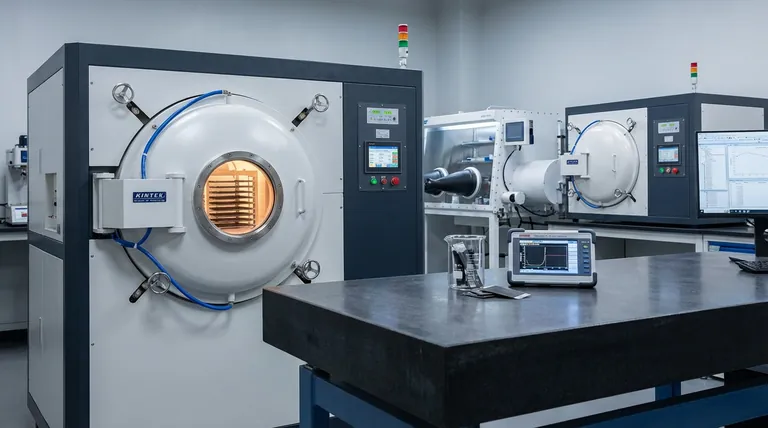
A vacuum oven serves as the decisive stabilization step in the processing of manganese dioxide (delta-MnO2) electrode sheets. It functions primarily to drive out residual organic solvents from the coated slurry while strictly controlling the atmospheric environment to prevent chemical degradation.
By maintaining a vacuum at moderate temperatures, typically 60°C for approximately 12 hours, the equipment ensures the electrode achieves structural and chemical integrity before battery assembly.
Core Takeaway While standard drying removes moisture, a vacuum oven provides a low-pressure environment that allows for deep solvent extraction without excessive heat. Crucially, it isolates the delta-MnO2 from atmospheric oxygen and moisture, preserving the specific oxygen vacancies required for high-performance energy storage.
The Critical Functions of Vacuum Drying
Deep Solvent Extraction
After the electrode slurry is coated onto the substrate, it retains significant amounts of organic solvents. The vacuum oven removes these solvents thoroughly.
By lowering the pressure, the vacuum environment reduces the boiling point of these solvents. This allows for complete evaporation at a relatively low temperature (60°C), ensuring the electrode dries efficiently without requiring damaging high heat.
Prevention of Adverse Side Reactions
Manganese dioxide is chemically sensitive during the drying phase. The vacuum oven eliminates atmospheric air from the chamber.
This oxygen-free and moisture-free environment prevents the active material from reacting with ambient humidity or oxygen. Preventing these reactions is essential to stop the material from degrading before it is even assembled into a battery.
Preservation of Oxygen Vacancies
The specific electrochemical performance of delta-MnO2 relies heavily on its internal structure, specifically the presence of oxygen vacancies.
Standard drying in air could lead to oxidation that fills these vacancies or alters the crystal structure. The vacuum oven locks in the material's stability, ensuring these vacancies remain available to facilitate ion transport during battery operation.
Understanding the Trade-offs
Temperature vs. Time Balance
Operating at a lower temperature like 60°C is safer for the material but requires patience.
The process typically requires a long duration, such as 12 hours, to ensure total dryness. Rushing this process by increasing heat could thermally shock the material or degrade the binder, while shortening the time risks leaving residual solvent trapped deep in the pores.
Processing Complexity
Using a vacuum oven adds a layer of complexity compared to ambient drying.
It requires precise control of pressure levels and seal integrity. A failure in the vacuum seal introduces oxygen and moisture, which can immediately compromise the stability of the delta-MnO2 active sites.
Making the Right Choice for Your Goal
To maximize the performance of delta-MnO2 electrodes, align your processing parameters with your specific electrochemical targets.
- If your primary focus is Electrochemical Stability: Prioritize the integrity of the vacuum seal to strictly exclude oxygen, preserving the oxygen vacancies essential for long cycle life.
- If your primary focus is Structural Integrity: Adhere strictly to the moderate temperature limit (60°C) to remove solvents without causing thermal stress to the binder or active material.
The vacuum oven is not merely a drying tool; it is a stabilization chamber that defines the initial quality and future potential of the electrode.
Summary Table:
| Feature | Vacuum Oven Processing Parameters | Impact on delta-MnO2 Performance |
|---|---|---|
| Temperature | 60°C (Moderate Heat) | Prevents thermal degradation and protects binder integrity. |
| Drying Time | Approximately 12 Hours | Ensures deep solvent extraction without trapping residues in pores. |
| Atmosphere | Low-Pressure / Oxygen-Free | Prevents chemical degradation and preserves critical oxygen vacancies. |
| Primary Goal | Deep Solvent Removal | Achieves structural and chemical stability before battery assembly. |
Maximize Your Battery Research with KINTEK’s Precision Heating Solutions
Precise control over temperature and atmosphere is vital for the stability of delta-MnO2 electrodes. Backed by expert R&D and manufacturing, KINTEK offers a comprehensive range of Muffle, Tube, Rotary, Vacuum, and CVD systems, all designed to meet the rigorous demands of advanced material science. Whether you are scaling up production or refining laboratory prototypes, our customizable high-temperature furnaces ensure your materials maintain their structural integrity and electrochemical performance.
Ready to optimize your electrode drying process? Contact us today to find the perfect vacuum system for your lab!
References
- Shilong Li, Xiang Wu. Oxygen Vacancy-Rich δ-MnO2 Cathode Materials for Highly Stable Zinc-Ion Batteries. DOI: 10.3390/batteries10080294
This article is also based on technical information from Kintek Furnace Knowledge Base .
Related Products
- Vacuum Heat Treat Sintering and Brazing Furnace
- Vacuum Heat Treat Sintering Furnace Molybdenum Wire Vacuum Sintering Furnace
- Dental Porcelain Zirconia Sintering Ceramic Vacuum Press Furnace
- Vacuum Hot Press Furnace Machine for Lamination and Heating
- Vacuum Hot Press Furnace Machine Heated Vacuum Press
People Also Ask
- What are the benefits of using vacuum heat treating furnaces for metal alloys? Achieve Superior Metal Properties and Performance
- What is one of the most important uses of vacuum heat treating furnaces in aerospace? Achieve Superior Strength in Aircraft Alloys
- How does vacuum heat treating affect the grain structure of metal alloys? Achieve Precise Microstructure Control
- What is the temperature of a vacuum furnace brazing? Optimize Your Joint Strength and Cleanliness
- What are the steps involved in a typical vacuum brazing treatment? Master the Process for Strong, Clean Joints



















