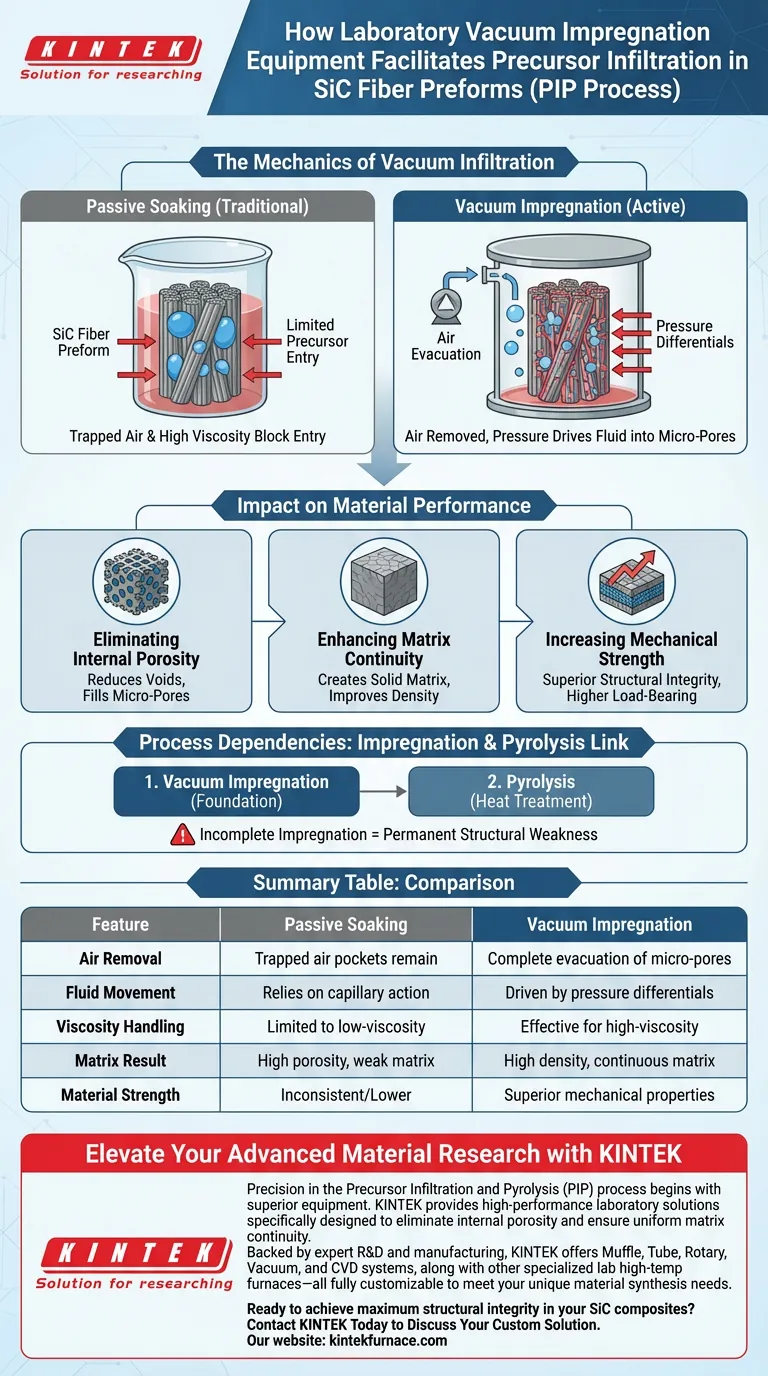
Laboratory vacuum impregnation equipment facilitates infiltration by actively evacuating air from the internal structure of SiC fiber preforms. By creating a vacuum environment, the equipment removes the gas pockets that typically block fluid entry, allowing pressure differentials to force high-viscosity precursor solutions into the smallest micro-pores and gaps. This ensures deep, uniform saturation of the fiber bundles, which is impossible to achieve through passive soaking methods.
By effectively replacing trapped air with liquid precursor, vacuum impregnation directly dictates the density of the final composite. It transforms the preform from a porous structure into a solid, continuous matrix, which is the prerequisite for achieving high mechanical strength.
The Mechanics of Vacuum Infiltration
Overcoming High Viscosity Barriers
In the PIP process, precursor solutions often possess high viscosity, making them resistant to flowing into tight spaces naturally.
Vacuum impregnation eliminates the resistance caused by trapped air pockets. Without air occupying the internal volume, the thick precursor fluid can move freely into the intricate weave of the fiber bundles.
Leveraging Pressure Differentials
The equipment operates on the principle of pressure differentials.
After the air is evacuated, the difference between the internal vacuum and the external pressure drives the liquid inward. This force pushes the precursor into the deepest regions of the preform, ensuring intimate contact between the fluid and the fiber surfaces.
Impact on Material Performance
Eliminating Internal Porosity
The primary enemy of composite strength is the void—an empty space within the material.
Vacuum impregnation targets the internal structure of the preform to remove these potential defects before they form. By filling micro-pores and gaps with precursor, the equipment significantly reduces the internal porosity of the composite.
Enhancing Matrix Continuity
The quality of the impregnation directly impacts the subsequent heat treatment (pyrolysis) phase.
Because the precursor has fully penetrated the structure, the heat treatment results in the formation of a more continuous matrix. This continuity increases the overall density of the composite material.
Increasing Mechanical Strength
The ultimate goal of using this equipment is to improve the mechanical properties of the SiC composite.
A denser material with fewer voids and a continuous matrix is inherently stronger. Deep impregnation ensures that the load-bearing capabilities of the fibers are fully supported by the surrounding ceramic matrix.
Understanding the Process Dependencies
The Link Between Impregnation and Pyrolysis
It is critical to understand that vacuum impregnation is not a standalone solution; it is the foundation for the pyrolysis step.
If the impregnation step fails to fully remove air, the subsequent heat treatment will lock those defects in place. The equipment must be calibrated to ensure deep penetration, as any remaining voids will become permanent structural weaknesses in the final ceramic product.
Making the Right Choice for Your Goal
To maximize the effectiveness of the PIP process, align your equipment usage with your specific material objectives:
- If your primary focus is maximizing mechanical strength: Ensure your vacuum protocols are aggressive enough to evacuate air from the deepest micro-pores, as this density directly correlates to structural integrity.
- If your primary focus is handling complex precursors: Rely on vacuum impregnation to manage high-viscosity fluids that cannot penetrate the fiber preform through capillary action alone.
Deep impregnation is not just a filling step; it is the defining factor in the structural continuity of your final composite.
Summary Table:
| Feature | Passive Soaking | Vacuum Impregnation |
|---|---|---|
| Air Removal | Trapped air pockets remain | Complete evacuation of micro-pores |
| Fluid Movement | Relies on capillary action | Driven by pressure differentials |
| Viscosity Handling | Limited to low-viscosity fluids | Effective for high-viscosity precursors |
| Matrix Result | High porosity, weak matrix | High density, continuous matrix |
| Material Strength | Inconsistent/Lower | Superior mechanical properties |
Elevate Your Advanced Material Research with KINTEK
Precision in the Precursor Infiltration and Pyrolysis (PIP) process begins with superior equipment. KINTEK provides high-performance laboratory solutions specifically designed to eliminate internal porosity and ensure uniform matrix continuity.
Backed by expert R&D and manufacturing, KINTEK offers Muffle, Tube, Rotary, Vacuum, and CVD systems, along with other specialized lab high-temp furnaces—all fully customizable to meet your unique material synthesis needs.
Ready to achieve maximum structural integrity in your SiC composites?
Contact KINTEK Today to Discuss Your Custom Solution
Visual Guide
References
- Katsumi Yoshida, Masaki Kotani. Mechanical properties of SiC <sub>f</sub> /SiC composites with h‐BN interphase formed by the electrophoretic deposition method. DOI: 10.1111/ijac.14687
This article is also based on technical information from Kintek Furnace Knowledge Base .
Related Products
- Laboratory Vacuum Tilt Rotary Tube Furnace Rotating Tube Furnace
- High Pressure Laboratory Vacuum Tube Furnace
- Vacuum Hot Press Furnace Machine for Lamination and Heating
- Small Vacuum Heat Treat and Tungsten Wire Sintering Furnace
- Vacuum Dental Porcelain Sintering Furnace for Dental Laboratories
People Also Ask
- What are the key advantages of using a rotary tube furnace? Achieve Dynamic, Uniform Heating for Powders
- When are rotary tube furnaces not suitable for a process? Avoid Costly Mistakes in Thermal Processing
- What other fields utilize rotary tube furnaces? Discover Versatile Heating Solutions for Multiple Industries
- What optional features enhance the processing capabilities of rotary tube furnaces? Boost Efficiency with Advanced Customizations
- What are the technical advantages of using a rotary tube furnace for hydrochar activation? Achieve Superior Porosity