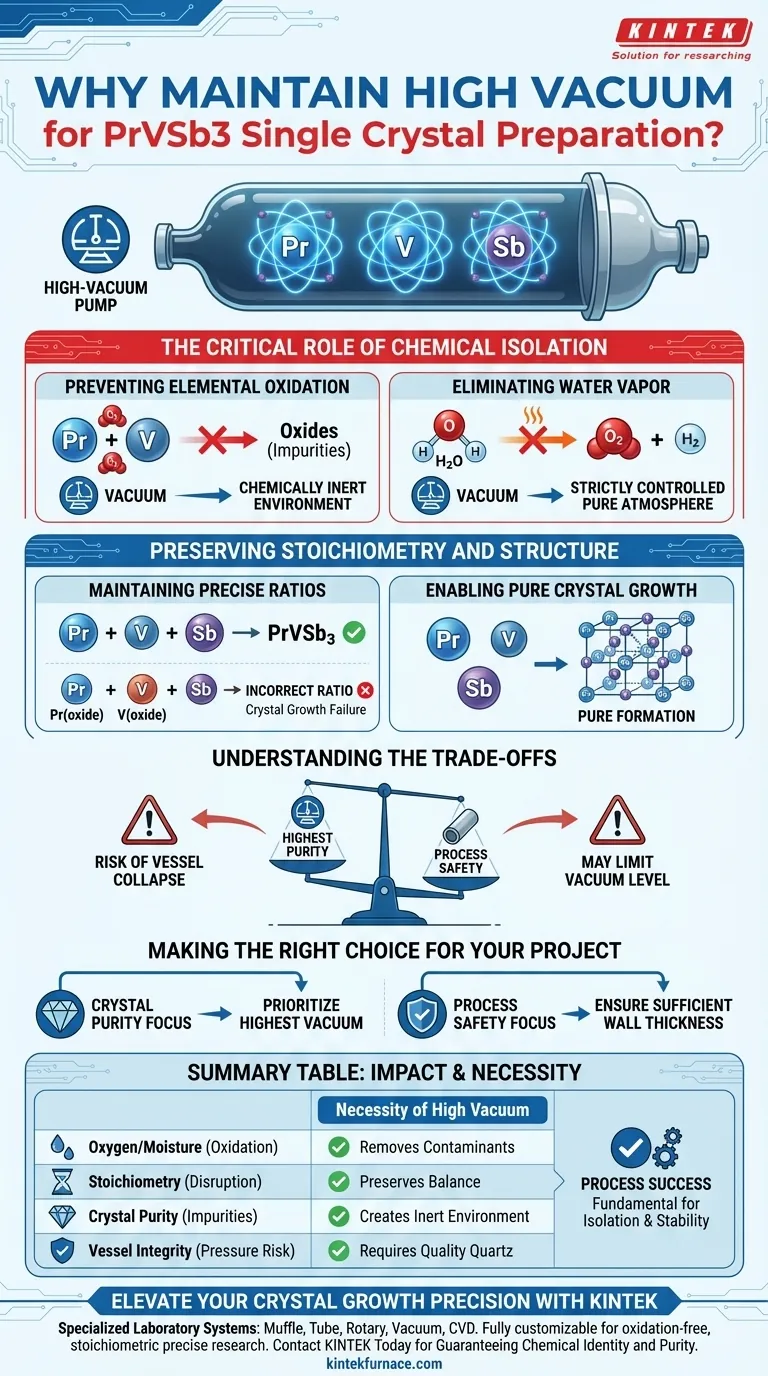
Maintaining a high vacuum state during the sealing process is a fundamental requirement to eliminate oxygen and water vapor from the reaction vessel. Specifically for PrVSb3 preparation, this step is mandatory to prevent the oxidation of the rare earth element Praseodymium (Pr) and the transition metal Vanadium (V) when exposed to high temperatures.
Core Insight: The integrity of a single crystal depends on the precise availability of its constituent atoms; failing to remove reactive gases causes essential metals to become oxides, permanently destroying the stoichiometric balance required for crystal growth.
The Critical Role of Chemical Isolation
Preventing Elemental Oxidation
Praseodymium (Pr) and Vanadium (V) are highly reactive elements, particularly when heated. If air remains in the tube, these metals will react with oxygen rather than with the Antimony (Sb).
This reaction creates oxides (impurities) instead of the desired PrVSb3 compound. High vacuum ensures the environment remains chemically inert, protecting the raw materials.
Eliminating Water Vapor
Moisture is as detrimental as free oxygen in high-temperature synthesis. Even trace amounts of water vapor trapped in the tube can dissociate at high heat, releasing oxygen and hydrogen.
Vacuum sealing removes this moisture, ensuring that the internal atmosphere is strictly controlled and pure.
Preserving Stoichiometry and Structure
Maintaining Precise Ratios
Single crystal growth requires an accurate stoichiometric ratio—a specific mathematical balance of atoms.
If a portion of the Praseodymium or Vanadium oxidizes, it is effectively removed from the synthesis equation. This leaves the remaining melt with an incorrect ratio of elements, preventing the formation of high-quality PrVSb3 crystals.
Enabling Pure Crystal Growth
The vacuum creates an isolated environment where the only available reactants are the intended raw materials.
This isolation allows the atoms to mix and arrange themselves purely based on their chemical affinity for the crystal structure, rather than battling contaminants.
Understanding the Trade-offs
Mechanical Stress on the Vessel
While high vacuum is chemically necessary, it creates a pressure differential between the inside and outside of the quartz tube.
At high temperatures, quartz softens slightly. If the vacuum is too high relative to the wall thickness of the tube, there is a risk of the tube collapsing or imploding under external pressure.
Process Complexity
Achieving and maintaining a high vacuum adds a layer of complexity to the preparation.
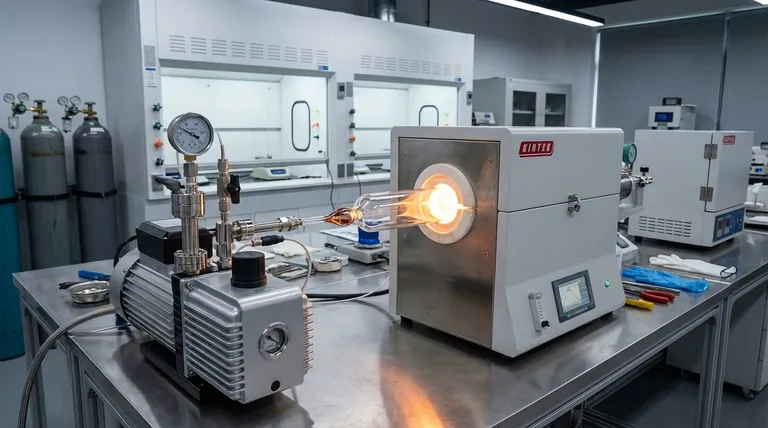
It requires specialized pumping equipment and precise sealing techniques to ensure the quartz is closed off without allowing air to rush back in at the final moment.
Making the Right Choice for Your Project
To ensure successful PrVSb3 growth, prioritize your process parameters based on your specific limitations:
- If your primary focus is Crystal Purity: Prioritize the highest possible vacuum level (lowest pressure) to completely eliminate oxygen and protect the Pr and V atoms.
- If your primary focus is Process Safety: Ensure your quartz tubes have sufficient wall thickness to withstand the pressure differential created by the high vacuum at melting temperatures.
Ultimately, the vacuum is not just an empty space; it is an active protective barrier that guarantees the chemical identity of your final material.
Summary Table:
| Factor | Impact on PrVSb3 Synthesis | Necessity of High Vacuum |
|---|---|---|
| Oxygen/Moisture | Causes oxidation of reactive Pr and V | Removes contaminants to prevent impurities |
| Stoichiometry | Disrupts atomic ratios required for growth | Preserves the precise balance of raw materials |
| Crystal Purity | Introduces oxides and foreign phases | Creates an inert environment for pure formation |
| Vessel Integrity | High pressure differential at heat | Requires high-quality quartz for safety |
| Process Success | Potential failure of crystal growth | Fundamental for chemical isolation and stability |
Elevate Your Crystal Growth Precision with KINTEK
Achieving the perfect high-vacuum environment is essential for the synthesis of advanced materials like PrVSb3. KINTEK provides state-of-the-art laboratory high-temperature systems—including Muffle, Tube, Rotary, Vacuum, and CVD systems—specifically engineered to meet the rigorous demands of rare earth and transition metal research.
Backed by expert R&D and world-class manufacturing, our equipment is fully customizable to ensure your quartz tube sealing and heating processes remain oxidation-free and stoichiometrically precise. Contact KINTEK today to discover how our high-performance furnace solutions can guarantee the chemical identity and purity of your research materials.
Visual Guide
Related Products
- Vacuum Sealed Continuous Working Rotary Tube Furnace Rotating Tube Furnace
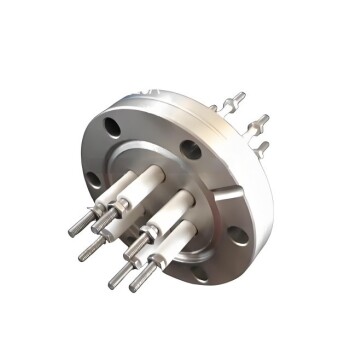
- CF KF Flange Vacuum Electrode Feedthrough Lead Sealing Assembly for Vacuum Systems
- High Pressure Laboratory Vacuum Tube Furnace
- Multi Zone Laboratory Quartz Tube Furnace Tubular Furnace
- Vertical Laboratory Quartz Tube Furnace Tubular Furnace
People Also Ask
- What is the purpose of rotary tube furnaces? Achieve Uniform Heat Treatment for Powders and Granules
- What are the key advantages of using a rotary tube furnace? Achieve Dynamic, Uniform Heating for Powders
- How does the amount of material processed vary between batch and continuous rotary tube furnaces? Scale Your Production Efficiently
- What are the advantages of rotary tube furnaces in fuel compatibility? Boost Efficiency and Cut Costs
- What is the temperature range of some rotary tube furnaces? Achieve Uniform Heating Up to 1200°C