
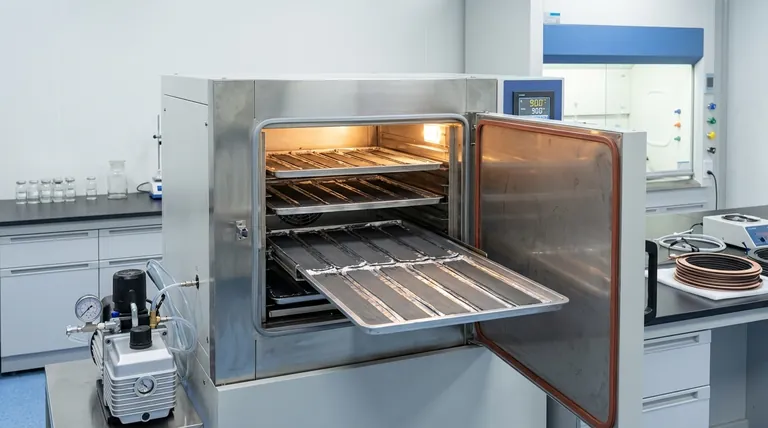
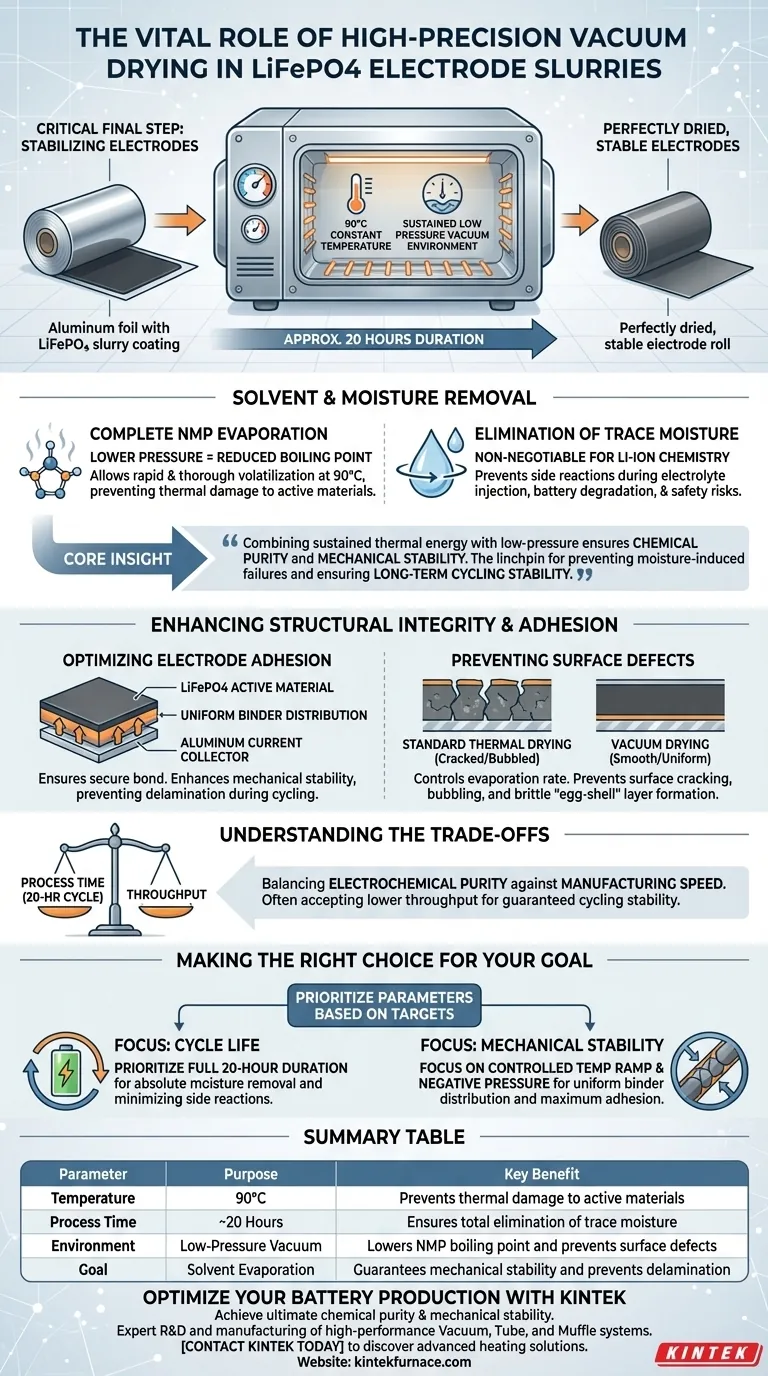
High-precision vacuum drying is the critical final step in stabilizing LiFePO4 electrode slurries prior to cell assembly. It involves treating the coated aluminum foil at controlled temperatures, specifically 90°C for approximately 20 hours, to guarantee the total evaporation of N-methyl-2-pyrrolidone (NMP) solvents and the elimination of residual trace moisture.
Core Insight: By combining sustained thermal energy with a low-pressure environment, vacuum drying ensures the chemical purity and mechanical stability of the electrode. This process is the linchpin for preventing moisture-induced failure mechanisms and ensuring the long-term cycling stability of the battery.
The Critical Role of Solvent and Moisture Removal
Complete Evaporation of NMP
The primary function of the vacuum oven is to drive off N-methyl-2-pyrrolidone (NMP), the organic solvent used to create the slurry.
By lowering the pressure, the oven reduces the boiling point of the solvent. This allows for rapid and thorough volatilization at moderate temperatures (90°C), preventing the slurry from remaining "wet" without subjecting the active materials to damaging levels of heat.
Elimination of Trace Moisture
Beyond bulk solvent removal, the process targets residual trace moisture deep within the electrode structure.
Removing this moisture is non-negotiable for lithium-ion chemistry. If water remains, it can trigger side reactions during electrolyte injection, leading to battery degradation and safety risks.
Enhancing Structural Integrity and Adhesion
Optimizing Electrode Adhesion
A thoroughly dried electrode is required to secure the bond between the active LiFePO4 material and the aluminum current collector.
The vacuum drying process ensures that the binder distributes uniformly. This enhances the mechanical stability of the electrode, preventing delamination or detachment during the physical stress of battery cycling.
Preventing Surface Defects
Vacuum drying helps manage the evaporation rate to avoid defects common in standard thermal drying.
By lowering the boiling point, the solvent evaporates evenly rather than "flashing" off the surface. This prevents the surface layer from drying too quickly, which effectively mitigates cracking, bubbling, or the formation of a brittle "egg-shell" layer on the coating surface.
Understanding the Trade-offs
Process Time vs. Throughput
While high-precision vacuum drying offers superior quality, it is inherently a time-intensive process.
The requirement for a 20-hour cycle significantly impacts production throughput compared to rapid convective drying methods. Engineers must balance the need for electrochemical purity against manufacturing speed, often accepting lower throughput to guarantee the cycling stability of the final cell.
Making the Right Choice for Your Goal
When integrating vacuum drying into your electrode production line, prioritize parameters based on your specific performance targets:
- If your primary focus is Cycle Life: Prioritize the full 20-hour duration to ensure absolute moisture removal, minimizing side reactions over time.
- If your primary focus is Mechanical Stability: Focus on the controlled temperature ramp and negative pressure levels to ensure uniform binder distribution and maximum adhesion to the current collector.
Precision in this stage is not merely about drying; it is about establishing the fundamental baseline for battery reliability.
Summary Table:
| Parameter | Purpose | Key Benefit |
|---|---|---|
| Temperature | 90°C | Prevents thermal damage to active materials |
| Process Time | ~20 Hours | Ensures total elimination of trace moisture |
| Environment | Low-Pressure Vacuum | Lowers NMP boiling point and prevents surface defects |
| Goal | Solvent Evaporation | Guarantees mechanical stability and prevents delamination |
Optimize Your Battery Production with KINTEK
Achieve the ultimate chemical purity and mechanical stability for your LiFePO4 electrodes. At KINTEK, we understand that precision drying is the linchpin of battery reliability. Backed by expert R&D and manufacturing, we offer high-performance Vacuum, Tube, and Muffle systems specifically designed to handle the rigorous 20-hour cycles required for solvent and moisture removal.
Whether you need customizable lab-scale high-temp furnaces or industrial-grade drying solutions, our systems are engineered to prevent surface defects and ensure uniform binder distribution. Contact KINTEK today to discover how our advanced heating solutions can enhance your electrochemical performance and battery cycling stability.
Visual Guide
References
- Da Eun Kim, Yong Joon Park. Improving the Electrochemical Properties of LiFePO4 by Mixed-source-derived Carbon Layer. DOI: 10.33961/jecst.2025.00213
This article is also based on technical information from Kintek Furnace Knowledge Base .
Related Products
- Vacuum Heat Treat Sintering and Brazing Furnace
- Vacuum Heat Treat Sintering Furnace Molybdenum Wire Vacuum Sintering Furnace
- Dental Porcelain Zirconia Sintering Ceramic Vacuum Press Furnace
- Molybdenum Vacuum Heat Treat Furnace
- Vacuum Hot Press Furnace Machine Heated Vacuum Press
People Also Ask
- What are the benefits of using vacuum heat treating furnaces for metal alloys? Achieve Superior Metal Properties and Performance
- How does vacuum heat treating affect the grain structure of metal alloys? Achieve Precise Microstructure Control
- What is one of the most important uses of vacuum heat treating furnaces in aerospace? Achieve Superior Strength in Aircraft Alloys
- What is the temperature of a vacuum furnace brazing? Optimize Your Joint Strength and Cleanliness
- What are the steps involved in a typical vacuum brazing treatment? Master the Process for Strong, Clean Joints












