
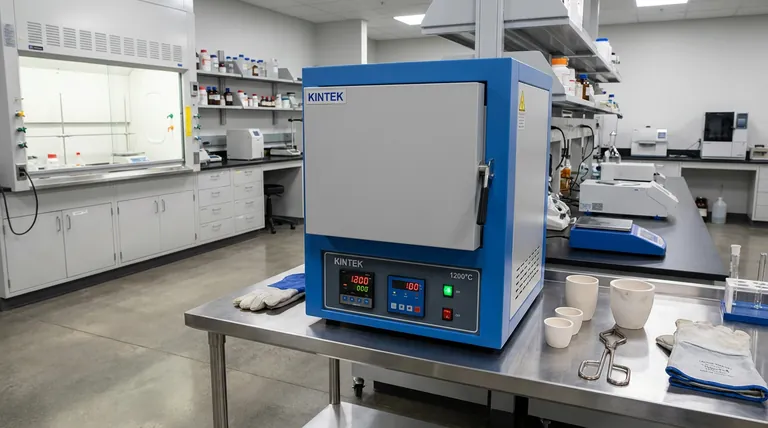
The primary function of a forced convection oven in the preparation of Titanium Hydride (TiH2) is to rigorously dry the Titanium Dioxide (TiO2) precursors prior to chemical reduction. This unit operates at a specific temperature of 383 K for 72 hours to eliminate moisture that has adhered to the raw materials.
By effectively removing adsorbed moisture, the oven prevents detrimental side reactions during the high-temperature reduction phase. This critical pre-treatment step ensures the high purity of the reactants, which is essential for synthesizing high-quality TiH2 powder.
The Mechanics of Pre-Treatment
Targeted Moisture Removal
The synthesis of TiH2 requires raw materials that are chemically pure and free of contaminants. The forced convection oven is utilized to strip away adsorbed moisture from the TiO2 powder.
To achieve this, the process demands a sustained heating cycle. The material is subjected to a constant temperature of 383 K (approx. 110°C).
The Necessity of Duration
Heat alone is not sufficient; the duration of exposure is equally critical. The protocol specifies a continuous drying period of 72 hours.
This extended timeframe ensures that moisture is driven out from deep within the powder bed, rather than just the surface layer.
Why Drying Determines Success
Preventing Adverse Side Reactions
If moisture remains in the TiO2 when it enters the reduction phase, it introduces uncontrolled variables. Water vapor at high temperatures can trigger adverse side reactions.
These unwanted reactions compete with the intended reduction process. This can degrade the quality of the final TiH2 product or lower the overall yield.
Ensuring Reactant Purity
The forced convection oven acts as a gatekeeper for purity. By establishing a dry, stable baseline for the raw materials, it minimizes experimental errors and process variability.
This guarantees that the subsequent chemical reactions are driven solely by the interaction between the TiO2 and the reducing agents, rather than by impurity interference.
Operational Constraints and Trade-offs
The Time vs. Purity Trade-off
The most significant operational constraint in this process is time. Dedicating 72 hours solely to drying is a substantial bottleneck in production throughput.
However, attempting to shorten this duration is a common pitfall. Accelerating the drying time often results in residual moisture, which compromises the integrity of the entire batch during reduction.
Energy Consumption
Maintaing a forced convection oven at 383 K for three days requires continuous energy input.
While this increases operational costs, it is a necessary investment to avoid the much higher cost of a failed synthesis batch caused by moisture contamination.
Making the Right Choice for Your Goal
To optimize your TiH2 preparation process, consider the following based on your specific objectives:
- If your primary focus is Product Purity: Strictly adhere to the 72-hour drying cycle at 383 K to ensure zero interference from adsorbed moisture.
- If your primary focus is Troubleshooting Defects: Investigate the pre-treatment phase first; incomplete drying is a frequent root cause of unexpected side reactions during reduction.
A disciplined approach to moisture removal is the invisible foundation of successful Titanium Hydride synthesis.
Summary Table:
| Process Parameter | Specification | Purpose in TiH2 Synthesis |
|---|---|---|
| Temperature | 383 K (approx. 110°C) | Removal of adsorbed moisture from TiO2 precursors |
| Duration | 72 Hours | Ensures deep-bed drying and consistent reactant purity |
| Mechanism | Forced Convection | Uniform heat distribution to prevent cold spots |
| Critical Goal | Contaminant Removal | Prevents adverse side reactions during reduction phase |
Elevate Your Material Synthesis with KINTEK Precision
Success in Titanium Hydride production begins with uncompromising thermal accuracy. Backed by expert R&D and manufacturing, KINTEK offers high-performance Muffle, Tube, Rotary, Vacuum, and CVD systems—including forced convection ovens—specifically designed to meet the rigorous demands of lab high-temp research.
Whether you need customizable thermal solutions for moisture removal or high-temperature reduction, our systems provide the stability required for high-purity results. Contact us today to optimize your lab's efficiency and eliminate process variability!
References
- Sung-Hun Park, Jungshin Kang. Direct TiH2 powder production by the reduction of TiO2 using Mg in Ar and H2 mixed gas atmosphere. DOI: 10.1038/s41598-024-84433-w
This article is also based on technical information from Kintek Furnace Knowledge Base .
Related Products
- Multi Heating Zones CVD Tube Furnace Machine for Chemical Vapor Deposition Equipment
- High Temperature Muffle Oven Furnace for Laboratory Debinding and Pre Sintering
- 1400℃ Muffle Oven Furnace for Laboratory
- Laboratory Muffle Oven Furnace with Bottom Lifting
- 1700℃ High Temperature Muffle Oven Furnace for Laboratory
People Also Ask
- What is the function of a multi-zone tube furnace in CVD synthesis? Master 2D In2Se3 Nanosheet Precision
- What temperature-related capabilities make multi zone tube furnaces valuable for research? Unlock Precision Thermal Control
- Why are multi zone tube furnaces particularly useful for nanomaterial research? Unlock Precise Thermal Control for Advanced Synthesis
- What role do multi zone tube furnaces play in new energy research? Unlock Precise Thermal Control for Innovation
- What environmental protection applications utilize multi zone tube furnaces? Unlock Precision in Waste Treatment and Green Tech






