
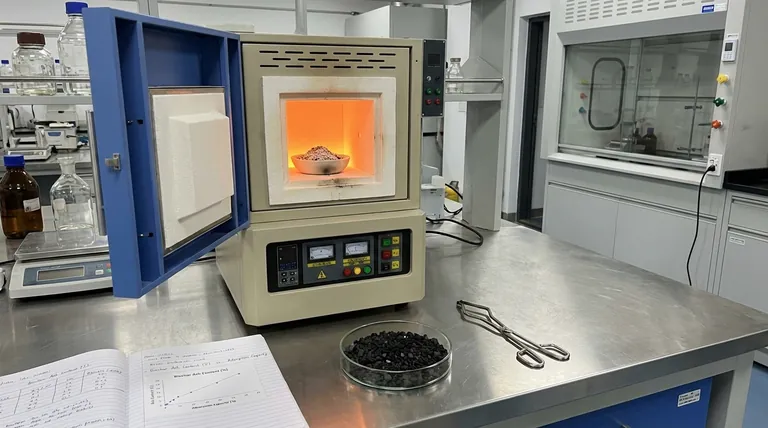
Using a muffle furnace is the standard method for isolating and quantifying the inorganic mineral content (ash) within biochar through high-temperature incineration. By subjecting the material to intense heat in an oxygen-rich environment, the furnace removes all organic carbon, leaving behind only the mineral residue necessary for evaluating material performance.
Core Takeaway The muffle furnace acts as a critical filter for material characterization, separating organic structure from inorganic minerals. This "ash content" metric is indispensable for predicting biochar's efficacy in adsorption applications and assessing safety risks like slagging when used as fuel.
Evaluating Adsorption Potential
The Link Between Ash and Performance
The primary significance of determining ash content lies in its ability to predict adsorption potential. The inorganic minerals remaining after incineration are not inert bystanders; they actively dictate how the biochar interacts with its environment.
Influence on Surface Charge
Mineral components revealed by the muffle furnace directly influence the surface charge of the biochar. This electrochemical property is vital for attracting and holding specific ions, making it a key factor in chemical filtration processes.
Pore Distribution Dynamics
Ash content significantly impacts the pore distribution within the carbon framework. Understanding the mineral percentage helps researchers determine if the pores are accessible or blocked, which defines the material's total surface area available for reactions.
Wastewater Treatment Efficiency
These factors culminate in the material's ability to treat water. High-precision ash analysis allows engineers to estimate the removal efficiency of nutrients and pollutants during wastewater treatment, ensuring the biochar is suitable for environmental remediation.
The Mechanism of Analysis
Complete Mineralization
The muffle furnace operates by facilitating complete combustion, typically removing all organic matter. This ensures that the final weight measurement reflects only the inorganic residue, providing a precise quantitative analysis.
Temperature Standards
Protocols vary based on the specific goal. Common standards involve heating samples to 550°C to preserve certain volatile minerals, or up to 815°C for complete mineralization. This flexibility allows for tailored analysis depending on the biomass source.
Understanding Material Risks and Trade-offs
Fuel Applications and Slagging
When biochar is intended for use as a solid fuel, the muffle furnace test is a safety necessity. High ash content, particularly in biomass like pea shells, indicates a high risk of slagging and fouling in combustion equipment.
The "Ash Constraint"
While minerals can aid surface charge, excessive ash can be detrimental. It acts as non-combustible dead weight in fuels and can physically clog the porous network needed for adsorption. The muffle furnace helps identify this threshold, ensuring the material is not chemically active but structurally compromised.
Making the Right Choice for Your Goal
- If your primary focus is Wastewater Treatment: Focus on ash content to predict surface charge and nutrient removal efficiency, as minerals play a catalytic role in adsorption.
- If your primary focus is Biochar Fuel: Use the ash content metric to assess thermal efficiency and equipment safety, avoiding materials that will cause slagging at high temperatures.
Summary: The muffle furnace transforms raw biochar samples into actionable data, allowing you to validate whether the material's mineral composition supports your specific engineering or environmental objectives.
Summary Table:
| Feature | Significance in Biochar Analysis | Impact on Performance |
|---|---|---|
| Mineral Content | Quantifies inorganic residue after combustion | Dictates surface charge and electrochemical properties |
| Pore Distribution | Identifies mineral-blocked vs. accessible pores | Determines total surface area for adsorption efficiency |
| Slagging Risk | Measures non-combustible material | Predicts fouling and equipment safety in fuel applications |
| Adsorption Potential | Correlates ash levels with nutrient removal | Key for wastewater treatment and environmental remediation |
Optimize Your Biochar Characterization with KINTEK
Precision in ash content determination is the cornerstone of high-performance material evaluation. Whether you are maximizing adsorption for wastewater treatment or assessing thermal safety for fuel applications, KINTEK provides the advanced heating technology you need to succeed.
Backed by expert R&D and world-class manufacturing, we offer a comprehensive range of Muffle, Tube, Rotary, Vacuum, and CVD systems. Our lab high-temperature furnaces are fully customizable to meet your unique research protocols, ensuring complete mineralization and repeatable results every time.
Ready to elevate your lab's capabilities? Contact us today to find the perfect furnace solution for your needs!
Visual Guide

References
- Mariana Paola Cabrini, Claudinei Fonseca Souza. Biochar from orange waste as a filter medium for domestic effluent treatment aimed at agricultural reuse. DOI: 10.4136/ambi-agua.3024
This article is also based on technical information from Kintek Furnace Knowledge Base .
Related Products
- 1400℃ Muffle Oven Furnace for Laboratory
- 1700℃ High Temperature Muffle Oven Furnace for Laboratory
- 1800℃ High Temperature Muffle Oven Furnace for Laboratory
- 1200℃ Muffle Oven Furnace for Laboratory
- High Temperature Muffle Oven Furnace for Laboratory Debinding and Pre Sintering
People Also Ask
- What is the primary function of a high-temperature laboratory muffle furnace in chemical synthesis? Achieve Precision.
- How does a high-temperature laboratory muffle furnace affect material properties? Transform Anodic Oxide Films Fast
- How does a laboratory high-temperature muffle furnace facilitate the homogenization of borosilicate glass samples? Expert Insights
- How is a laboratory high-temperature muffle furnace utilized in g-C3N4 synthesis? Optimize Your Thermal Polycondensation
- What is the muffle furnace function in ilmenite oxidative roasting? Enhance Phase Change & Magnetic Separation



















