
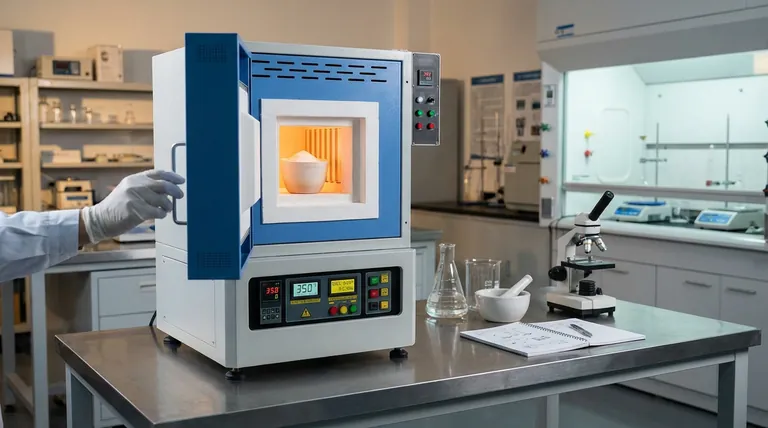
Precise temperature control is the deciding factor in the structural quality of ZnO nanomaterials. In a box resistance furnace, the regulation of heating rates and dwell times directly dictates the removal of organic templates and the formation of the crystal lattice, ultimately determining the material's specific surface area and porosity.
Core Insight: The calcination of ZnO is a delicate balancing act; the thermal profile must be gentle enough to slowly decompose organic templates without collapsing the pore structure, yet robust enough to induce crystallization. Poor temperature control leads to either carbon contamination or severe sintering, both of which ruin the material's performance.
The Critical Role of Programmed Heating
The primary function of the box resistance furnace in this context is not just to "heat" the material, but to follow a specific thermal program.
Controlled Decomposition of Templates
ZnO nanorods are often synthesized using organic templates like CTAB or beta-CD. These templates act as a scaffold for the nanomaterial.
A programmed heating rate—specifically a slow ramp such as 3 degrees Celsius per minute—is vital. This slow increase allows the organic templates to decompose gradually rather than combusting violently, which could shatter the delicate nanostructure.
Preserving Porosity
If the furnace heats too rapidly, the rapid release of gases can cause the pore structure to collapse.
By maintaining strict control over the ramp rate, the furnace ensures that the gas release is uniform. This preservation of structure is what leads to ZnO nanorods with precise porosities and high specific surface areas.
Achieving Phase Stability and Purity
Beyond the physical structure, temperature control governs the chemical phase of the material.
Ensuring Complete Oxidation
The furnace must maintain a stable dwell temperature, such as 350 degrees Celsius for 6 hours.
This extended duration at a stable temperature ensures that all precursor materials and organic residues are completely oxidized. Without this stability, residual carbon can remain, contaminating the ZnO and inhibiting its properties.
Promoting Crystal Growth
Consistent thermal energy is required to rearrange the atoms into a stable ZnO crystal phase.
The box resistance furnace provides a stable thermal field that promotes uniform crystal growth. This results in a material with high crystallinity, which is essential for the electronic and optical performance of ZnO.
Understanding the Trade-offs
When selecting parameters or evaluating furnace performance, you must navigate two opposing risks.
The Risk of Sintering (Overshoot)
If the furnace temperature control is poor and overshoots the target, or if the set point is too high (e.g., approaching 800 °C), you risk severe sintering.
Sintering causes the individual nanorods to fuse together. This leads to a dramatic collapse of the pore structure and a reduction in surface oxygen vacancies, effectively destroying the high surface area you worked to create.
The Risk of Incomplete Calcination (Undershoot)
Conversely, if the furnace fails to reach or hold the target temperature (e.g., fluctuating below 350 °C), the organic templates may not decompose fully.
This results in a material with "clogged" pores and poor phase purity. The remaining organic matter blocks active sites, rendering the ZnO ineffective for catalytic or sensing applications.
Making the Right Choice for Your Goal
To optimize your calcination process, align your furnace settings with your specific material objectives:
- If your primary focus is maximum surface area: Prioritize a slow heating ramp (e.g., 3 °C/min) and moderate dwell temperatures to prevent pore collapse and sintering.
- If your primary focus is high crystallinity and purity: Ensure the furnace has excellent thermal stability to hold the soak temperature (e.g., 350 °C) precisely for the full duration (e.g., 6 hours) to guarantee complete phase conversion.
Ultimately, the quality of your ZnO nanomaterials is defined by the precision of your thermal history.
Summary Table:
| Parameter | Influence on ZnO Nanomaterials | Risk of Poor Control |
|---|---|---|
| Heating Rate | Governs decomposition of organic templates (e.g., CTAB) | Rapid heating causes pore collapse or structure shattering |
| Dwell Temperature | Determines phase purity and crystal lattice formation | Overshoot leads to sintering; Undershoot causes carbon residue |
| Soak Duration | Ensures complete oxidation and stable crystal growth | Inconsistent timing results in incomplete phase conversion |
| Thermal Stability | Maintains uniform gas release and high surface area | Fluctuations create non-uniform porosities and clogged pores |
Elevate Your Nanomaterial Synthesis with KINTEK
Precision is the difference between a high-performance nanostructure and a failed batch. KINTEK provides industry-leading Muffle, Tube, and Vacuum furnaces engineered for the rigorous demands of nanomaterial calcination.
Backed by expert R&D and manufacturing, our systems offer the programmed heating precision and thermal stability required to preserve porosities and ensure phase purity in ZnO and other sensitive materials. All our lab high-temp furnaces are fully customizable to your unique research or production needs.
Ready to optimize your thermal history?
Contact KINTEK Experts Today
References
- Yanan Fan, Yongheng Zhu. Research on pH-responsive antibacterial materials using citral-modified zinc oxide nanoparticles. DOI: 10.1093/fqsafe/fyae010
This article is also based on technical information from Kintek Furnace Knowledge Base .
Related Products
- 1200℃ Muffle Oven Furnace for Laboratory
- 1400℃ Muffle Oven Furnace for Laboratory
- Laboratory Muffle Oven Furnace with Bottom Lifting
- High Temperature Muffle Oven Furnace for Laboratory Debinding and Pre Sintering
- 1700℃ High Temperature Muffle Oven Furnace for Laboratory
People Also Ask
- What is the primary function of a high-temperature laboratory muffle furnace in chemical synthesis? Achieve Precision.
- How does a high-temperature laboratory muffle furnace affect material properties? Transform Anodic Oxide Films Fast
- How is a laboratory muffle furnace used in 3D-printed PP-CF cross-linking? Achieve Thermal Stability at 150 °C
- Why is a laboratory high-temperature muffle furnace required for LaNixFe1-xO3 catalysts? Optimize Two-Stage Synthesis
- What is the role of a laboratory high-temperature muffle furnace in iron analysis? Key to Precise Sample Mineralization



















